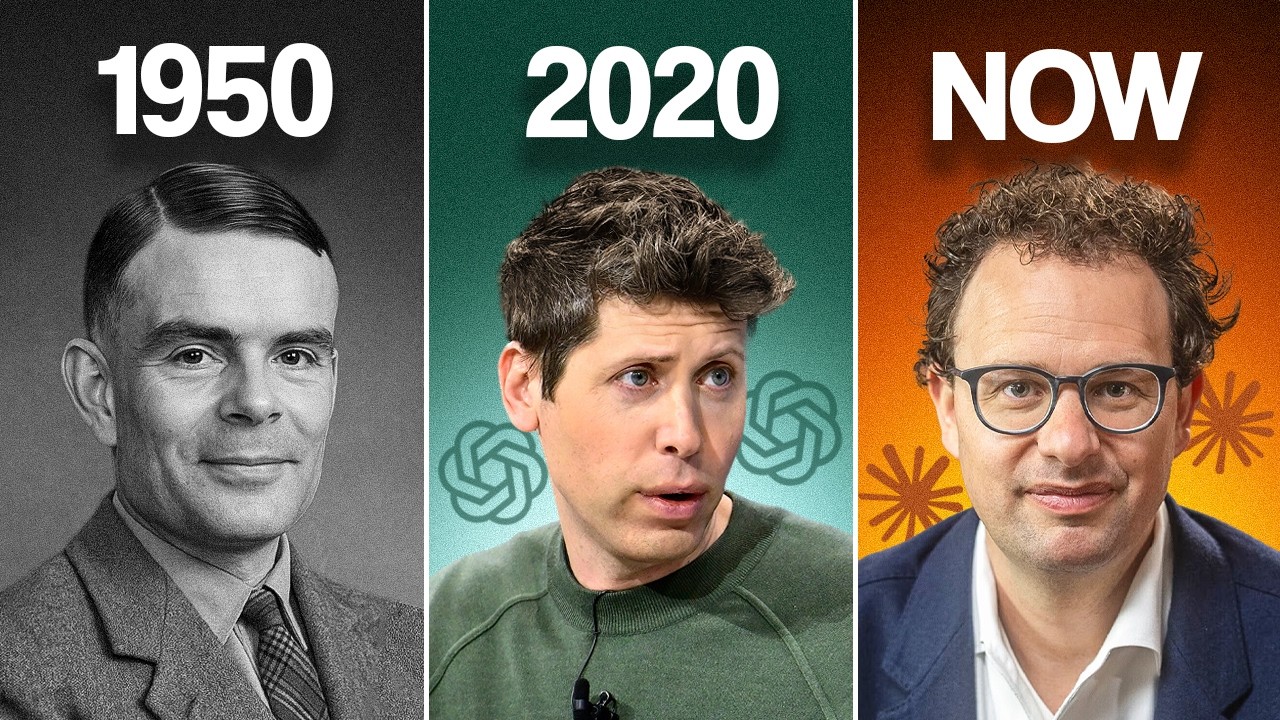
100 Years of Artificial Intelligence Explained
Keywords
Summary
131 words
Critical Evaluation
Value of the Information & Strength of the Argument
The video provides a compelling narrative that connects key historical events in AI development, making it accessible to a broad audience. It effectively explains the technical concepts of neural networks, backpropagation, and transformers in simple terms. The argumentation is coherent, but it is heavily influenced by the creator’s perspective, particularly in the final section where Claude Code is portrayed as the dominant tool. The video’s value lies in its synthesis of major milestones, but it lacks critical analysis of the social and ethical implications of AI.
Scientific Rigor, Source Quality, Title Accuracy
The video does not cite academic sources directly, but it mentions key papers and events (e.g., ‘Attention is All You Need’, ImageNet, AlphaGo). The description links are mostly promotional (courses, tools) and do not serve as scientific references. The title accurately reflects the content, and the video is well-structured with clear chapters. However, the narrative is biased towards the creator’s interests, particularly in the promotion of Claude Code, which may affect the objectivity of the historical account.
178 words
Title / Content Match
The title accurately reflects the content: a chronological overview of AI history from the 1930s to the present.
Quality & Reliability
7/10
The video provides a generally accurate historical overview of AI, from Turing's Bombe to modern developments, with key milestones correctly identified. However, it simplifies complex topics and omits nuances, and the narrative is shaped by the creator's promotional interests, particularly regarding Claude Code. The sources cited are mostly promotional links, not academic references.
Chapters
Cited Sources
- AI OS Course — Promotional link for the creator's course, mentioned in the description.
- AI Automation Society Plus — Promotional link for the creator's paid course, mentioned in the description.
- Podcast Application — Link to apply for the creator's podcast, mentioned in the description.
- Uppit AI — Link to the creator's company, mentioned in the description.
- Glaido — Promotional link for a voice-to-text tool, mentioned in the description.
- Hostinger VPS — Promotional link for VPS hosting, mentioned in the description.
- LinkedIn Profile — Link to the creator's LinkedIn profile, mentioned in the description.
Concurring Sources
- History of artificial intelligence — General historical overview that aligns with the video's narrative.
- Attention Is All You Need — The paper introducing the transformer architecture, which the video discusses.
Dissenting Sources
- Perceptrons: An Introduction to Computational Geometry — Minsky and Papert's book, which the video cites as proving limitations of neural networks, but some argue it was misinterpreted and contributed to the AI winter.
Contribution & Novelties
The video offers a concise and engaging synthesis of AI history, making it accessible to a general audience. It highlights the cyclical nature of AI hype and winters, and the importance of compute and data. The narrative is up-to-date, including recent developments like Claude Code and the competitive dynamics of the AI industry.
Pour aller plus loin :
- History of artificial intelligence — Comprehensive overview of AI history.
- Attention Is All You Need — The original transformer paper.
- ImageNet — The dataset that enabled deep learning breakthroughs.
- AlphaGo — DeepMind’s AlphaGo page.
92 words
Radar Profile
The radar profile shows high scores in quantity of information and global reliability, but lower in technical depth and quality of information, reflecting the video's broad but simplified approach.