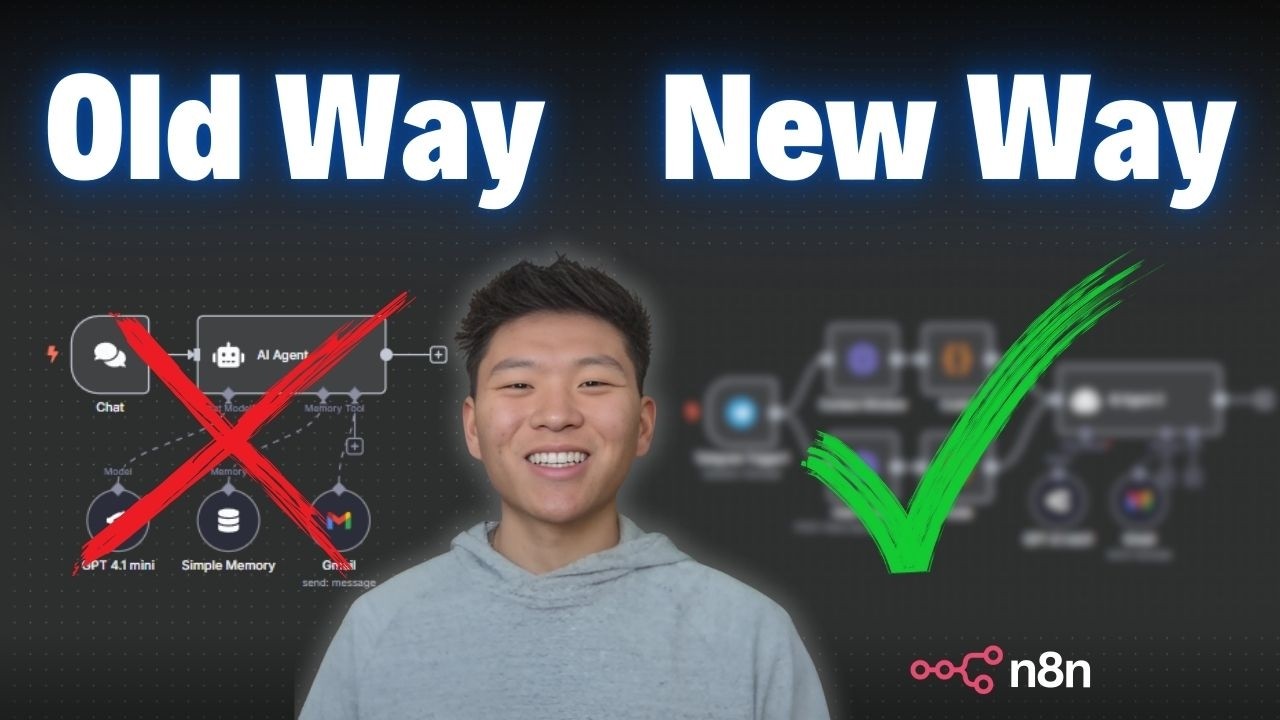
Unlock the Next Evolution of Agents with Human-like Memory (n8n + zep)
Keywords
Summary
119 words
Critical Evaluation
Value of the Information & Strength of the Argument
The video provides valuable practical information on implementing long-term memory in AI agents, a topic of growing importance. The argumentation is solid, supported by live demonstrations and concrete token usage comparisons. The creator clearly explains the trade-offs between short-term and long-term memory and offers actionable strategies to mitigate costs. The reasoning is logical and easy to follow, making the content accessible to its target audience.
Scientific Rigor, Source Quality, Title Accuracy
The video is a tutorial based on the creator’s own experience and the official documentation of n8n and Zep. The sources cited are primarily the tools’ websites and the creator’s community. The title accurately reflects the content, focusing on the evolution of agents with human-like memory. The scientific rigor is moderate, as the claims are not backed by external studies, but the practical examples and clear explanations enhance credibility.
149 words
Title / Content Match
The title accurately reflects the content: the video focuses on implementing human-like memory in AI agents using n8n and Zep, with a strong emphasis on practical application and cost optimization.
Quality & Reliability
7/10
The video is a practical tutorial with clear explanations and demonstrations. The creator shows real workflows and provides cost-saving strategies. However, the content is largely based on personal experience and the specific tools (n8n, Zep) without deep scientific validation. The claims about token reduction are supported by concrete examples, but the approach is not formally benchmarked.
Chapters
Cited Sources
- n8n — The automation platform used to build the workflows.
- Zep — The memory service providing relational graph memory.
- Nate Herk's LinkedIn — Creator's professional profile.
- AI Automation Society Plus (Paid Community) — Paid community for advanced courses.
- AI Automation Society (Free Community) — Free community for resources and workflow downloads.
- Watch Next Video — Related video suggested by the creator.
Concurring Sources
- Zep Documentation — Official documentation for Zep, supporting the described features.
- n8n Documentation — Official n8n documentation, supporting the workflow implementation.
Dissenting Sources
- Comment on Zep's USP — A commenter notes that limiting responses to top three facts defeats the purpose of a graph database, suggesting a vector database might be more appropriate for such filtering.
Contribution & Novelties
The video offers a practical, cost-aware approach to integrating long-term memory into AI agents using Zep’s graph database. It provides a clear comparison between naive memory integration and optimized methods, with concrete token usage data. The hybrid approach (Zep for long-term, PostgreSQL for short-term) is a novel contribution to the community.
Pour aller plus loin :
- Knowledge graph — Foundational concept for relational memory.
- GraphRAG — A method combining graphs with LLMs for enhanced retrieval.
- Vector database — Alternative approach for similarity-based memory retrieval.
84 words
Radar Profile
The radar profile shows high scores in information quantity and technical level, indicating a content-rich tutorial. The quality and reliability scores are slightly lower, reflecting the practical, experience-based nature of the content rather than formal scientific rigor.
💬 Très positif. Sur les 30 commentaires analysés, la majorité exprime une forte appréciation, avec des remerciements et des demandes de sujets complémentaires, indiquant une grande satisfaction du public.