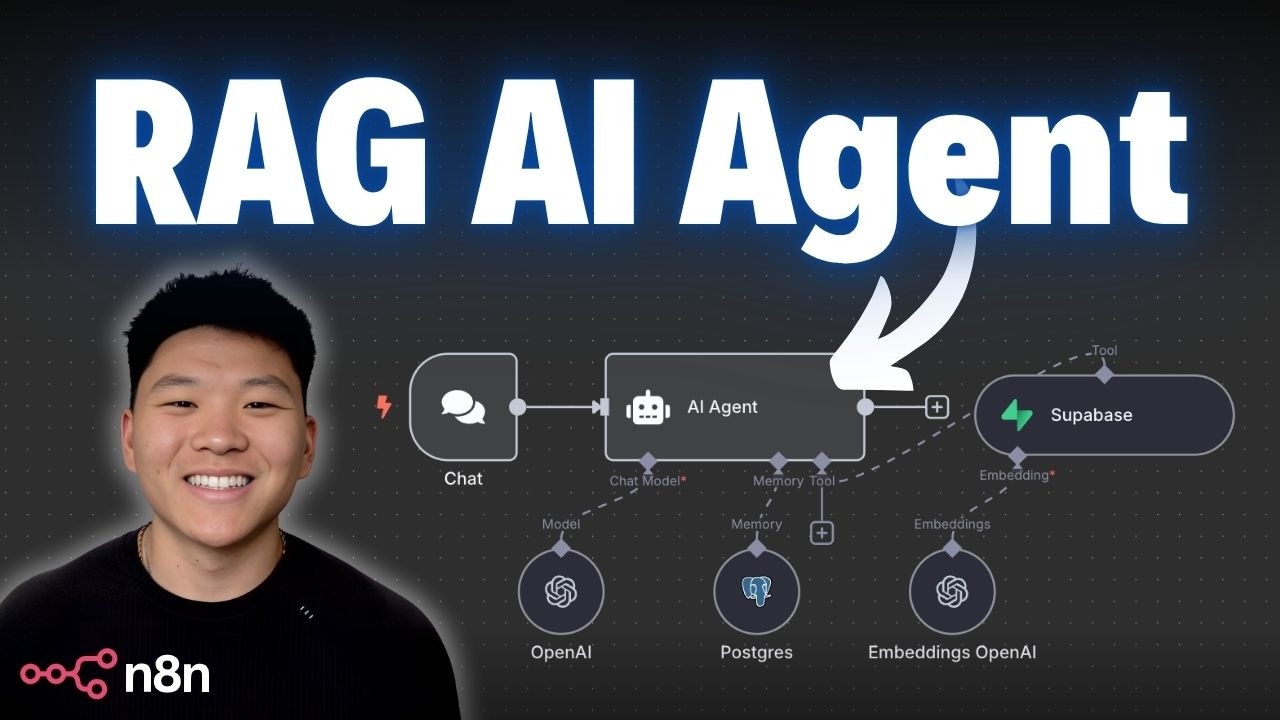
From Zero to RAG Agent: Full Beginner's Course (no code)
Keywords
Summary
193 words
Critical Evaluation
Value of the Information & Strength of the Argument
The video provides high practical value for beginners, offering a complete, actionable walkthrough. The argumentation is clear and logical, building from basic concepts to a working system. The creator effectively uses analogies (e.g., Googling an answer) and visual aids to explain abstract ideas. However, the content lacks critical discussion of limitations, such as retrieval quality, embedding model choices, or potential pitfalls, which would strengthen the argumentation for real-world applications.
Scientific Rigor, Source Quality, Title Accuracy
The tutorial is methodical and accurate in its instructions, with steps that are reproducible. Sources are primarily tool documentation (Supabase, n8n, OpenAI) and the creator’s own community resources, which are appropriate for a tutorial but not exhaustive. The title accurately reflects the content, and the video stays on topic throughout. No external scientific sources are cited, which is acceptable for a practical tutorial but limits the depth of theoretical grounding.
154 words
Title / Content Match
The title accurately reflects the content: a beginner-friendly, no-code tutorial for building a RAG agent.
Quality & Reliability
7/10
Clear, step-by-step tutorial with practical demonstrations. Concepts are accurately explained at a high level, but lacks depth on limitations and alternative approaches. Sources are limited to tool documentation and community resources.
Chapters
Cited Sources
- AI Automation Society (free community) — Free community where the PDF resource and additional support are provided.
- AI Automation Society Plus (full courses) — Full courses and unlimited support for advanced learning.
- Podcast application — Application link for the creator's YouTube podcast.
- Uppit AI (work with me) — Professional services offered by the creator.
- Hostinger VPS hosting — Recommended VPS hosting for AI projects.
- Glaido voice-to-text — Tool for voice-to-text transcription, offered with a free month.
- LinkedIn profile — Creator's professional profile.
- Watch next video — Suggested next video on extended workflows.
Concurring Sources
- n8n documentation — Official documentation for n8n, the platform used in the tutorial.
- Supabase Vector documentation — Official guide for using Supabase as a vector database.
- OpenAI Embeddings documentation — Official documentation for OpenAI embedding models.
Contribution & Novelties
The video offers a clear, no-code entry point to RAG, demystifying the technology for beginners. Its main contribution is the practical, step-by-step integration of n8n with Supabase, showing how to build a functional RAG agent without programming. It also highlights the use of PostgreSQL for memory, adding a layer of persistence. However, it does not introduce novel concepts, as RAG and vector databases are well-established. The value lies in accessibility and clarity.
Pour aller plus loin :
- Retrieval-Augmented Generation (RAG) - Wikipedia — Overview of RAG concepts and evolution.
- Vector database - Wikipedia — Explanation of vector databases and their applications.
- n8n documentation — Official documentation for n8n workflows and nodes.
- Supabase Vector documentation — Guide to using Supabase for vector storage and AI features.
- OpenAI Embeddings documentation — Details on embedding models and usage.
135 words
Radar Profile
The radar profile shows balanced scores across information quantity, quality, and reliability, with a lower technical depth. This reflects a tutorial that is comprehensive for beginners but does not delve into advanced technical details, making it accessible yet not exhaustive.
💬 Très positif. Sur les 30 commentaires analysés, les utilisateurs expriment une gratitude marquée et une forte appréciation pour la clarté et l'utilité du tutoriel, avec de nombreuses demandes pour des contenus plus avancés.