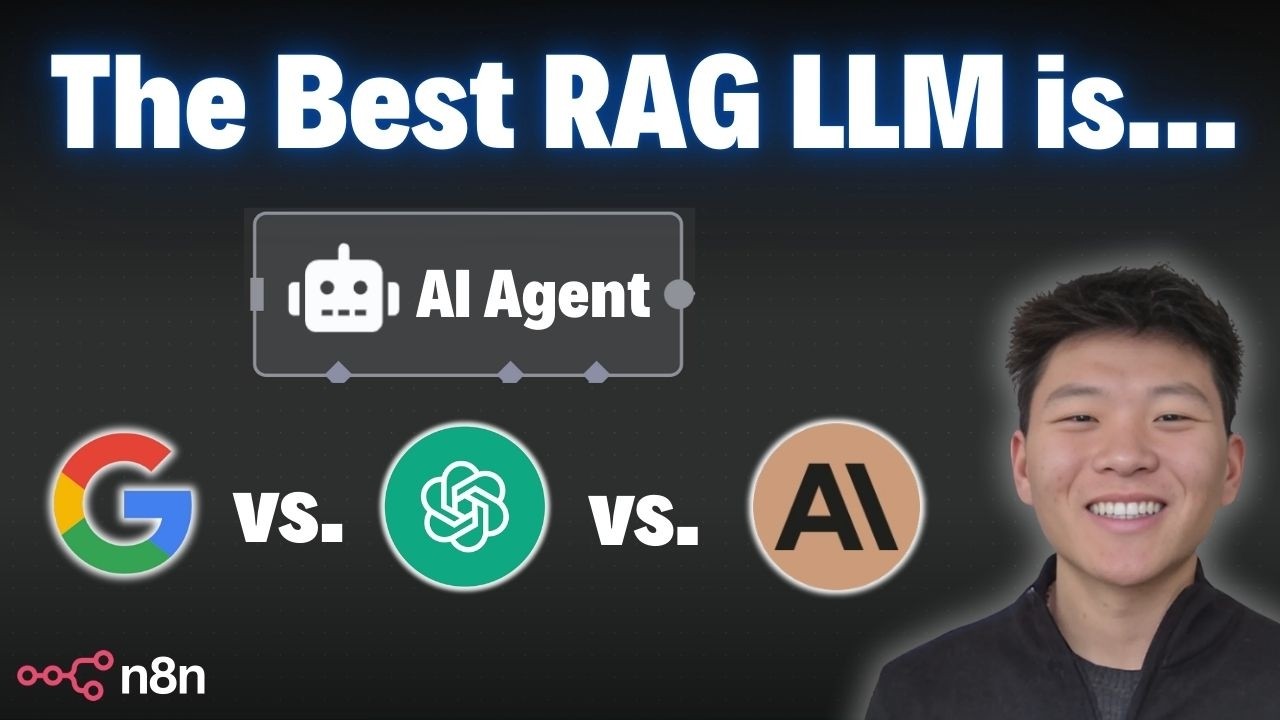
Best Model for RAG? GPT-4o vs Claude 3.5 vs Gemini Flash 2.0 (n8n Experiment Results)
Keywords
Summary
166 words
Critical Evaluation
Value of the Information & Strength of the Argument
The video provides a practical, hands-on comparison of LLMs for RAG, which is valuable for practitioners building AI agents. The creator demonstrates a clear methodology, albeit informal, and transparently shares the results. The argumentation is straightforward: the experiment is designed to be consistent, and the creator acknowledges its imperfections. The value lies in the practical insights, such as Gemini’s speed advantage and Claude’s strength in generating coherent, well-structured responses. However, the lack of rigorous statistical analysis and the reliance on a single grader (GPT-4o) weaken the argument’s robustness. The creator’s reasoning for grading is explained, but the subjective nature of the evaluations is a limitation.
Scientific Rigor, Source Quality, Title Accuracy
The video does not cite external scientific sources; it relies on the creator’s own experiment. The description includes links to n8n (with an affiliate link), Skool communities, and social media, but these are not sources for the content. The title accurately reflects the content, as it is indeed an experiment comparing models for RAG. The methodology is described in detail, but the lack of peer-reviewed references or external validation reduces the scientific rigor. The creator’s transparency about the experiment’s limitations is a positive aspect, but the overall reliability is limited by the informal nature of the test.
217 words
Title / Content Match
The title accurately reflects the content: a comparative experiment of three LLMs for RAG, with results presented.
Quality & Reliability
5/10
The video presents a casual, non-scientific experiment with acknowledged methodological limitations, such as using a single grader (GPT-4o) and inconsistent grading criteria. The creator is transparent about these limitations, but the lack of rigorous controls and the absence of peer-reviewed sources reduce the overall reliability.
Chapters
Cited Sources
- n8n - Workflow Automation — The tool used to build the RAG agents in the experiment.
- Nate Herk on LinkedIn — Creator's professional profile.
- AI Automation Society (Paid) — Paid community for deeper n8n and AI automation learning.
- AI Automation Society (Free) — Free community for learning and workflow access.
- Background Music — Music used in the video.
- Watch Next Video — Suggested next video.
Concurring Sources
- n8n - Workflow Automation — The tool used to build the RAG agents in the experiment.
Contribution & Novelties
The video offers a practical, hands-on comparison of three major LLMs for RAG, which is valuable for practitioners. It provides a replicable methodology (though informal) and highlights performance differences in speed, coherence, and context handling. The main novelty is the direct comparison in a real-world n8n workflow, offering insights that are often missing from theoretical discussions.
Pour aller plus loin :
- Retrieval-Augmented Generation (RAG) — Overview of RAG concepts.
- n8n Documentation — Official documentation for n8n, the tool used in the experiment.
- Pinecone Vector Database — The vector database used in the experiment (mentioned in the video).
- GPT-4o — Official information about GPT-4o.
- Claude 3.5 Sonnet — Official announcement of Claude 3.5 Sonnet.
- Gemini Flash 2.0 — Official blog post about Gemini 2.0.
123 words
Radar Profile
The radar profile shows moderate scores across all dimensions, with a slight dip in reliability. This reflects the video's practical but informal nature: it provides useful information and a decent technical level, but the lack of rigorous methodology and external validation lowers its overall reliability.