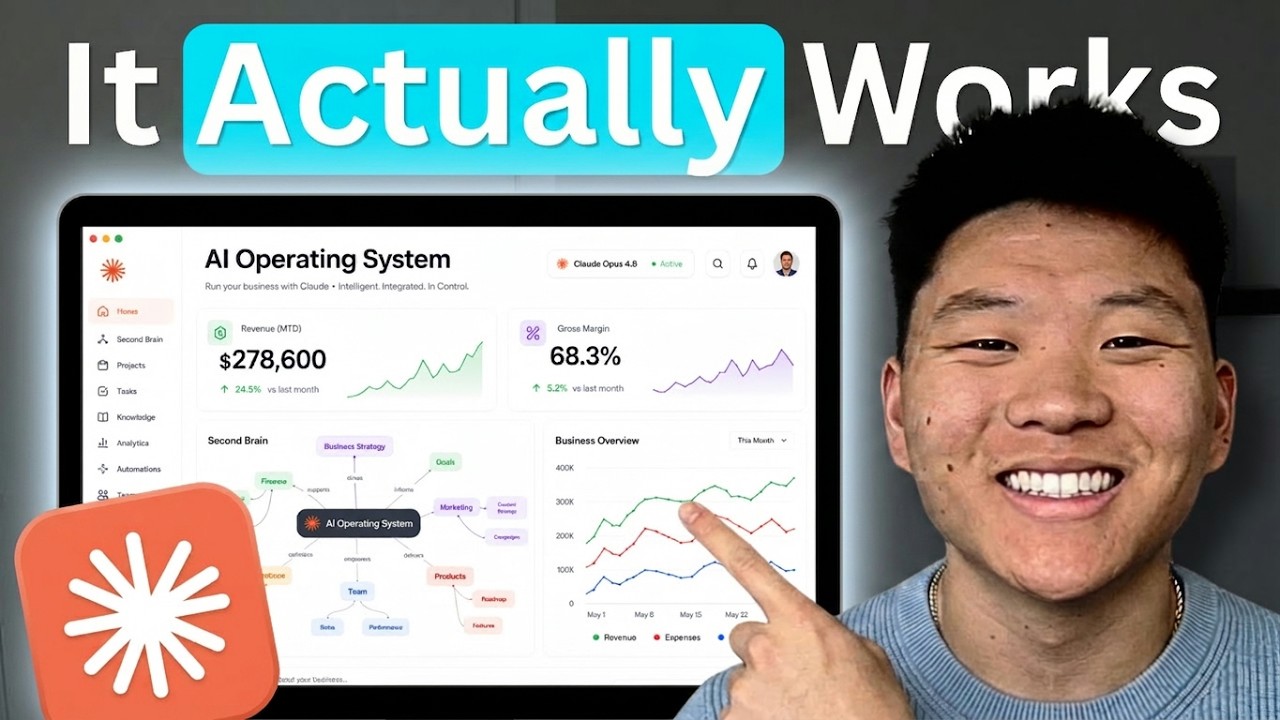
I Turned Claude Opus 4.8 Into My Entire AI Operating System
Keywords
Summary
136 words
Critical Evaluation
Value of the Information & Strength of the Argument
The video provides high practical value for viewers interested in building AI-driven workflows. The Four C’s framework offers a clear mental model, and the emphasis on context over model choice is a valuable insight. The argumentation is coherent, built on personal experience and a real-world example of agent failure, which strengthens the credibility of the risk discussion. The bike method analogy effectively communicates the need for gradual trust-building. However, the argumentation relies heavily on anecdotal evidence and lacks comparative analysis or external validation, which limits its scientific rigor.
Scientific Rigor, Source Quality, Title Accuracy
The video is a tutorial based on the creator’s personal experience, not a scientific study. No external sources are cited within the content; the description links are mostly promotional (courses, tools, social media). The title accurately reflects the content, and the video is well-structured with clear chapters. The lack of citations and reliance on subjective impressions (e.g., model ‘feel’) reduce the scientific rigor, but the practical advice is internally consistent and actionable.
175 words
Title / Content Match
The title accurately reflects the content: the creator demonstrates how he uses Claude Opus 4.8 as a central AI operating system for his business.
Quality & Reliability
7/10
The video offers a practical, experience-based tutorial on building an AI operating system with Claude Code. The creator shares a personal workflow, a framework (Four C's), and a real incident of agent error, but lacks formal citations or empirical validation. The advice is actionable and coherent, but the reliability is limited by anecdotal evidence and promotional elements.
Chapters
Cited Sources
- Free AI OS Course — Mentioned as a free resource for learning to build an AIOS.
- Full courses + unlimited support — Promoted as a paid option for deeper learning.
- Apply for my YT podcast — Mentioned as a way to engage with the creator.
- Work with me — Linked as a service offering.
- FREE MONTH voice to text — Promoted as a tool for voice-to-text transcription.
- Code NATEHERK for 10% off VPS — Affiliate link for VPS hosting.
- LinkedIn — Social media profile.
Concurring Sources
- Model Context Protocol (MCP) — The video's discussion of connections aligns with MCP as a standard for integrating external tools.
- Claude Code documentation — The video's tutorial is based on Claude Code, and this documentation provides official details.
Contribution & Novelties
The video contributes a practical, experience-based framework (Four C’s) for building an AI operating system, emphasizing context as the primary value driver. It offers a concrete methodology for organizing files and skills, and introduces the ‘bike method’ for safely scaling agent autonomy, illustrated by a real failure case. This is a valuable addition to the discourse on AI agent workflows, providing actionable insights for practitioners.
Pour aller plus loin :
- Model Context Protocol (MCP) — Official documentation for MCP, relevant to the ‘connections’ aspect.
- Claude Code documentation — Official guide for Claude Code, the core tool discussed.
- AI agent safety — Overview of safety considerations for autonomous agents, relevant to the risk discussion.
- Context window — Explanation of context in LLMs, central to the ‘context is king’ argument.
128 words
Radar Profile
The radar profile shows high scores in information quantity and technical level, reflecting the video's detailed and practical nature. The lower scores in reliability and information quality indicate a reliance on anecdotal evidence and lack of external validation, typical of a tutorial based on personal experience.
💬 Très positif. Sur les 30 commentaires analysés, les spectateurs expriment un enthousiasme marqué, saluant la clarté, la valeur pratique et l'inspiration du contenu, avec des remerciements répétés et des demandes de ressources supplémentaires.