The Evolution Of UCIe
Keywords
Summary
127 words
Critical Evaluation
Value of the Information & Strength of the Argument
The video provides valuable insights into the technical evolution of UCIe, explaining both physical and logical aspects with clear examples. The argumentation is solid, based on the speaker’s direct involvement in developing UCIe PHYs at Cadence. Specific details like the addition of 3D stacking in 2.0 and management transport in 2.0 are well-articulated. The discussion on interoperability and backward compatibility is convincing, supported by a real-world demo with Intel. The speaker also addresses challenges honestly, such as verification difficulties and market fragmentation, which adds credibility.
Scientific Rigor, Source Quality, Title Accuracy
The video is an expert interview, not a formal presentation with citations. The information is consistent with publicly known UCIe specifications, but no external sources are referenced. The title accurately reflects the content, which systematically covers the evolution of UCIe. The speaker’s authority as a director at Cadence lends credibility, but the lack of cited sources limits the ability to verify claims independently. The content is technically rigorous, with specific details on PHY speeds and bump maps, but the absence of references to official UCIe documents is a minor weakness.
190 words
Title / Content Match
The title accurately reflects the content, which traces the evolution of UCIe from version 1.0 to 3.0.
Quality & Reliability
8/10
The video features an expert from Cadence discussing UCIe specifications with technical depth and specific examples. Claims are consistent with publicly known UCIe history, though no external sources are cited. The information is presented as expert opinion rather than peer-reviewed research.
Key Moments
Markers derived by PSI from the transcript: the creator did not define chapters.
- Introduction to UCIe evolution and specification changes.
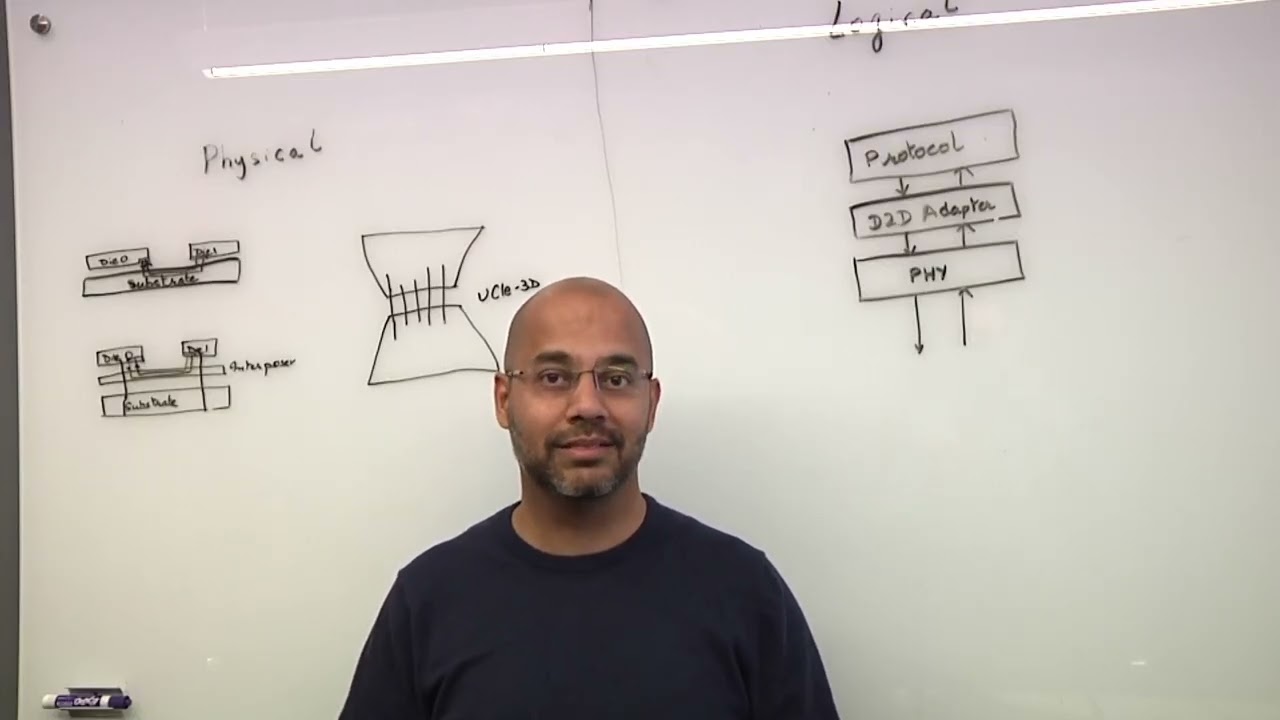
- Physical view: standard package, advanced package, and 3D UCIe.
- Logical view: PHY, die-to-die adapter, and protocol layer.
- UCIe 1.0 limitations and changes in 1.1 (CRC, retry, link health).
- UCIe 2.0 adds management transport and security features.
- Backward compatibility and speed negotiation.
- Challenges: verification, adoption, and market fragmentation.
- Future standardization efforts and conclusion.
Concurring Sources
- UCIe 1.0 Specification — Official specification for UCIe 1.0, confirming the initial release in March 2022.
- UCIe 2.0 Specification — Official specification for UCIe 2.0, including management transport and 3D support.
Contribution & Novelties
The video provides a clear and concise overview of UCIe’s evolution, highlighting key technical additions and the importance of interoperability. It offers practical insights from an industry expert, making it valuable for engineers and decision-makers. The discussion on backward compatibility and speed negotiation is particularly useful.
Pour aller plus loin :
- UCIe Consortium — Official website for the UCIe standard, providing specifications and updates.
- Chiplet Design and Heterogeneous Integration Packaging — Academic article on chiplet packaging challenges.
- Advanced Packaging: The Next Frontier in Semiconductor Manufacturing — Industry analysis on advanced packaging trends.
92 words
Radar Profile
The radar profile shows high scores in information quantity, quality, and reliability, with a slightly lower technical level. This indicates a well-balanced video that is informative and credible, though it may require some background knowledge to fully appreciate the technical details.
💬 No comments were provided for analysis.