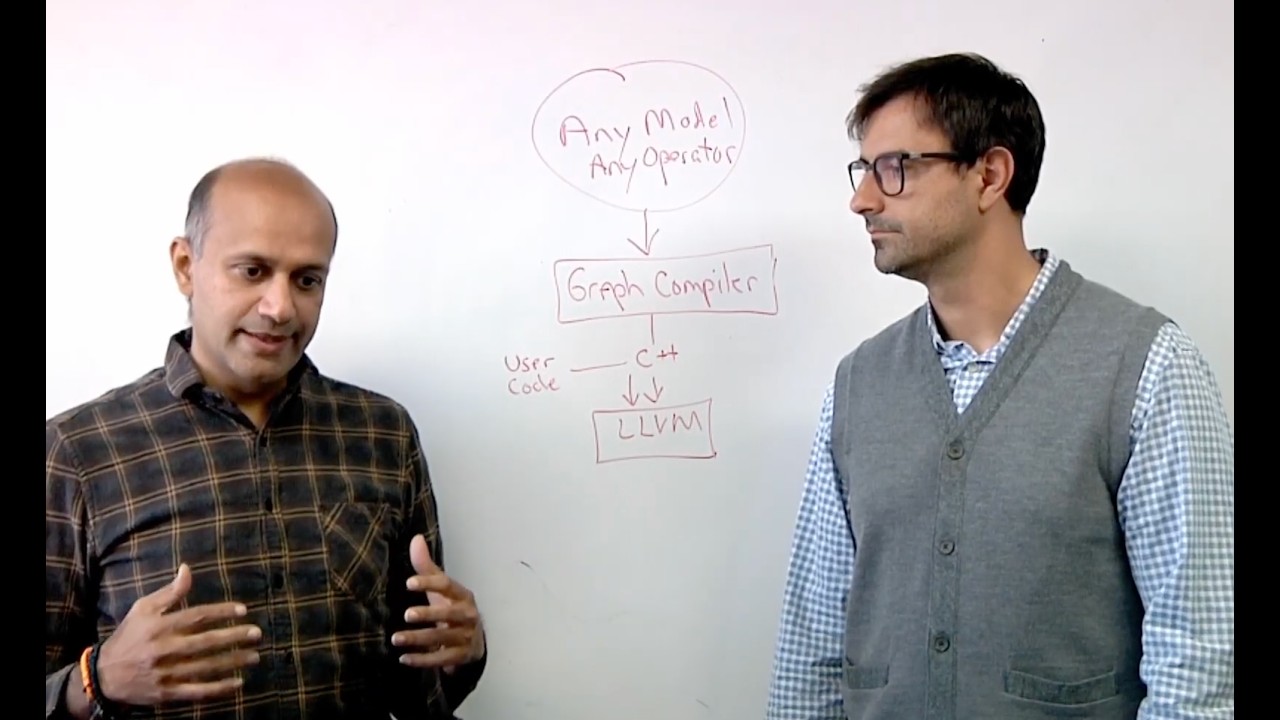
AI Models On The Edge
Keywords
Summary
162 words
Critical Evaluation
Value of the Information & Strength of the Argument
The video provides valuable insights into the practical challenges of edge AI deployment, particularly the need for compiler-based approaches and hardware-software co-design. The argumentation is coherent and grounded in the speakers’ direct experience at Quadric, making it credible for industry practitioners. They effectively argue that flexibility is crucial due to the rapid evolution of AI models, and they support this with examples of changing model architectures and the need for adaptable NPUs. However, the discussion is somewhat promotional, as it consistently highlights Quadric’s solutions without critical comparison to alternative approaches. The value lies in the practical knowledge shared, but the argumentation could be strengthened by acknowledging potential drawbacks or trade-offs of their approach.
122 words
Title / Content Match
The title accurately reflects the content, which focuses on the challenges and solutions for running AI models on edge devices.
Quality & Reliability
7/10
The video features two industry experts from Quadric discussing technical challenges and solutions for deploying AI models at the edge. The information is based on their professional experience and specific product development, but lacks peer-reviewed sources or independent verification. The discussion is coherent and technically plausible, but the promotional context (company representatives) slightly reduces the overall reliability.
Key Moments
Markers derived by PSI from the transcript: the creator did not define chapters.
- Introduction to the topic and the shift from CNNs to LLMs at the edge.
- Discussion on the challenge of mapping models to hardware and the need for compiler-based approaches.
- Ravi explains the use of open-source TVM stack for compiler development.
- Daniel describes the general-purpose NPU (GMNPU) and co-optimization with software.
- Discussion on market-specific optimization strategies and the impossibility of fixed architectures.
- Ravi highlights the importance of software foundation and the challenges of supporting varied models.
- Daniel talks about the changing skill set required for embedded engineers.
- Ravi discusses quantization and its impact on accuracy and memory footprint.
- Daniel emphasizes the need for hardware-specific quantization optimization.
- Conclusion and thanks.
Cited Sources
- TVM: An Automated End-to-End Optimizing Compiler for Deep Learning — Mentioned as the open-source compiler stack used by Quadric.
Concurring Sources
- TVM: An Automated End-to-End Optimizing Compiler for Deep Learning — The video's mention of TVM aligns with this academic paper.
Contribution & Novelties
The video offers a practical perspective on edge AI deployment, emphasizing the importance of compiler-based approaches and hardware-software co-design. It highlights the shift from dedicated NPUs to general-purpose NPUs for flexibility, which is a notable industry trend. The discussion on quantization and its trade-offs provides useful insights for engineers.
Pour aller plus loin :
- TVM: An Automated End-to-End Optimizing Compiler for Deep Learning — The paper introducing TVM, the open-source compiler stack mentioned in the video.
- Quantization in Deep Learning — Overview of quantization techniques relevant to model compression.
- Small Language Models — Background on language models, including small variants.
- Edge AI — General concept of AI at the edge.
110 words
Radar Profile
The radar profile shows balanced scores across all dimensions, with slightly lower reliability due to the promotional nature. The high technical level and information quality indicate a solid expert discussion, but the lack of external sources and potential bias keep the overall score moderate.