How AI Will Automate Chip Design
Keywords
Summary
184 words
Critical Evaluation
Value of the Information & Strength of the Argument
The video provides valuable insights into the current state and future direction of AI in chip design, particularly the five-level framework which is a useful conceptual model. The argumentation is coherent and grounded in the speaker’s experience at Cadence, with concrete examples of tools and applications. However, it is largely promotional, lacking critical examination of limitations or alternative perspectives. The discussion of challenges like grounding and traceability is valuable but not deeply explored.
Scientific Rigor, Source Quality, Title Accuracy
The video is an expert opinion piece, with the speaker representing Cadence, a major EDA vendor. The sources cited are primarily Cadence’s own tools and internal developments, which may introduce bias. No external references are provided. The title accurately reflects the content, and the discussion is scientifically plausible but not rigorously sourced. The lack of independent verification and the promotional nature reduce the overall scientific rigor.
154 words
Title / Content Match
The title accurately reflects the content, which focuses on how AI will automate chip design through a five-level framework.
Quality & Reliability
7/10
The video features an expert from Cadence (Ziyad Hanna) discussing AI in chip design, with a clear framework (5 levels of autonomy) and references to specific tools (e.g., Cerebrus, Verisium). However, it is largely promotional and lacks independent verification or detailed technical depth.
Key Moments
Markers derived by PSI from the transcript: the creator did not define chapters.
- Introduction: Ed Spuring introduces the topic and guest Ziyad Hanna from Cadence.
- Hanna explains the history of AI in EDA and the shift to generative and agentic AI.
- Discussion on how AI affects different design types, including analog and older nodes.
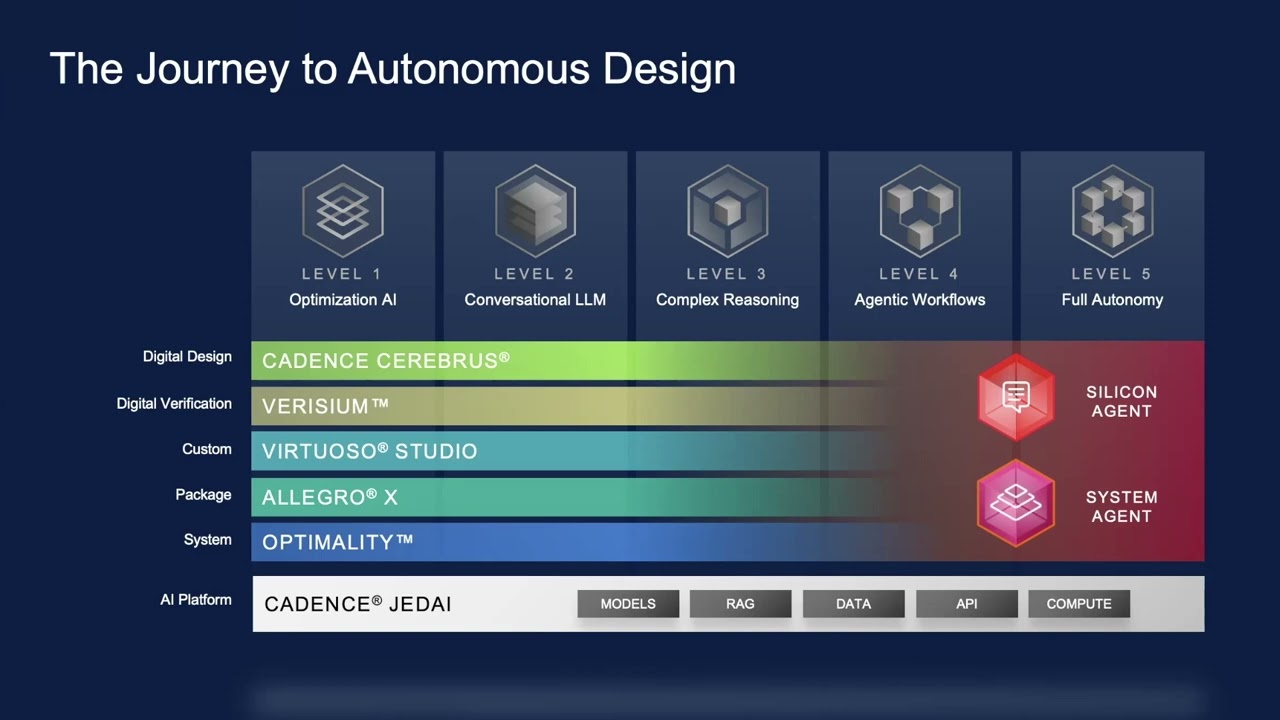
- Hanna introduces the five-level framework for AI autonomy in chip design.
- Detailed explanation of Level 1 (optimization AI) and Level 2 (conversational AI).
- Explanation of Level 3 (reasoning AI) and Level 4 (agentic workflows).
- Discussion on where most companies are today (mostly Level 2) and the shift to cloud-based AI.
- Challenges: grounding, traceability, and explainability in AI-driven design.
- Impact on chiplets and the future role of AI in system-level design.
- Conclusion: Hanna summarizes the potential and challenges of AI in chip design.
Cited Sources
- Cadence Cerebrus — Mentioned as an example of optimization AI in digital design implementation.
- Cadence Verisium — Mentioned as an example of optimization AI in front-end and validation.
- Cadence Virtuoso Studio — Mentioned as an example of optimization AI in custom design.
Concurring Sources
- AI in EDA: A Survey — General survey on AI applications in EDA, supporting the trend discussed.
Dissenting Sources
- Limitations of AI in Chip Design — Some experts argue that AI will not fully automate chip design due to complexity and verification challenges.
Contribution & Novelties
The video presents a clear five-level framework for AI autonomy in chip design, which is a useful conceptual contribution. It also highlights the shift from optimization AI to agentic workflows and discusses practical challenges like grounding and traceability. The discussion is relevant for engineers and managers in the semiconductor industry.
Pour aller plus loin :
- Electronic design automation — Overview of EDA and its role in chip design.
- Generative artificial intelligence — Background on generative AI technologies.
- Agent-based model — Relevant to agentic AI and multi-agent systems.
- Reinforcement learning — Core technology behind optimization AI.
- Chiplet — Concept of chiplets and their impact on design.
105 words
Radar Profile
The radar profile shows balanced scores across information quantity, quality, technical level, and reliability, with a slight emphasis on quantity and quality. This suggests the video provides a substantial overview with expert insights, though technical depth and independent verification are moderate.
💬 Sur les 0 commentaires analysés, aucune tendance n'est disponible.