Agentic AI In Chip Manufacturing
Keywords
Summary
173 words
Critical Evaluation
Value of the Information & Strength of the Argument
The video provides valuable insights into the application of agentic AI in semiconductor manufacturing, a topic of growing importance. Herlocker’s argumentation is coherent and well-structured, building from the definition of agentic AI to its potential in process control and collaboration. He uses analogies to human organizational structures, which makes the concepts accessible. The discussion is forward-looking and acknowledges uncertainties, which adds credibility. However, the claims are largely speculative and lack concrete examples or case studies, limiting the practical value.
Scientific Rigor, Source Quality, Title Accuracy
The video is an expert interview, not a peer-reviewed presentation. No external sources are cited, and the discussion is based on the speaker’s professional experience and hypotheses. The title accurately reflects the content. The lack of citations and empirical evidence reduces the scientific rigor, but the speaker’s expertise and the clear distinction between hypothesis and proven fact mitigate this. The video is part of a series, which may provide additional context.
165 words
Title / Content Match
The title accurately reflects the content, focusing on agentic AI applications in chip manufacturing.
Quality & Reliability
7/10
The video features an expert interview with Jon Herlocker, VP at Cohu, discussing agentic AI in semiconductor manufacturing. It provides a clear conceptual overview and practical insights, but lacks empirical data or citations. The claims are presented as hypotheses and future directions, which is appropriate for the topic.
Key Moments
Markers derived by PSI from the transcript: the creator did not define chapters.
- Introduction: Ed Sperling introduces Jon Herlocker and the topic of agentic AI.
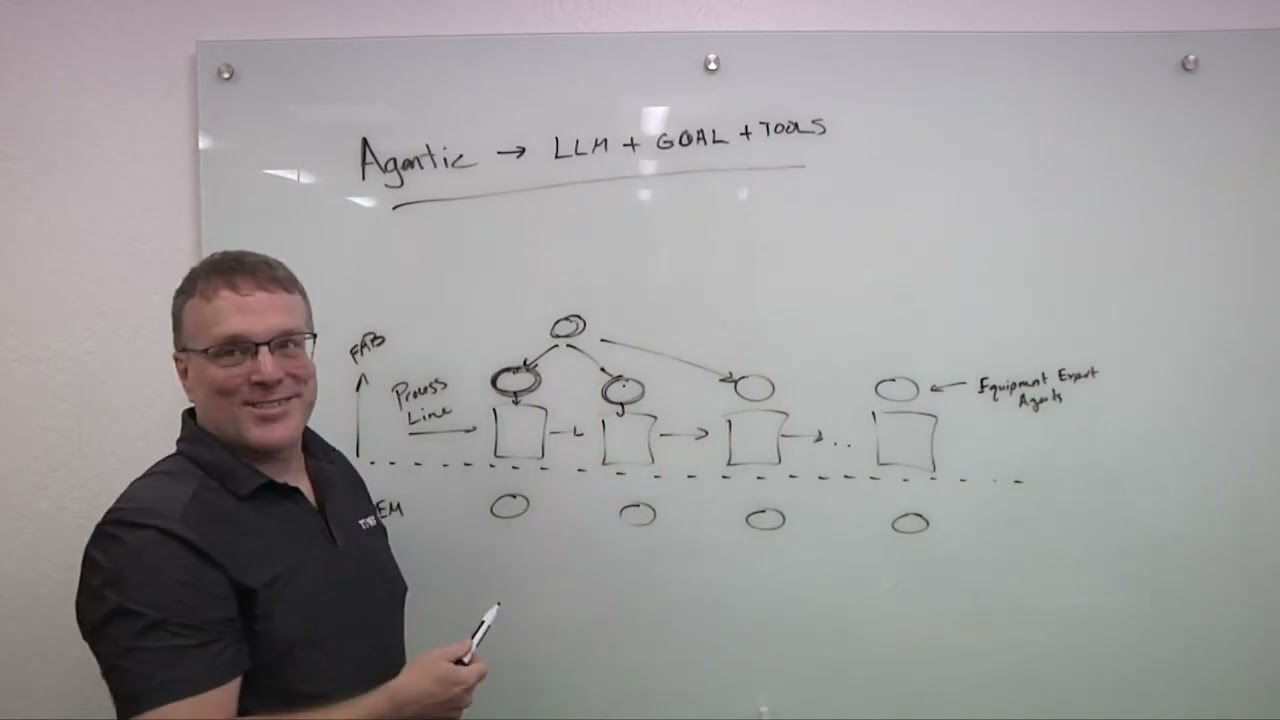
- Herlocker defines agentic AI and contrasts it with generative AI, emphasizing autonomy and tool use.
- Discussion of how agents can collaborate and be specialized, similar to human teams.
- Herlocker presents his hypothesis: agents will mirror human organizational structures in fabs.
- Addressing silos: agents can help break down data silos between fabs and OEMs while protecting IP.
- The role of humans: agents handle routine tasks, but humans are needed for oversight and exceptions.
- Control loops and trust: open research area, need for bounds and validation.
- Conclusion: Herlocker predicts fewer process engineers but not elimination, and thanks for the discussion.
Contribution & Novelties
The video offers a novel perspective on applying agentic AI to semiconductor manufacturing, specifically in process control and collaboration. It introduces the idea of specialized agents mirroring human organizational structures, which is an original contribution to the discussion. The discussion of breaking down data silos through agent-to-agent communication is particularly insightful.
Pour aller plus loin :
- Agentic AI — Provides a general overview of agentic AI concepts.
- Semiconductor manufacturing — Background on the manufacturing process.
- Advanced process control — Relevant to the control loops mentioned in the video.
88 words
Radar Profile
The radar profile shows balanced scores across all dimensions, with slightly higher values in information quantity and quality, reflecting the expert interview format. The technical level is moderate, suitable for a general technical audience. The overall reliability is good, but the lack of citations and speculative nature of the content prevent a higher score.
💬 No comments were provided for analysis.