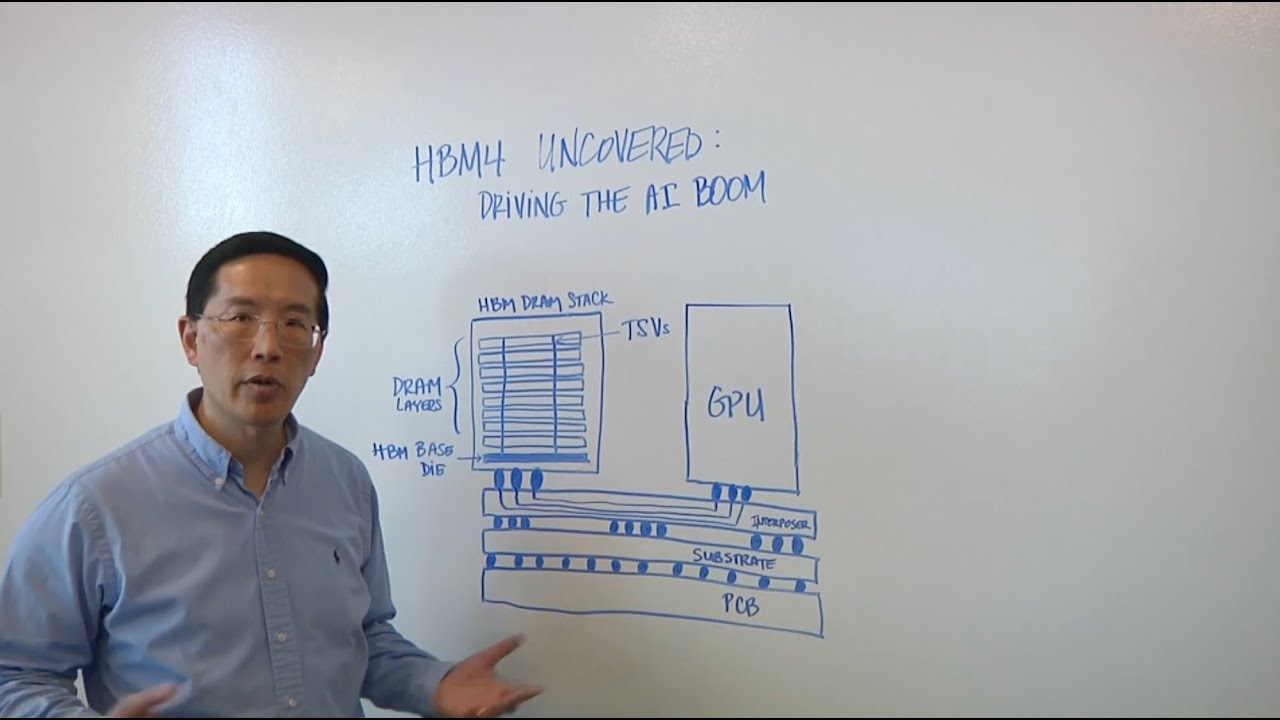
Critical Factors For Storing Data In DRAM
Keywords
Summary
140 words
Critical Evaluation
Value of the Information & Strength of the Argument
The video provides valuable insights into the evolving landscape of DRAM and HBM, emphasizing that traditional metrics are insufficient for modern AI workloads. The argumentation is solid, with clear explanations and analogies (e.g., traffic analogy for latency under load). The expert’s credibility adds weight, and the discussion is well-structured, covering each factor systematically. However, the content is primarily qualitative, lacking quantitative data or case studies, which limits its depth for technical audiences.
Scientific Rigor, Source Quality, Title Accuracy
The video is a professional interview with an industry expert, ensuring a high level of technical accuracy. However, it does not cite specific sources or references, relying on the expert’s knowledge. The title accurately reflects the content, and the video’s production quality is high. The description mentions the topics covered, and the interview format allows for in-depth discussion. No comments were provided for analysis.
151 words
Title / Content Match
The title accurately reflects the content, which focuses on critical factors for storing data in DRAM, including latency, bandwidth, capacity, and emerging considerations.
Quality & Reliability
8/10
The video features an expert from Rambus discussing technical aspects of DRAM and HBM, with clear explanations and relevant examples. The content is accurate and up-to-date, though it lacks detailed citations and is presented as an interview rather than a peer-reviewed source.
Key Moments
Markers derived by PSI from the transcript: the creator did not define chapters.
- Introduction to the interview and the topic of critical factors for storing data in DRAM.
- Discussion of traditional factors: latency, bandwidth, and capacity.
- Explanation of latency under load and its importance for AI workloads.
- Introduction of fill frequency and its relevance in graphics and inference.
- Discussion of power considerations, including data movement distance and signal integrity.
- Overview of reliability challenges, including on-die ECC and thermal sensors.
- Cost factors in DRAM development and manufacturing.
- How all factors converge in HBM4 stacks, including architecture and cooling.
- Discussion of power and thermal management in HBM, including liquid cooling.
- Reliability and mechanical effects in HBM stacks, and the importance of system-level design.
Cited Sources
- Semiconductor Engineering - Critical Factors For Storing Data In DRAM — The video itself, featuring an interview with Steven Woo from Rambus.
Concurring Sources
- Rambus - HBM4 — Rambus provides technical details on HBM, aligning with the video's content.
Contribution & Novelties
The video provides a comprehensive overview of the evolving factors in DRAM and HBM design, particularly for AI applications. It highlights the importance of latency under load and fill frequency, which are often overlooked. The discussion of HBM4 architecture and cooling solutions offers current insights.
Pour aller plus loin :
- High Bandwidth Memory (HBM) — Provides background on HBM technology and its evolution.
- Dynamic random-access memory (DRAM) — Explains the basics of DRAM and its operation.
- Row hammer — A reliability issue mentioned in the video, with detailed explanation.
- Error correction code (ECC) — Relevant to the discussion of on-die ECC and reliability.
103 words
Radar Profile
The radar profile shows high scores across all dimensions, indicating a well-rounded and informative video. The strongest aspects are information quantity and quality, while technical depth is slightly lower, reflecting the interview's accessible style.