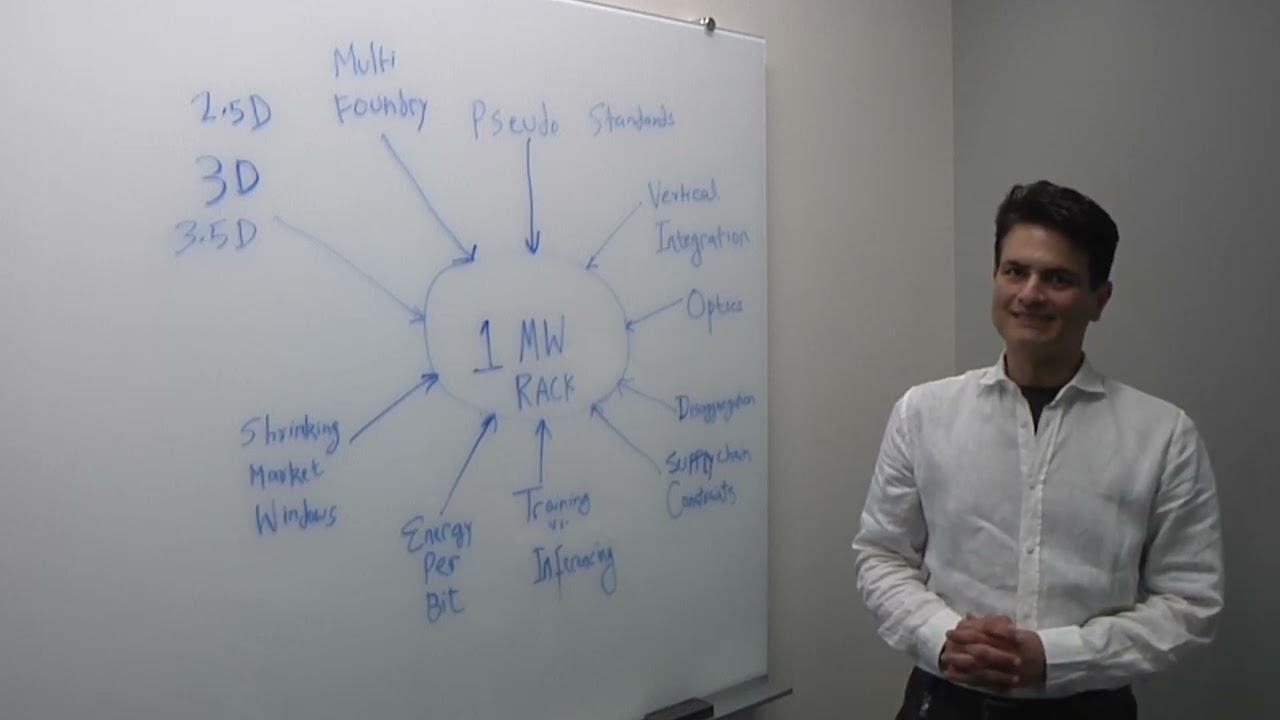
1 Megawatt Racks In Data Centers
Keywords
Summary
181 words
Critical Evaluation
Value of the Information & Strength of the Argument
The video provides valuable insights into the technical and market forces driving the evolution of data center racks. It offers a clear explanation of the challenges and solutions, such as the shift to optics and advanced packaging. The argumentation is coherent and well-structured, with the interviewee providing concrete examples (e.g., copper reach at different speeds) and explaining trade-offs (e.g., training vs. inferencing). The discussion is grounded in industry expertise, making it credible for professionals. However, it lacks quantitative data or references to specific studies, and the perspective is that of a vendor (Synopsys), which could introduce bias.
Scientific Rigor, Source Quality, Title Accuracy
The video is an expert interview, not a peer-reviewed presentation. The information is based on the interviewee’s professional experience and industry knowledge. No external sources are cited within the video or description, so the quality of sources is limited to the credibility of the speaker and the publication (Semiconductor Engineering). The title accurately reflects the content, and the discussion stays on topic. The video does not include a public comment section in the provided data, so no analysis of public reception is possible.
195 words
Title / Content Match
The title accurately reflects the content, which focuses on the challenges and technologies enabling 1 MW racks in data centers.
Quality & Reliability
8/10
Discussion with a Synopsys director of product management, providing expert insights into the technical and market dynamics of 1 MW racks. The information is credible and well-articulated, but it is an opinion/interview rather than a peer-reviewed study, and specific data points are not cited.
Key Moments
Markers derived by PSI from the transcript: the creator did not define chapters.
- Introduction to the topic of 1 MW racks and the interview setup.
- Overview of the major SoC components in a 1 MW rack.
- Discussion of technological shifts: advanced packaging, optics, liquid cooling, and interface IP evolution.
- Explanation of scale-up, scale-out, and scale-across concepts.
- Comparison of training vs. inferencing requirements and the role of memory tiering with CXL.
- Discussion on standards evolution and the emergence of pseudo-standards.
- Supply chain constraints and multi-foundry strategies.
- Deep dive into advanced packaging, including 3D face-to-face configurations and TSVs.
- Impact of workload-specific designs on IP customization and hyperscaler vertical integration.
- Conclusion and thanks.
Contribution & Novelties
The video provides a comprehensive overview of the technological and market shifts required to achieve 1 MW racks in AI data centers. It highlights the convergence of advanced packaging, optical interconnects, and custom silicon design, offering a holistic view of the challenges and solutions. The discussion on pseudo-standards and the role of hyperscalers in shaping the industry is particularly insightful.
Pour aller plus loin :
- Advanced packaging — Provides background on packaging technologies like 2.5D and 3D.
- CXL (Compute Express Link) — Official site for CXL, a key enabler for memory tiering.
- Ultra Ethernet Consortium — Information on the Ultra Ethernet standard for scale-up/scale-out networking.
- NVLink — NVIDIA’s proprietary interconnect for AI accelerators.
113 words
Radar Profile
The radar profile shows high scores in quantity and quality of information, with a slightly lower but still solid technical level. This indicates a well-informed expert discussion that is accessible to a technical audience, though it may not delve into the deepest technical details.