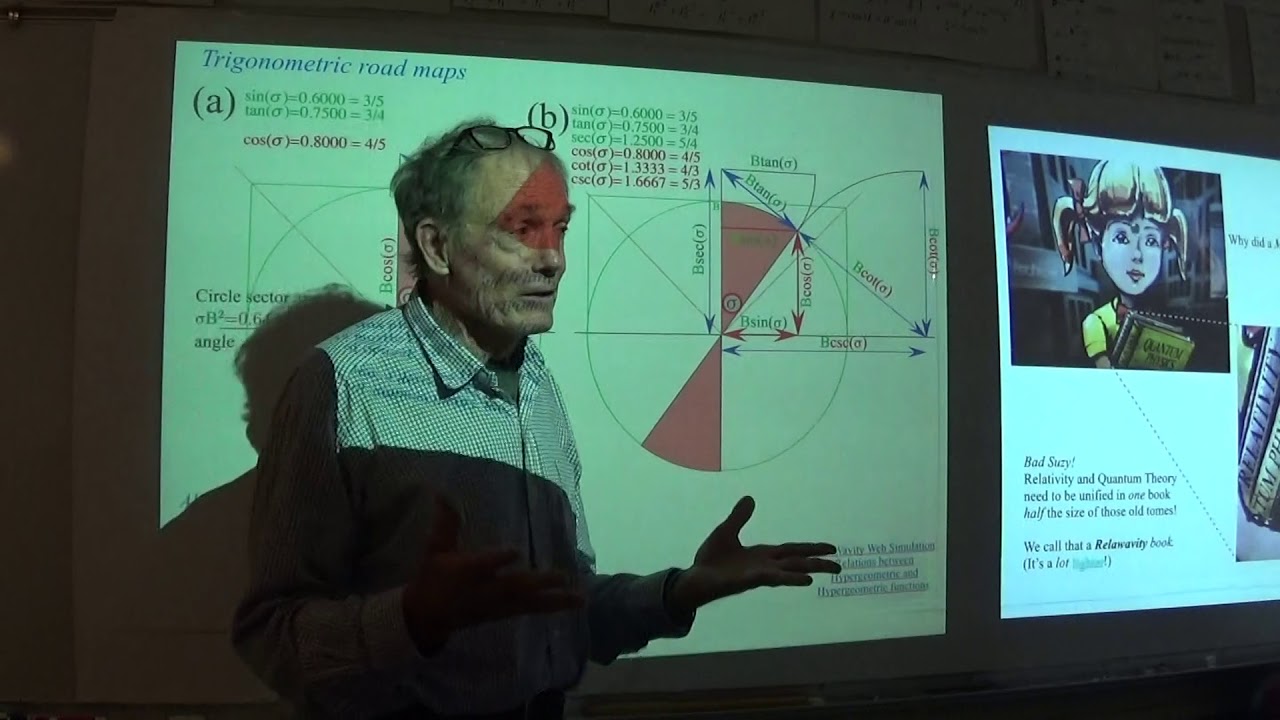
Classical Mechanics with a Bang! (2018 Fall) - Lecture #29 Part 1/2
Keywords
Summary
121 words
Critical Evaluation
Value of the Information & Strength of the Argument
The lecture offers a valuable pedagogical perspective by presenting classical mechanics and relativity through a unified geometric framework. The argumentation is built on the idea that trigonometric and hyperbolic functions, along with space-time diagrams, provide a clear and intuitive understanding of wave mechanics and relativity. The instructor supports his claims with mathematical derivations and historical anecdotes, though the presentation is somewhat informal and relies on the audience’s familiarity with the course material. The value lies in the novel approach to teaching these topics, which could help students grasp complex concepts more easily.
Scientific Rigor, Source Quality, Title Accuracy
The scientific rigor is moderate: the lecture is based on established physics and mathematical principles, but it does not provide explicit citations to external sources. The course website and lecture slides are mentioned in the description, which serve as primary references. The title accurately reflects the content, as the lecture is part of a series on classical mechanics with a modern geometric twist. The presentation is consistent with the course’s stated goal of using geometry to clarify mechanics and quantum theory.
188 words
Title / Content Match
The title accurately reflects the content: a lecture on classical mechanics with a modern geometric perspective, part of a series.
Quality & Reliability
7/10
Lecture by a university professor, part of a graduate course, with a geometric approach to classical mechanics and relativity. The content is mathematically rigorous and based on established physics, but the presentation is informal and lacks explicit citations to external sources.
Key Moments
Markers derived by PSI from the transcript: the creator did not define chapters.
- Introduction: geometric approach to modern physics, goal to simplify advanced concepts.
- Discussion of sine and cosine, basic trigonometric functions, and their geometric meaning.
- Introduction of the 'roadmap' of trigonometric and hyperbolic functions, connecting circular and hyperbolic sectors.
- Explanation of the relationship between trigonometric and hyperbolic functions, and their relevance to relativity.
- Discussion of space-time diagrams and the concept of phase velocity, with examples.
- Introduction of the 'keyboard of the gods' concept: Fourier analysis and the representation of waves.
- Historical notes on Hertz, Fourier, and Minkowski, and their contributions to wave theory and relativity.
- Explanation of the Doppler effect as a first-order relativistic effect, using wave concepts.
Cited Sources
- Course Web site — Official course website for 'Classical Mechanics with a Bang!'
- Lecture #29 slides (PDF) — Slides used in this lecture, providing visual aids and detailed content.
Concurring Sources
- Course Web site — Provides course materials and context consistent with the lecture.
Contribution & Novelties
The lecture presents a unique geometric approach to classical mechanics and relativity, emphasizing the use of trigonometric and hyperbolic functions as a unified framework. It offers a visual ‘roadmap’ that connects wave phenomena, space-time, and relativity, potentially making these topics more accessible. The approach is original in its pedagogical method, though the underlying physics is standard.
Pour aller plus loin :
- Hyperbolic functions — Relevant for understanding the hyperbolic trigonometry used in the lecture.
- Minkowski spacetime — Directly related to the space-time diagrams discussed.
- Doppler effect — Key concept in the lecture’s explanation of relativity.
95 words
Radar Profile
The radar profile shows high scores in quantity of information and technical level, reflecting the dense and advanced content. Quality and reliability are moderate, as the lecture is informal and lacks external citations. The overall balance suggests a content-rich but not fully rigorous presentation.