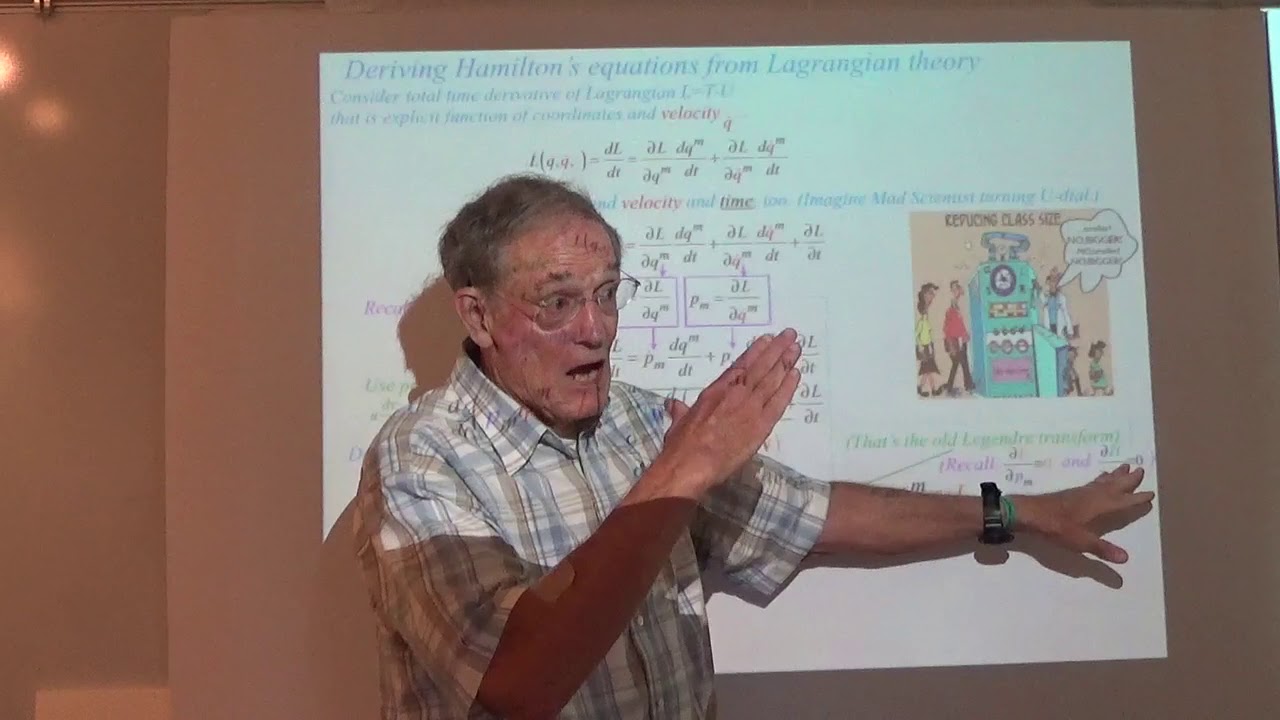
Classical Mechanics with a Bang! (2017 Fall) - Lecture #10
Keywords
Summary
167 words
Critical Evaluation
Value of the Information & Strength of the Argument
The lecture provides a thorough and rigorous derivation of Hamiltonian mechanics, building on the Lagrangian formalism. The professor carefully explains the mathematical steps, including the Legendre transformation and the role of the metric tensor, making the content accessible to graduate students. The argumentation is solid, with clear connections to physical principles such as energy conservation and symmetry. The use of polar coordinates as an example effectively illustrates the practical differences between the two formalisms. The lecture also highlights the computational advantages of Hamilton’s equations, which is valuable for students applying these methods in research.
Scientific Rigor, Source Quality, Title Accuracy
The lecture is scientifically rigorous, with derivations that are mathematically sound and consistent with standard textbooks. The professor references the course textbook and provides supplementary materials (slides and course website) for further study. The title accurately reflects the content, which is a lecture on Hamiltonian mechanics within a classical mechanics course. The presentation is well-structured, with clear explanations and visual aids. The sources cited are appropriate and reliable, coming from the course’s official materials.
183 words
Title / Content Match
The title accurately reflects the content, which is a lecture on Hamiltonian mechanics within a classical mechanics course.
Quality & Reliability
8/10
Lecture by a university professor, part of a graduate course, with clear derivations and references to course materials. The content is mathematically rigorous and consistent with standard classical mechanics.
Key Moments
Markers derived by PSI from the transcript: the creator did not define chapters.
- Introduction to Hamiltonian mechanics and comparison with Lagrangian approach.
- Derivation of Hamilton's equations from Lagrangian using Legendre transformation.
- Discussion on the role of the metric tensor in converting velocities to momenta.
- Application to polar coordinates and comparison of Hamiltonian and Lagrangian results.
- Advantages of Hamiltonian mechanics for conserved quantities and symmetries.
- Example of central potential and reduction to one-dimensional problem.
- Numerical integration using Hamilton's equations and Runge-Kutta method.
- Summary and outlook for future lectures.
Cited Sources
- Course Web site — Course materials and information for PHYS 5103.
- Lecture #10 slide presentation (pdf) — Slides used in this lecture.
Concurring Sources
- Classical Mechanics (Goldstein) — Standard textbook covering Hamiltonian mechanics in depth.
Contribution & Novelties
This lecture provides a clear and detailed introduction to Hamiltonian mechanics, emphasizing the geometric interpretation and the role of the metric tensor. It offers a pedagogical approach that connects the Lagrangian and Hamiltonian formalisms, making it valuable for graduate students. The lecture also highlights practical applications, such as numerical integration and conservation laws.
Pour aller plus loin :
- Hamiltonian mechanics — Overview of Hamiltonian mechanics and its applications.
- Legendre transformation — Mathematical background for the transformation used in the lecture.
- Runge-Kutta methods — Numerical methods for solving differential equations, as mentioned in the lecture.
94 words
Radar Profile
The radar profile shows high scores in technical level and information quality, indicating a rigorous and detailed lecture. The lower score in accessibility suggests that the content is advanced and may not be suitable for beginners.