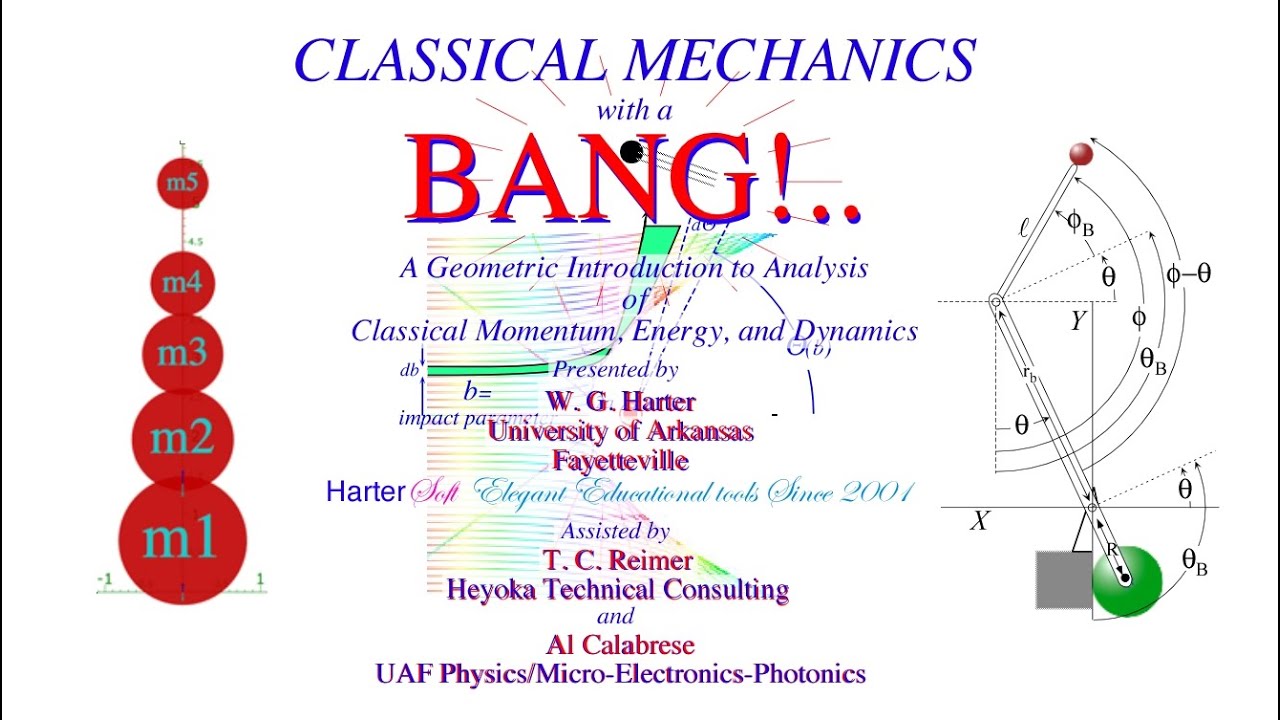
Classical Mechanics with a Bang! - Lecture 1, Part 1/3
Keywords
Summary
170 words
Critical Evaluation
Value of the Information & Strength of the Argument
The lecture provides a clear and insightful introduction to collision problems, emphasizing the conservation of momentum as a fundamental principle. The geometric approach offers a novel perspective that simplifies the analysis and provides intuitive understanding. The argumentation is solid, building from the basic axiom of momentum conservation to derive the outcomes for both elastic and inelastic collisions. The use of a concrete example (SUV vs. Volkswagen) makes the concepts accessible, and the instructor effectively demonstrates the power of the geometric method. However, the lecture is introductory and does not delve into the derivation of energy conservation or the underlying symmetries in detail, which are mentioned but not fully explored.
Scientific Rigor, Source Quality, Title Accuracy
The lecture is based on the textbook ‘Classical Mechanics with a Bang!’ by the same author, which provides a rigorous foundation. The instructor references fundamental principles such as momentum conservation and mentions connections to quantum mechanics and relativity, but does not provide external sources or citations. The title accurately reflects the content, which is a lively and engaging introduction to classical mechanics. The lecture is well-structured and pedagogically sound, with clear explanations and visual aids.
199 words
Title / Content Match
The title accurately reflects the content: a lecture on classical mechanics with a focus on collisions, presented in a lively and engaging manner.
Quality & Reliability
8/10
Lecture by a university professor, based on a textbook, with clear pedagogical structure and mathematical derivations. The content is rigorous and accurate, though it is an introductory lecture and does not delve into advanced proofs.
Key Moments
Markers derived by PSI from the transcript: the creator did not define chapters.
- Introduction to the lecture and the geometric approach to classical mechanics.
- Setting up the collision problem: SUV (4 tons) rear-ending a Volkswagen (1 ton) at 60 mph and 10 mph.
- Introduction of velocity-velocity space and the initial point representing the velocities.
- Explanation of momentum conservation as an axiom and its representation as a straight line in velocity space.
- Derivation of the momentum conservation line equation: 4x + y = constant.
- Discussion of idealizations and the concept of totally inelastic collision.
- Finding the solution for totally inelastic collision: both vehicles end at 50 mph.
- Introduction of the elastic collision case and the use of symmetry to find the solution.
- Solution for elastic collision: SUV at 40 mph, Volkswagen at 90 mph.
- Discussion of the computer simulation and the graphical representation of the collision.
Cited Sources
- Classical Mechanics with a Bang! — Textbook by the lecturer, William G. Harter, on which the course is based.
Concurring Sources
- Classical Mechanics (Goldstein) — Standard graduate textbook on classical mechanics, covering similar topics.
Contribution & Novelties
The lecture presents a geometric approach to classical mechanics, which is a refreshing alternative to the traditional algebraic methods. It emphasizes the power of visualization in understanding physical principles and provides a foundation for more advanced topics. The use of velocity-velocity space to solve collision problems is a clear and intuitive method that can be extended to other areas of mechanics.
Pour aller plus loin :
- Momentum conservation — Fundamental principle in physics, central to the lecture.
- Elastic collision — Detailed explanation of elastic collisions, relevant to the lecture.
- Inelastic collision — Detailed explanation of inelastic collisions, relevant to the lecture.
- Symmetry in physics — The role of symmetry in physical laws, mentioned in the lecture.
116 words
Radar Profile
The radar profile shows high scores in quality of information and reliability, reflecting the academic rigor of the lecture. The quantity of information is moderate, as it is an introductory lecture, and the technical level is appropriate for a graduate audience. The overall balance indicates a solid educational resource.
💬 No comments were provided for analysis.