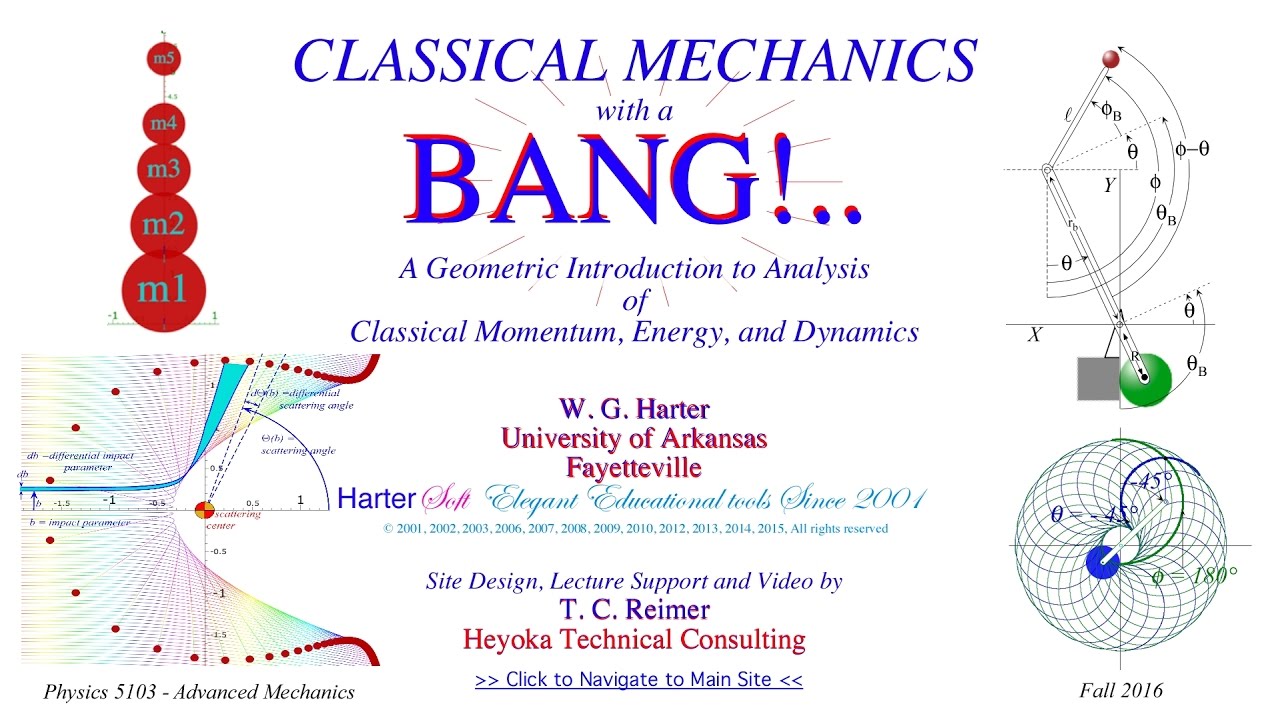
Classical Mechanics with a Bang! (2016 Fall) - Lecture #25
Keywords
Summary
170 words
Critical Evaluation
Value of the Information & Strength of the Argument
The lecture provides a thorough and rigorous mathematical treatment of central force problems, specifically comparing the harmonic oscillator and Coulomb potential. The argumentation is logical and builds step-by-step from the effective potential to the explicit orbital equations. The instructor emphasizes the physical insights gained from the mathematics, such as the relationship between orbital and radial frequencies and the geometric interpretation of orbits. The use of the effective potential to find stable orbits and oscillation frequencies is clearly explained, and the derivation of the orbital equations is detailed. The lecture also introduces the Kustaanheimo-Stiefel transformation as a mathematical curiosity, adding depth. The presentation is well-structured, though the informal style and occasional digressions may require careful attention.
Scientific Rigor, Source Quality, Title Accuracy
The lecture is based on the textbook ‘Classical Mechanics with a Bang!’ by Prof. Harter, and is part of a university course. The mathematical derivations are consistent with standard classical mechanics. The instructor references the Kustaanheimo-Stiefel transformation, which is a known mathematical tool. The lecture does not cite external sources beyond the course materials, but the content is academically sound. The title accurately reflects the content, as it is a lecture on classical mechanics. The video is a raw lecture recording without editing, which may affect production quality but not the scientific content.
223 words
Title / Content Match
The title accurately reflects the content: a lecture on classical mechanics, specifically comparing harmonic oscillator and Coulomb potential orbits.
Quality & Reliability
8/10
The lecture is delivered by a university professor as part of a graduate course, based on a textbook and accompanied by course materials. The content is mathematically rigorous and consistent with established classical mechanics. However, it is a single lecture without external citations or peer review, and the recording quality is basic.
Key Moments
Markers derived by PSI from the transcript: the creator did not define chapters.
- Introduction: comparing harmonic oscillator and Coulomb potential, effective potential review.
- Review of effective potential and 'three steps to hell' for Coulomb potential.
- Derivation of stable radius and oscillation frequency for both potentials.
- Comparison of orbital and radial frequencies: 2:1 for oscillator, 1:1 for Coulomb.
- Solving for classical turning points and introducing variable changes.
- Derivation of orbital equations and discussion of 'mysterious similarity' (Kustaanheimo-Stiefel).
- Geometry of orbits: eccentricity, conic sections, and polar equation.
Cited Sources
- Course Web site — Course materials and resources for 'Classical Mechanics with a Bang!'
- Lecture #25 slide presentation (PDF) — Slides used in this lecture, containing equations and figures.
Concurring Sources
- Classical Mechanics with a Bang! (textbook) — The textbook by Prof. Harter, which the lecture follows.
Contribution & Novelties
This lecture provides a detailed comparison of the harmonic oscillator and Coulomb potential within the effective potential framework, highlighting the mathematical similarities and differences. The ‘mysterious similarity’ where the coupling constant and energy are interchanged is a notable insight, though it is not fully explored. The lecture also connects the classical orbits to conic sections, providing a geometric understanding. The preview of the Runge-Lenz vector sets the stage for a group-theoretical approach.
Pour aller plus loin :
- Kustaanheimo-Stiefel transformation — A mathematical transformation that regularizes the Kepler problem, relevant to the ‘mysterious similarity’ mentioned.
- Runge-Lenz vector — A conserved vector in the Kepler problem, previewed for the next lecture.
- Effective potential — The concept used throughout the lecture to analyze central force problems.
123 words
Radar Profile
The radar profile shows high scores in technical level and information quality, indicating a rigorous and detailed lecture. The quantity of information is also high, but the fiabilite is slightly lower due to the lack of external citations. Overall, the lecture is a solid academic resource for advanced classical mechanics.