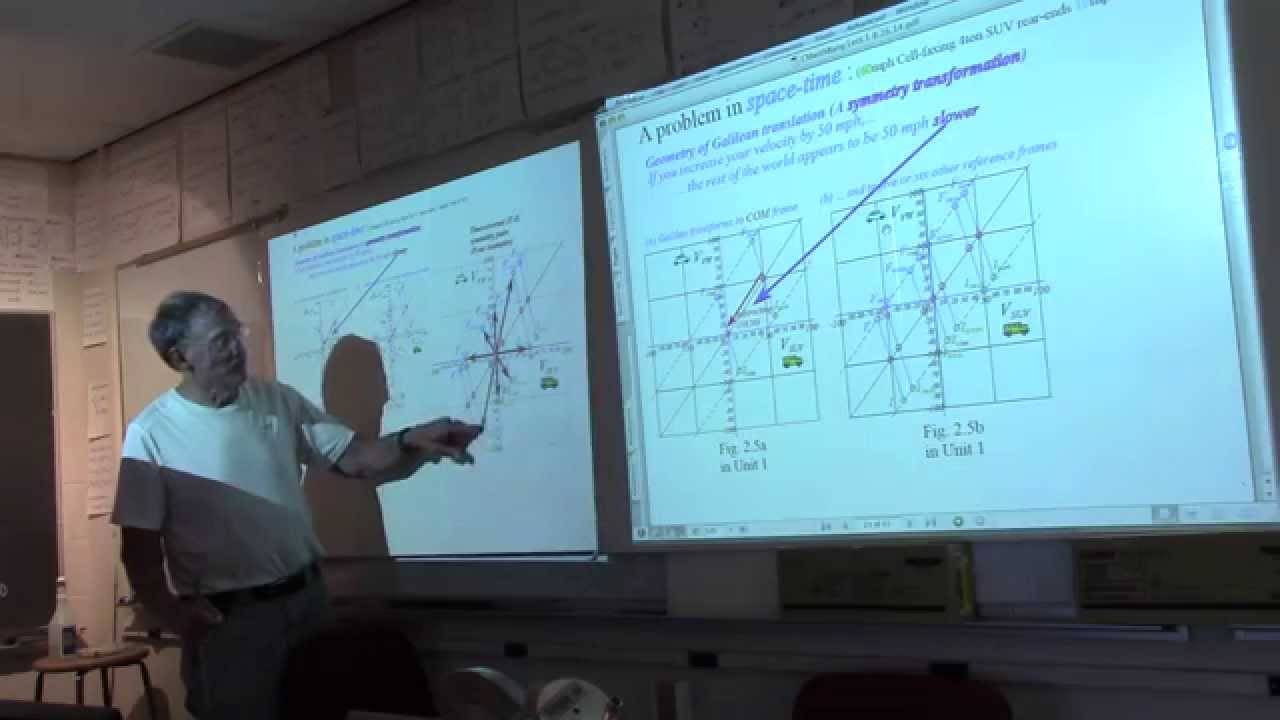
Classical Mechanics with a Bang! - Lecture 1, Part 2/3
Keywords
Summary
129 words
Critical Evaluation
Value of the Information & Strength of the Argument
The lecture provides a clear and insightful geometric interpretation of classical collision problems, which is valuable for understanding the underlying physics. The argumentation is solid, building from simple examples to more general principles, and the use of visual aids enhances comprehension. The professor effectively demonstrates how conservation laws constrain the system and how different reference frames offer different perspectives. The approach is rigorous and mathematically sound, though it assumes a certain level of familiarity with vector algebra and mechanics.
Scientific Rigor, Source Quality, Title Accuracy
The lecture is scientifically rigorous, with a logical progression of ideas and correct physics. The sources are primarily the textbook ‘Classical Mechanics with a Bang!’ by the same author, which is a legitimate academic resource. The title accurately reflects the content, which is a lecture on classical mechanics with a focus on collisions. The presentation is well-structured and the mathematical derivations are clear. However, as a lecture, it does not cite external sources, but this is appropriate for the format.
174 words
Title / Content Match
The title accurately reflects the content, which is a lecture on classical mechanics with a focus on collisions and geometric methods.
Quality & Reliability
8/10
Lecture by a university professor, part of a graduate course, with a geometric approach to classical mechanics. The content is mathematically rigorous and internally consistent, but it is a lecture, not peer-reviewed research.
Key Moments
Markers derived by PSI from the transcript: the creator did not define chapters.
- Introduction to the lecture and recap of previous content.
- Demonstration of a collision with damping force and exponential approach to terminal velocity.
- Discussion of elastic collisions and the possibility of generalizing to two dimensions.
- Simulation of an ideal elastic collision with zero friction, showing the system reaching the energy circle.
- Explanation of the coefficient of restitution and the role of tensors in describing compression.
- Idealizations in the model: no rolling friction, air resistance, and one-dimensional motion.
- Preview of future topics: three translational degrees of freedom, rotation, and Euler angles.
- Discussion of vibrational degrees of freedom for molecules and generalized curvilinear coordinates.
- Introduction to Galilean relativity and the concept of changing reference frames.
- Graphical representation of the collision in different reference frames, including the center of momentum frame.
- Time reversal symmetry and its implications for collision processes.
- Vector algebra representation of the collision and the parallelogram construction.
- Introduction of the center of momentum vector and its role in conservation laws.
- Use of tensor algebra to derive the energy conservation equation and avoid logical pitfalls.
- Final summary and conclusion of the lecture.
Cited Sources
- Classical Mechanics with a Bang! (textbook) — The course textbook, developed by Prof. Harter, which the lecture follows.
Concurring Sources
- Classical Mechanics (Goldstein) — Standard graduate textbook that covers similar topics in classical mechanics, though with a more algebraic approach.
Contribution & Novelties
The lecture offers a unique geometric approach to classical mechanics, emphasizing visual intuition over algebraic manipulation. It provides a clear graphical representation of conservation laws and reference frame transformations, which is often lacking in traditional treatments. The use of computer simulations enhances the understanding of dynamic processes.
Pour aller plus loin :
- Galilean invariance — Fundamental principle underlying the frame transformations discussed.
- Center-of-momentum frame — Key concept for analyzing collisions.
- Coefficient of restitution — Relevant to the discussion of elastic and inelastic collisions.
- Tensor algebra — Mathematical tool used in the lecture for deriving conservation laws.
96 words
Radar Profile
The radar profile shows high scores across all dimensions, indicating a well-rounded and rigorous lecture. The quantitative and qualitative information are strong, and the technical level is appropriate for a graduate course. The overall reliability is high, reflecting the academic context.