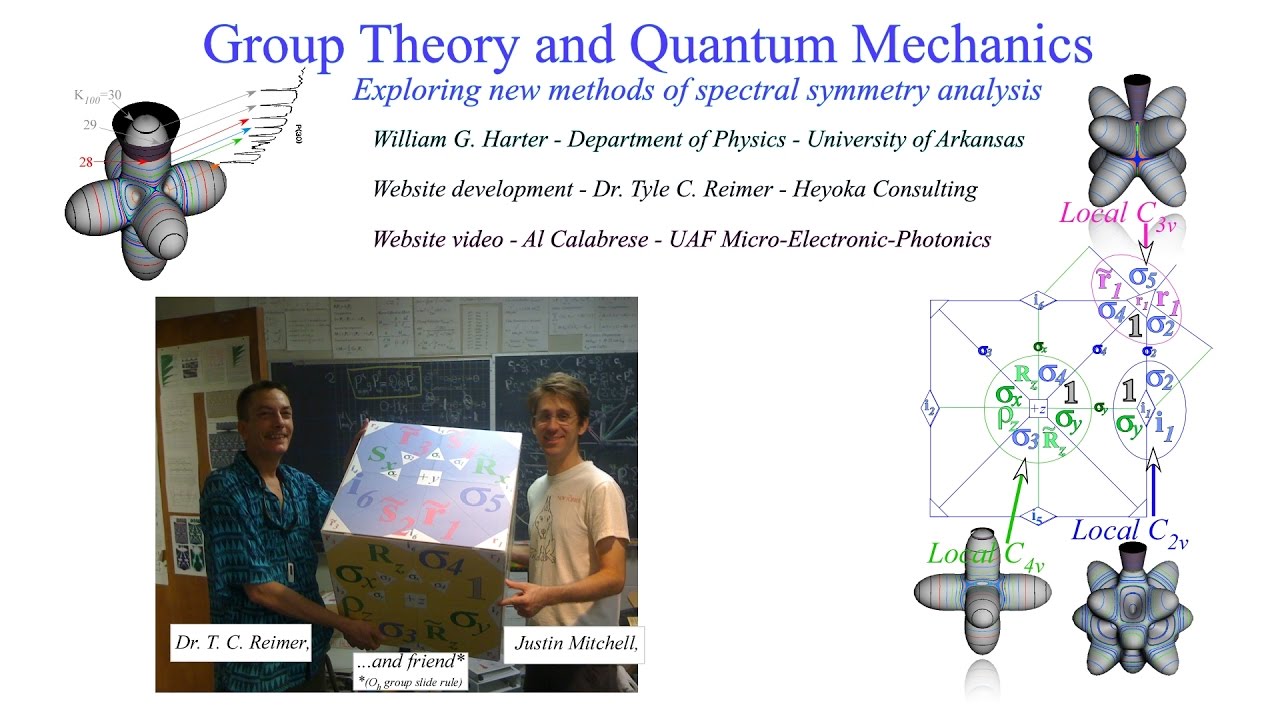
Group Theory in Quantum Mechanics (2017 Sp) - Lecture #27
Keywords
Summary
119 words
Critical Evaluation
Value of the Information & Strength of the Argument
The lecture provides valuable insights into the application of group theory in quantum mechanics, a topic that is often abstract but here is grounded in physical examples. The argumentation is solid, as it follows a logical progression from symmetry principles to their consequences in spectroscopy. The professor’s approach of starting from physical reality helps clarify the mathematical formalism. However, the value is diminished by the poor audio and transcription quality, which may hinder comprehension for those not already familiar with the subject.
Scientific Rigor, Source Quality, Title Accuracy
The scientific rigor is high, as the lecture is based on established textbooks and the professor’s expertise. The sources cited include the course website and the lecture slides, which are reliable academic resources. The title accurately reflects the content. The lecture is part of a structured course, indicating careful preparation. However, the lack of editing and the poor recording quality reduce the overall presentation quality.
162 words
Title / Content Match
The title accurately reflects the content: a lecture on group theory applied to quantum mechanics.
Quality & Reliability
7/10
Lecture by a professor with expertise in the field, based on established textbooks and course materials. However, the video is a raw lecture recording with no editing, and the transcription is heavily corrupted, limiting its standalone utility.
Key Moments
Markers derived by PSI from the transcript: the creator did not define chapters.
- Introduction and overview of the lecture topics.
- Discussion on symmetry operations and their mathematical representation.
- Introduction to group representation theory and its application to quantum mechanics.
- Examples of molecular symmetry and spectroscopy.
- Use of Fourier analysis in the context of symmetry.
- Advanced topics in representation theory.
- Application to specific physical systems.
- Summary and concluding remarks.
Cited Sources
- Course Web site — Course materials and additional content for the Group Theory in Quantum Mechanics course.
- Lecture #27 slide presentation (pdf) — Slides used in this lecture, providing visual aids and detailed content.
Concurring Sources
- Quantum Theory in the Computer Age — Textbook by Prof. William Harter, referenced as a principal text for the course.
- Principles of Symmetry, Dynamics, and Spectroscopy — Another textbook by Prof. William Harter, also referenced as a principal text.
Contribution & Novelties
This lecture offers a unique pedagogical approach by emphasizing the physical intuition behind group theory, which is often presented abstractly. It bridges the gap between mathematics and physics, making the subject more accessible. The course materials are openly available, providing a valuable resource for self-study.
Pour aller plus loin :
- Group theory — Foundational concept for the lecture.
- Representation theory — Central to the application of group theory in quantum mechanics.
- Molecular symmetry — Directly relevant to the spectroscopic applications discussed.
81 words
Radar Profile
The radar profile shows high scores in quantity of information, technical level, and reliability, indicating a dense and rigorous lecture. The quality of information is slightly lower, possibly due to the recording quality and the need for supplementary materials.