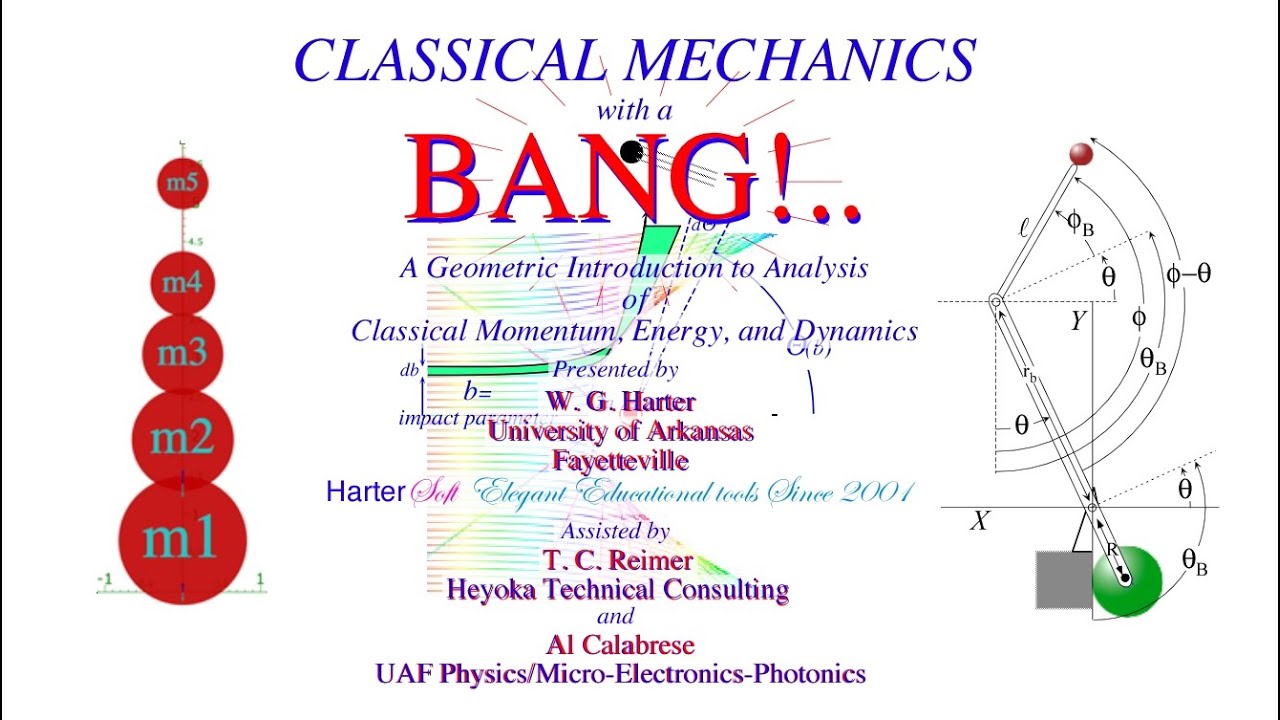
Classical Mechanics with a Bang! - Lecture 25
Keywords
Summary
141 words
Critical Evaluation
Value of the Information & Strength of the Argument
The lecture provides a deep and rigorous treatment of the projector method for solving eigenvalue problems, which is a powerful tool in both classical and quantum mechanics. The argumentation is logical and step-by-step, building from the secular equation to the construction of idempotent projectors and their properties. The instructor emphasizes the elegance and utility of the method, particularly in handling symmetries and avoiding the complexities of direct diagonalization. The value lies in the clear exposition of a sophisticated mathematical technique and its physical applications.
Scientific Rigor, Source Quality, Title Accuracy
The lecture is scientifically rigorous, with all derivations based on established mathematical theorems (e.g., Hamilton-Cayley). The instructor does not cite external sources, but the content is self-contained and consistent with standard textbooks. The title ‘Classical Mechanics with a Bang!’ is the course name, and this lecture fits within that scope. The lecture is part of a university course, which adds to its credibility.
162 words
Title / Content Match
The title 'Classical Mechanics with a Bang!' is the course name, and this lecture is part of that series. The content focuses on classical mechanics and quantum analogies, so the title is appropriate.
Quality & Reliability
8/10
Lecture by a university professor, part of a graduate course, with rigorous mathematical derivations. The content is based on established theory (Hamilton-Cayley, projectors) and is presented in a pedagogical manner. No external sources are cited, but the mathematical arguments are self-contained and verifiable.
Key Moments
Markers derived by PSI from the transcript: the creator did not define chapters.
- Introduction and overview of the lecture topics: projective algebra, idempotent projectors, and coupled oscillators.
- Review of the secular equation and the Hamilton-Cayley theorem.
- Introduction of 'baby projectors' and their derivation from the Hamilton-Cayley equation.
- Construction of normalized idempotent projectors (adult projectors) and their properties.
- Geometric interpretation of eigenvectors and the distinction between covariant and contravariant vectors.
- Demonstration of orthogonality and completeness of projectors, leading to spectral decomposition.
- Connection to quantum mechanics: projectors as measurement filters and the axioms of quantum mechanics.
- Discussion of degeneracy and non-diagonalizable matrices, and the importance of distinct eigenvalues.
- Further examples and applications of the projector method to coupled oscillators.
- Conclusion and preview of next lecture on rotation mechanics and symmetry.
Contribution & Novelties
The lecture presents a clear and elegant method for solving eigenvalue problems using projectors, which is a standard but powerful technique. The novelty lies in the pedagogical approach, emphasizing the geometric interpretation and the connection to quantum mechanics. The method avoids the need for explicit diagonalization and is particularly useful for symmetry analysis.
Pour aller plus loin :
- Spectral theorem — Provides the mathematical foundation for the decomposition of operators.
- Projection (linear algebra) — Explains the concept of projectors in linear algebra.
- Hamilton–Cayley theorem — The theorem used to derive the projectors.
92 words
Radar Profile
The radar profile shows high scores in quantity, quality, and technical level, indicating a dense and rigorous lecture. The fiabilite is also high, reflecting the academic context and the mathematical rigor. The lecture is highly specialized and may not be accessible to a general audience.