Classical Mechanics with a Bang! (2018 Fall) - Lecture #26 Part 1 of 2
Keywords
Summary
146 words
Critical Evaluation
Value of the Information & Strength of the Argument
The lecture provides valuable insights into the geometric structure of classical scattering, offering a visual and intuitive understanding that complements algebraic approaches. The argumentation is solid, built on rigorous geometric derivations and supported by simulations. The instructor clearly explains the steps and connects the geometry to physical phenomena, such as Rutherford scattering and astrophysical applications. The value lies in the unique perspective that enhances comprehension of classical mechanics.
Scientific Rigor, Source Quality, Title Accuracy
The lecture is scientifically rigorous, grounded in established classical mechanics. The instructor references his own course materials and papers, but no external sources are cited. The title accurately reflects the content, which is a lecture on classical mechanics with a focus on geometric methods. The presentation is well-structured and mathematically sound, though it assumes a high level of prior knowledge.
143 words
Title / Content Match
The title accurately reflects the content, which is a lecture on classical mechanics with a focus on geometric methods.
Quality & Reliability
8/10
The lecture is part of a graduate course by a professor, presenting rigorous geometric derivations of classical scattering. The content is mathematically sound and aligns with established physics, though it is not peer-reviewed and relies on the instructor's expertise.
Key Moments
Markers derived by PSI from the transcript: the creator did not define chapters.
- Introduction to the lecture's topics: scattering geometry, eccentricity vector, and envelope.
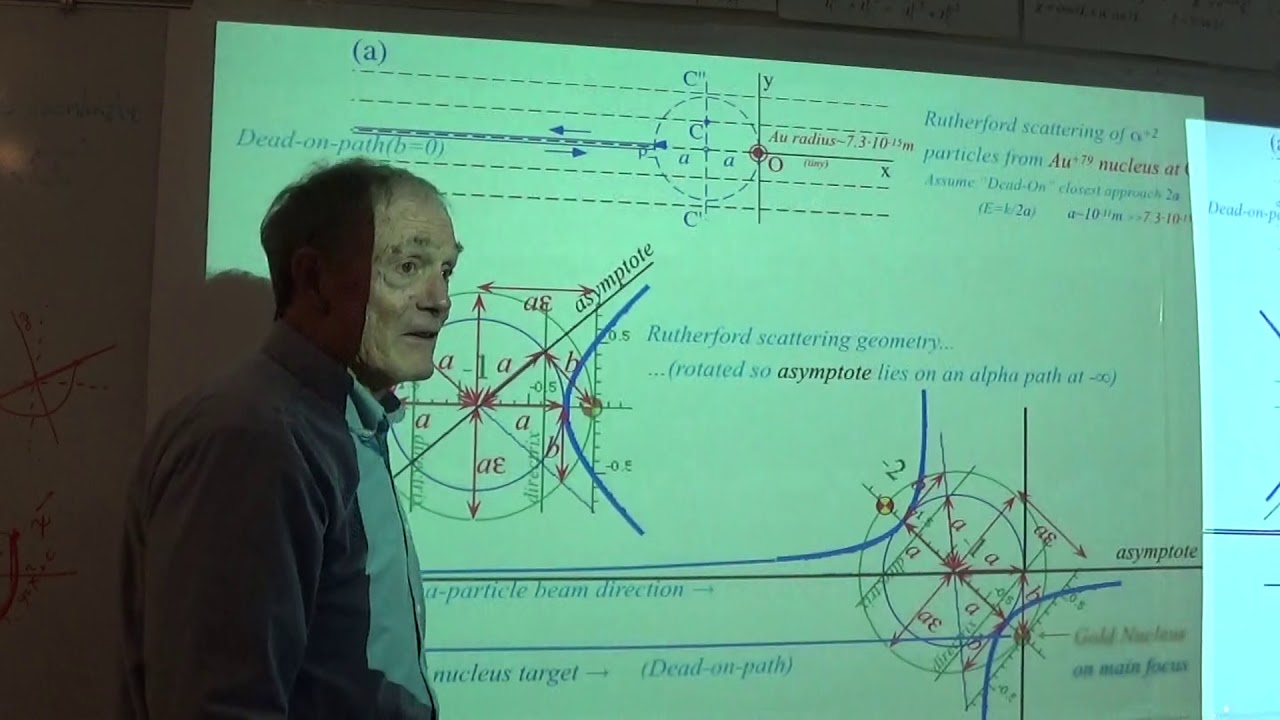
- Discussion of Rutherford scattering and the setup with alpha particles and gold nucleus.
- Geometric construction of hyperbolic orbits using ruler and compass.
- Explanation of the eccentricity vector and its analogy to the Stokes vector.
- Introduction of the envelope concept and its visualization.
- Computer simulation of scattering and the formation of parabolic envelopes.
- Derivation of the differential scattering cross-section for Coulomb scattering.
- Comparison with the quantum mechanical Born approximation.
- Discussion of total cross-section and its divergence for Coulomb potential.
Cited Sources
- Course Web site — Course materials and information for PHYS 5103.
- Lecture #26 slide presentation (pdf) — Slides for this lecture.
Concurring Sources
- Classical Mechanics with a Bang! — Course textbook by Prof. Harter, which the lecture follows.
Contribution & Novelties
The lecture offers a unique geometric perspective on classical scattering, emphasizing visual construction and envelope geometry. It provides a deeper understanding of the underlying symmetries and connects classical results with quantum approximations.
Pour aller plus loin :
- Rutherford scattering — Background on the experiment and cross-section.
- Eccentricity vector — Definition and properties.
- Born approximation — Quantum scattering approximation.
58 words
Radar Profile
The radar profile shows high scores in technical level and information quality, reflecting the advanced and rigorous nature of the lecture. The quantity of information is also high, but the global reliability is slightly lower due to the lack of external citations. Overall, the lecture is a valuable resource for advanced students.