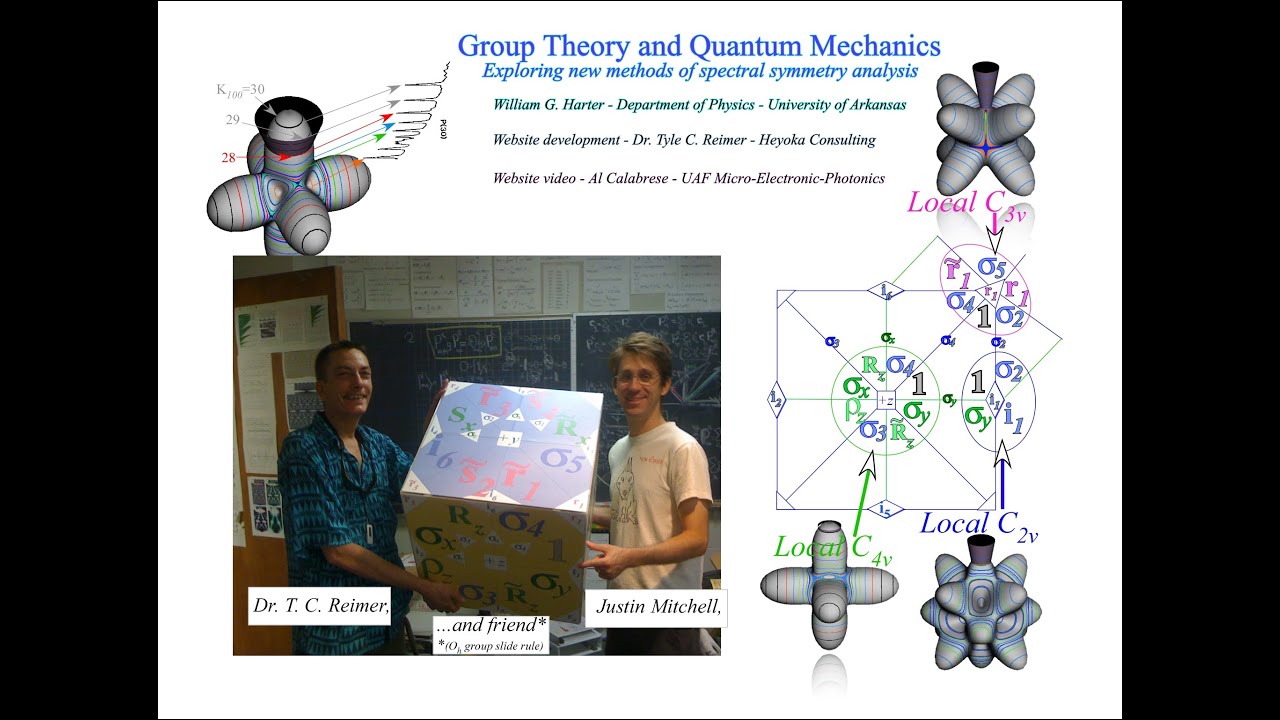
Applications of Group Theory to Physics - Lecture 24
Keywords
Summary
164 words
Critical Evaluation
Value of the Information & Strength of the Argument
The lecture provides a deep and rigorous derivation of angular momentum representations from the harmonic oscillator algebra, offering a unified perspective that is often not presented in standard textbooks. The argumentation is logical and step-by-step, building from the Hamiltonian to explicit matrices. The instructor’s approach clarifies the mathematical structure and its physical implications, making it valuable for advanced students and researchers. The use of projection operators and the emphasis on high angular momentum states are particularly insightful.
Scientific Rigor, Source Quality, Title Accuracy
The lecture is scientifically rigorous, based on the instructor’s own textbooks and established group theory. The sources cited are the course website and lecture slides, which provide additional materials. The title accurately reflects the content, which is a focused application of group theory to physics. The lecture is part of a structured course, indicating careful preparation and academic credibility.
151 words
Title / Content Match
The title accurately reflects the content, which focuses on applying group theory (specifically U(2) and SU(2)) to quantum mechanics, particularly angular momentum and harmonic oscillators.
Quality & Reliability
8/10
Lecture by a university professor, part of a graduate course, with rigorous mathematical derivations and references to established texts. The content is advanced and consistent with standard group theory applications in quantum mechanics.
Key Moments
Markers derived by PSI from the transcript: the creator did not define chapters.
- Introduction and overview of the lecture's goals: deriving wave functions for quantum rotors using projection operators.
- Review of the two-dimensional harmonic oscillator Hamiltonian and its representation in terms of creation and annihilation operators.
- Construction of the infinite-dimensional matrix for the oscillator and its block-diagonalization by total quantum number.
- Mapping oscillator quantum numbers to angular momentum quantum numbers (j and m).
- Explicit construction of the 2x2, 3x3, and 4x4 representations of angular momentum operators.
- Discussion of the relationship between U(2) and R(3), including the double cover and infinite-dimensional representations.
- Introduction of angular momentum uncertainty cones and their quantitative use.
- Preview of the 5x5 representation for j=2 and its importance for tensor operators.
- General formula for the dimension of the representation: 2j+1, and the plan to handle high angular momenta.
- Rewriting the Hamiltonian in terms of phasor operators and spin operators.
Cited Sources
- Course Web site — Course materials and additional content for the group theory in quantum mechanics course.
- Lecture 24 slides (PDF) — Slide presentation for this lecture, containing the detailed derivations and figures.
Concurring Sources
- Quantum Theory in the Computer Age — Textbook by William Harter, which the course is based on, providing a comprehensive treatment of the subject.
- Principles of Symmetry, Dynamics, and Spectroscopy — Another textbook by William Harter, referenced in the course description, covering related topics.
Contribution & Novelties
This lecture offers a unique pedagogical approach by deriving angular momentum representations directly from the harmonic oscillator algebra, providing a unified framework that simplifies the understanding of both systems. It emphasizes the power of projection operators and the ability to handle arbitrarily high angular momenta, which is useful for applications in molecular and nuclear spectroscopy. The lecture also introduces the concept of angular momentum uncertainty cones, which is not commonly discussed.
Pour aller plus loin :
- Representation theory of SU(2) — Provides a mathematical background for the representations constructed in the lecture.
- Angular momentum operator — Details the quantum mechanical angular momentum operators and their algebra.
- Harmonic oscillator — Reviews the quantum harmonic oscillator, which is the foundation of the lecture’s approach.
122 words
Radar Profile
The radar profile shows high scores in quantity of information, technical level, and reliability, with a slightly lower but still strong score in quality of information. This indicates a dense, advanced lecture with solid academic grounding, suitable for graduate-level study.