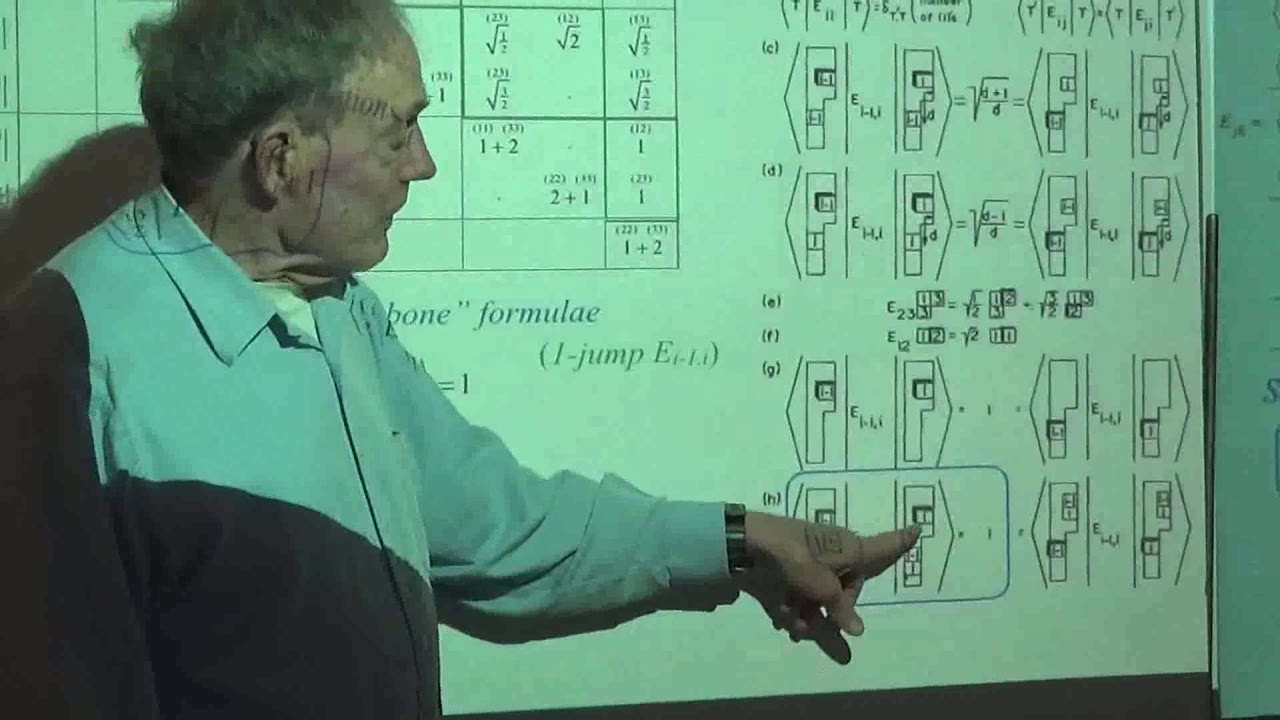
Symmetry Principles for Atomic, Molecular, Optical Physics (2018 Spring) - Lecture #23
Keywords
Summary
173 words
Critical Evaluation
Value of the Information & Strength of the Argument
The lecture provides a detailed and rigorous exposition of advanced techniques in group theory applied to atomic physics. The instructor demonstrates a clear pedagogical approach, breaking down complex calculations into manageable steps and providing justifications for each rule. The argumentation is solid, grounded in established mathematical frameworks such as Young tableaux and Lie algebra. The value lies in the practical demonstration of how to compute matrix elements and construct Hamiltonians for electron repulsion, which is often a challenging topic. The lecture also offers insights into the connection between U(3) symmetry and angular momentum operators, clarifying normalization factors. The presentation is coherent and builds upon previous knowledge, making it a valuable resource for graduate students and researchers in the field.
Scientific Rigor, Source Quality, Title Accuracy
The lecture is scientifically rigorous, with the instructor referencing his own textbooks and course materials, as well as original papers on Young tableaux. The sources cited in the description include the course website and the lecture slides, which provide supplementary material. The title accurately reflects the content, as the lecture indeed covers symmetry principles for atomic, molecular, and optical physics. The presentation is consistent with standard quantum mechanics and group theory, and the instructor’s expertise is evident. No external sources are cited beyond the course materials, but the content is self-contained and based on established principles. The lecture’s technical depth is high, and the instructor takes care to explain the reasoning behind each step, enhancing its reliability.
251 words
Title / Content Match
The title accurately reflects the content: a lecture on symmetry principles applied to atomic, molecular, and optical physics, specifically focusing on Young tableaux and multipole expansions.
Quality & Reliability
8/10
Lecture by a university professor, based on established group theory and quantum mechanics, with references to course materials and original papers. The content is technical and consistent with standard physics, though not peer-reviewed in this format.
Key Moments
Markers derived by PSI from the transcript: the creator did not define chapters.
- Introduction to the lecture's goals: finishing atomic physics and starting molecular analysis.
- Review of Young tableaux for p3 configuration and the doublet representation.
- Explanation of the hook-length rule for calculating matrix elements of elementary operators.
- Detailed calculation of matrix elements for various operators using the tableau method.
- Discussion of commutation relations for double-jump operators and their application.
- Introduction to multipole expansion and Legendre polynomials for electrostatic repulsion.
- Derivation of spherical harmonics via rotation of the multipole axis.
- Application of group multiplication to obtain off-axis multipole expansions.
- Preview of calculating electron repulsion in multi-electron atoms using the developed methods.
- Conclusion and summary of the lecture's key points.
Cited Sources
- Course Website: AMOPWeb — Course materials and resources for the AMOP course.
- Lecture #23 Slides (PDF) — Slides used in the lecture, containing the matrices and derivations discussed.
Concurring Sources
- Course Website: AMOPWeb — Provides course materials and references that align with the lecture content.
Contribution & Novelties
The lecture provides a novel pedagogical approach to teaching symmetry principles in atomic physics by emphasizing the use of Young tableaux for practical calculations. It offers a step-by-step method for computing matrix elements of U(3) generators and constructing the electrostatic repulsion Hamiltonian, which is often a complex topic. The instructor’s technique of using hook-length rules and commutation relations simplifies the process, making it accessible to graduate students. The lecture also clarifies the connection between U(3) symmetry and angular momentum operators, highlighting normalization factors that are often a source of confusion.
Pour aller plus loin :
- Young tableau — Provides background on the combinatorial objects used in representation theory.
- Spherical harmonics — Essential for understanding multipole expansions in quantum mechanics.
- Lie algebra — The mathematical framework underlying the commutation relations used in the lecture.
133 words
Radar Profile
The radar profile shows high scores in technical level and information quality, indicating a dense, advanced lecture. The lower score in information quantity suggests a focused scope, while the high reliability reflects the instructor's expertise and use of established methods.