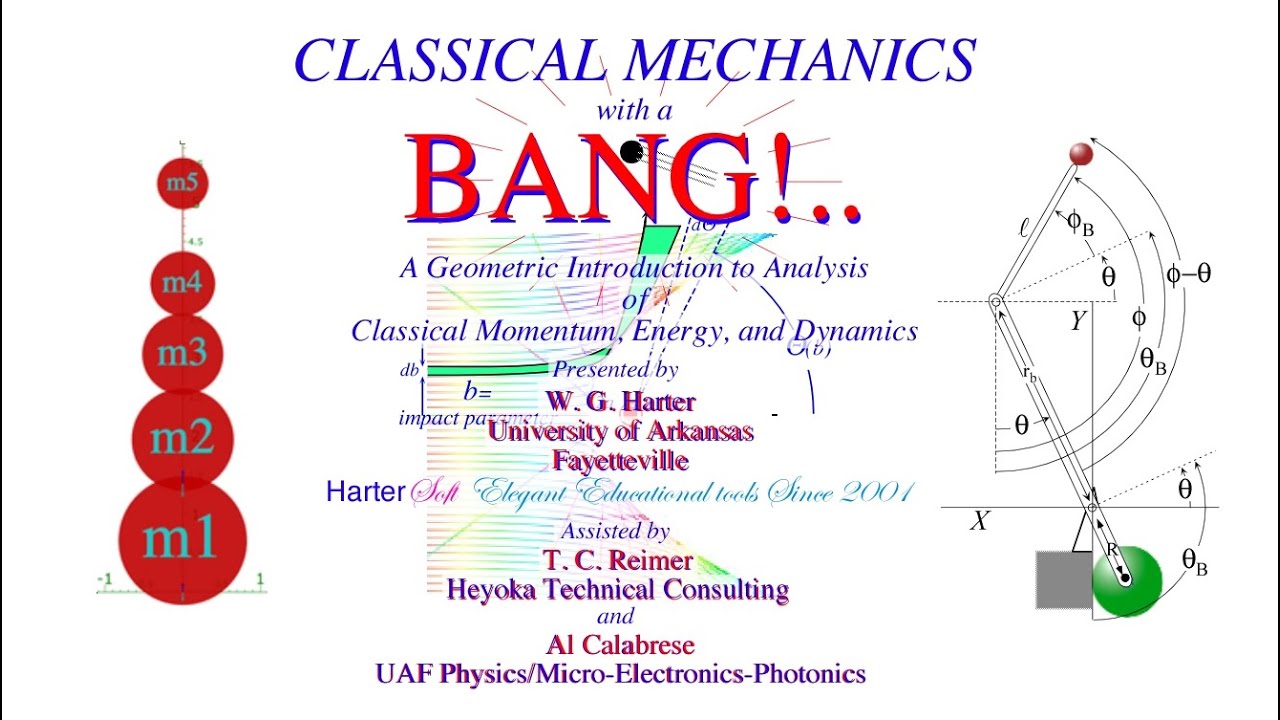
Classical Mechanics with a Bang! - Lecture 24
Keywords
Summary
173 words
Critical Evaluation
Value of the Information & Strength of the Argument
The lecture provides a solid foundation in the theory of harmonic oscillators, with clear derivations and intuitive explanations. The use of phasor diagrams and simulations enhances understanding. The argumentation is logical and builds from simple to more complex concepts, preparing students for advanced topics like resonance and Green’s functions. The professor’s emphasis on the importance of resonance across physics is compelling and well-justified.
Scientific Rigor, Source Quality, Title Accuracy
The lecture is based on the textbook ‘Classical Mechanics with a Bang!’ by Professor Harter, which is a course resource. The mathematical derivations are rigorous and follow standard methods. The title accurately reflects the course’s dynamic approach to classical mechanics. No external sources are cited, but the content is consistent with established physics. The lecture is part of a university course, lending it credibility.
142 words
Title / Content Match
The title 'Classical Mechanics with a Bang!' reflects the course's engaging approach, and this lecture on oscillators and resonance fits the overall theme.
Quality & Reliability
8/10
Lecture by a university professor, part of a graduate course, based on a textbook. The content is mathematically rigorous and pedagogically structured, with derivations and simulations. However, it is a single lecture without external citations or peer review.
Key Moments
Markers derived by PSI from the transcript: the creator did not define chapters.
- Introduction: importance of resonance in physics
- Review of harmonic oscillator and Hooke's law
- Phasor representation and complex exponentials
- Damped harmonic oscillator: equation and solution
- Effect of damping on frequency and amplitude
- Quality factor and five percent solution
- Logarithmic spiral in phase space
- Introduction to forced oscillations and Green's functions
Cited Sources
- Classical Mechanics with a Bang! (textbook) — Course textbook by Professor Harter, referenced throughout the lecture.
Concurring Sources
- Classical Mechanics (Goldstein) — Standard graduate textbook covering similar topics in classical mechanics.
Contribution & Novelties
This lecture provides a clear and intuitive introduction to the theory of harmonic oscillators, emphasizing the geometric approach and the importance of resonance. It offers practical insights such as the five percent solution and the quality factor, which are useful for quick estimations. The lecture also bridges classical and quantum mechanics by highlighting symmetry principles.
Pour aller plus loin :
- Harmonic oscillator — Overview of the harmonic oscillator in classical and quantum mechanics.
- Damping — Detailed explanation of damping and its effects on oscillatory systems.
- Resonance — General concept of resonance and its applications.
- Green’s function — Mathematical tool used to solve forced differential equations.
105 words
Radar Profile
The radar profile shows high scores in quantity, quality, technical level, and reliability, indicating a well-rounded and rigorous lecture. The content is dense and technically advanced, suitable for graduate-level physics students.