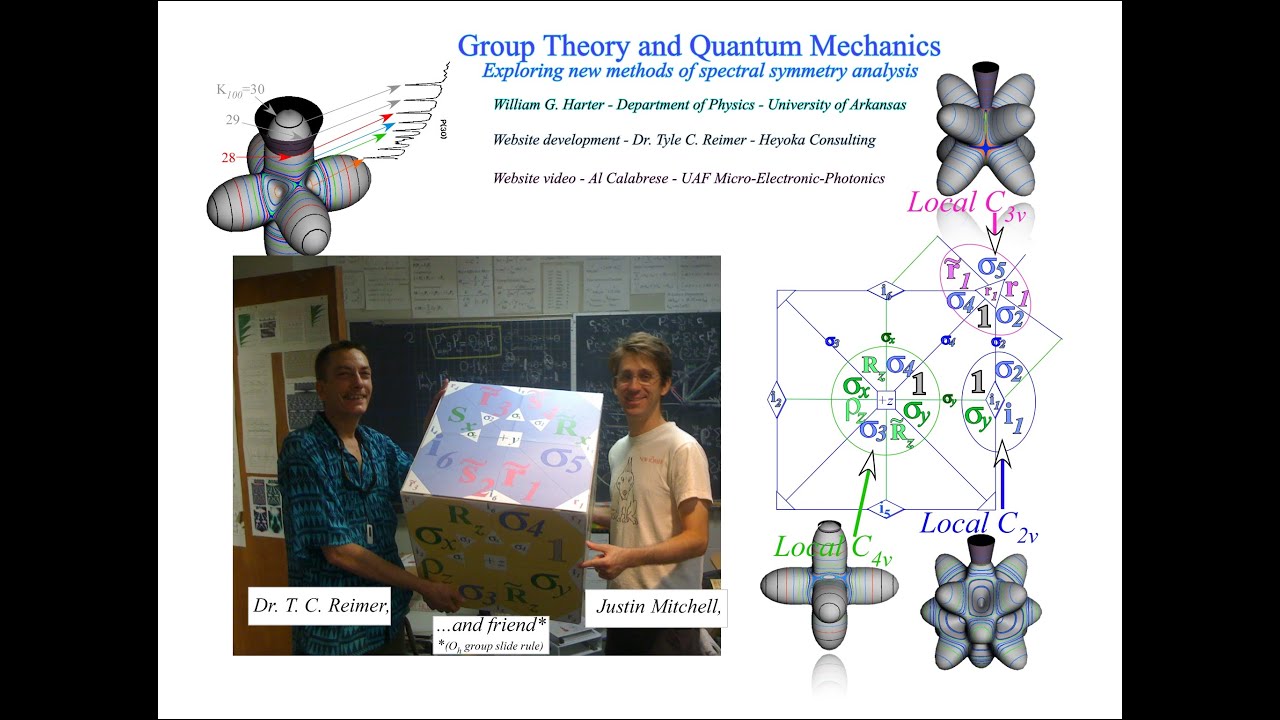
Applications of Group Theory to Physics - Lecture 27-30 (Selected Topics)
Keywords
Summary
172 words
Critical Evaluation
Value of the Information & Strength of the Argument
The lecture provides valuable insights into advanced applications of group theory to molecular physics, particularly in the context of rotational energy surfaces and spin interactions. The instructor’s argumentation is solid, building on established mathematical frameworks and illustrating concepts with physical examples. He emphasizes the physical interpretation of mathematical constructs, which aids understanding. The presentation is coherent and well-structured, though it assumes a strong background in quantum mechanics and group theory.
Scientific Rigor, Source Quality, Title Accuracy
The lecture is based on the instructor’s own textbooks and course materials, which are referenced in the video description. The sources are authoritative within the field, but the video itself does not cite external sources beyond these. The title accurately reflects the content, which is a selection of topics from lectures 27-30. The lecture is rigorous in its mathematical derivations and physical interpretations, though it is a recording of a live lecture and may contain minor errors or omissions.
164 words
Title / Content Match
The title accurately reflects the content: a selection of topics from lectures 27-30 on applications of group theory to physics.
Quality & Reliability
8/10
Lecture by a professor with deep expertise in group theory and molecular physics, based on his own textbooks and course materials. The content is advanced and mathematically rigorous, but the video is a recording of a lecture with limited production quality and no external verification of claims.
Key Moments
Markers derived by PSI from the transcript: the creator did not define chapters.
- Introduction and overview of the lecture topics.
- Review of lecture 27: color mixing on rotational energy surfaces.
- Discussion of extrinsic vs intrinsic symmetry breaking.
- Introduction to the gyro rotor concept.
- Classical analysis of gyro rotor dynamics.
- Semi-classical treatment and rotational eigenvalue surfaces.
- Examples of gyro rotor spectra and clusters.
- Preview of magic squares and conclusion.
Cited Sources
- Course Web site — Course materials and additional content.
- Lecture 27 slides — Slides for lecture 27.
- Lecture 28 slides — Slides for lecture 28.
- Lecture 29 slides — Slides for lecture 29.
- Lecture 30 slides — Slides for lecture 30.
Concurring Sources
- Quantum Theory in the Computer Age — Textbook by the instructor, likely covering similar material.
- Principles of Symmetry, Dynamics, and Spectroscopy — Another textbook by the instructor, likely covering similar material.
Contribution & Novelties
This lecture provides a unique perspective on the application of group theory to molecular physics, particularly through the use of rotational energy surfaces and the introduction of the gyro rotor concept. The instructor’s approach of treating mathematical analysis as a consequence of physical reality is pedagogically valuable. The lecture also introduces the concept of rotational eigenvalue surfaces, which extend traditional energy surfaces to include spin interactions, offering new insights into molecular dynamics.
Pour aller plus loin :
- Group theory — Foundational mathematical framework used throughout.
- Rotational spectroscopy — Directly related to the study of molecular rotations.
- Wigner D-matrix — Relevant to the representation of rotations in quantum mechanics.
108 words
Radar Profile
The radar profile shows high scores in all dimensions, indicating a technically dense and reliable lecture. The quantity of information is high, but the technical level may be too advanced for a general audience. The overall quality is strong, with a slight dip in accessibility.