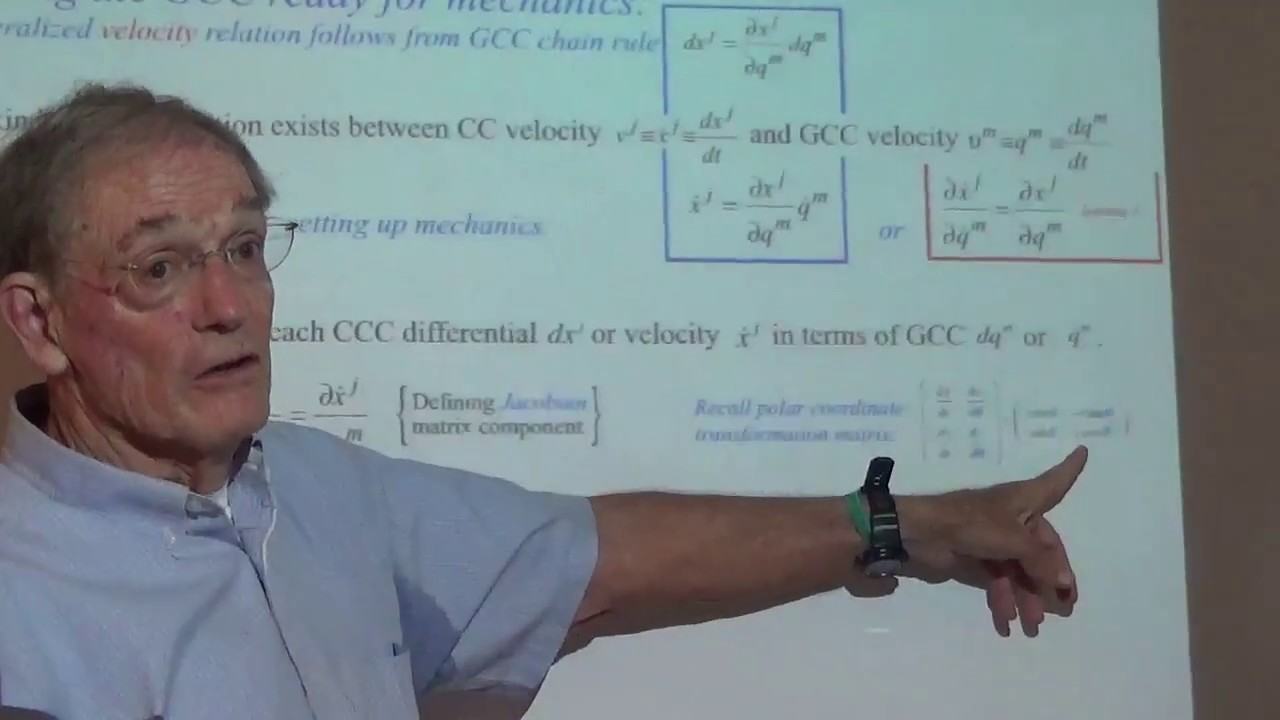
Classical Mechanics with a Bang! (2017 Fall) - Lecture #9
Keywords
Summary
142 words
Critical Evaluation
Value of the Information & Strength of the Argument
The lecture provides a thorough and rigorous derivation of Lagrange’s equations, emphasizing the mathematical structure and geometric interpretation. The argumentation is solid, building step-by-step from coordinate transformations to the final equations. The instructor clarifies common pitfalls, such as the need for constant mass tensor and the independence of coordinates. The value lies in the deep understanding it offers for advanced mechanics, preparing students for quantum mechanics and relativity.
Scientific Rigor, Source Quality, Title Accuracy
The lecture is scientifically rigorous, with clear derivations and references to the course textbook and website. The title accurately describes the content. The sources cited are the course website and the lecture slides, which are appropriate for a graduate course. The lecture is part of a structured course, ensuring reliability.
133 words
Title / Content Match
The title accurately reflects the content, which is a lecture on classical mechanics with a focus on generalized coordinates and Lagrangian mechanics.
Quality & Reliability
8/10
Lecture by a professor, part of a graduate course, with clear mathematical derivations and references to course materials. The content is rigorous and well-structured, though it is a lecture and not peer-reviewed.
Key Moments
Markers derived by PSI from the transcript: the creator did not define chapters.
- Introduction to the lecture and overview of topics: generalized coordinates, Lagrange's equations.
- Review of Hamiltonian and Lagrangian formulations, focusing on the first equations.
- Introduction to polar coordinates as an example of curvilinear coordinates.
- Explanation of the Jacobian matrix and its inverse for coordinate transformations.
- Derivation of lemma 1: velocity Jacobian.
- Derivation of lemma 2: acceleration lemma.
- Setting up Newton's second law in generalized coordinates.
- Derivation of Lagrange's equations using the product rule and independence of coordinates.
- Introduction of potential energy and definition of the Lagrangian.
- Final form of Lagrange's equations and discussion of conserved momentum.
Cited Sources
- Course Website: Classical Mechanics with a Bang! — Course materials and information.
- Lecture #9 Slides (PDF) — Slides used in this lecture.
Concurring Sources
- Classical Mechanics (Goldstein et al.) — Standard textbook covering Lagrangian mechanics.
Contribution & Novelties
This lecture provides a clear and detailed derivation of Lagrange’s equations using generalized coordinates, emphasizing the geometric interpretation and the role of the Jacobian. It is particularly valuable for students transitioning from Newtonian to Lagrangian mechanics.
Pour aller plus loin :
- Lagrangian mechanics — Overview of the Lagrangian formulation.
- Generalized coordinates — Definition and examples.
- Jacobian matrix and determinant — Mathematical background.
62 words
Radar Profile
The radar profile shows high scores in technical level and information quality, indicating a rigorous and detailed lecture. The quantity of information is also high, but the accessibility may be limited to advanced students.