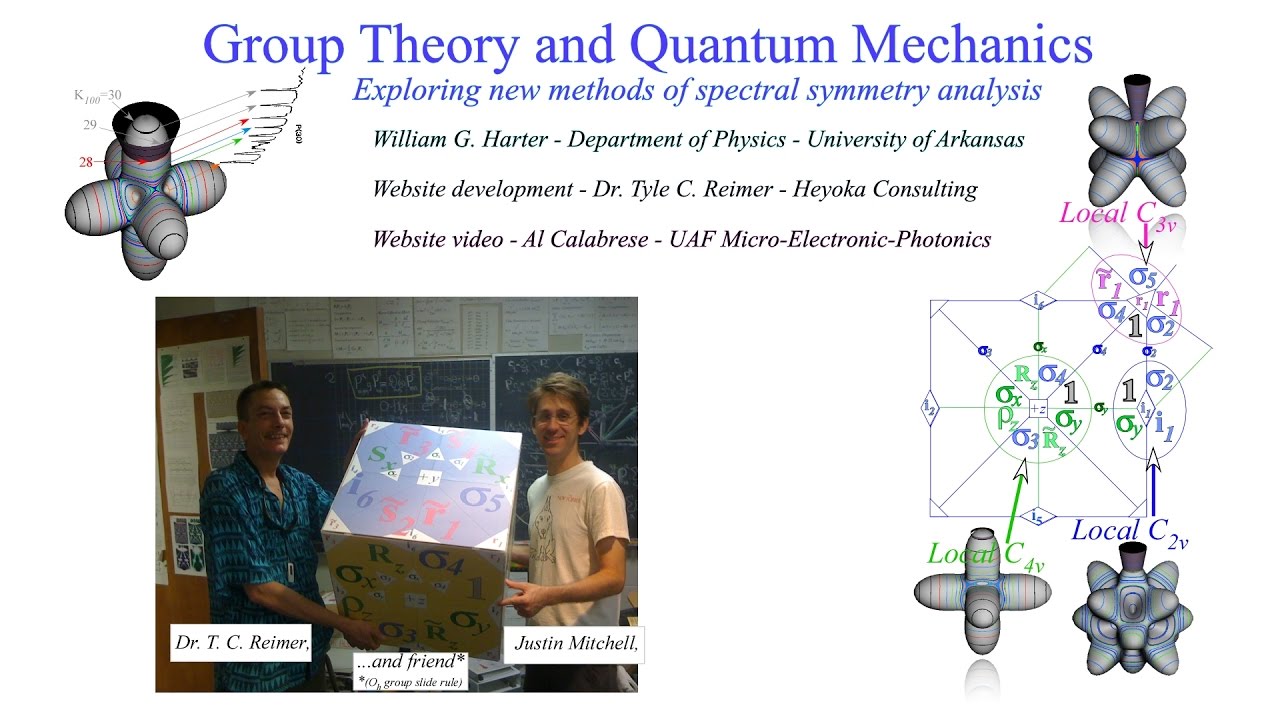
Group Theory in Quantum Mechanics (2017 Sp) - Lecture #27
Keywords
Summary
134 words
Critical Evaluation
Value of the Information & Strength of the Argument
The lecture provides valuable insights into the application of group theory to quantum mechanics, a topic that is often abstract but here is presented with a focus on physical intuition. The argumentation is based on established mathematical frameworks and physical principles, and the professor’s expertise lends credibility. The approach of deriving mathematics from physics is pedagogically sound and helps in understanding the material. However, the garbled transcription limits the ability to fully assess the depth of the argumentation.
Scientific Rigor, Source Quality, Title Accuracy
The lecture is rigorous, drawing from well-established textbooks and the professor’s own research. The sources cited are the course textbooks and the course website, which are reliable academic resources. The title accurately reflects the content. The lecture is part of a structured course, indicating careful preparation. The transcription quality is poor, but this is a technical issue rather than a reflection of the content’s rigor.
158 words
Title / Content Match
The title accurately reflects the content, which is a lecture on group theory applied to quantum mechanics.
Quality & Reliability
8/10
Lecture by a professor with expertise in the field, based on established textbooks and course materials. The content is advanced and mathematically rigorous, but the transcription is garbled, limiting direct verification.
Key Moments
Markers derived by PSI from the transcript: the creator did not define chapters.
- Introduction and overview of the lecture topic.
- Discussion of symmetry operations and their mathematical representation.
- Introduction to group representation theory and its relevance to quantum mechanics.
- Application of group theory to molecular spectroscopy.
- Examples of symmetry analysis in atomic systems.
- Discussion of Fourier analysis in the context of group theory.
- Advanced topics in representation theory.
- Summary and concluding remarks.
Cited Sources
- Course Web site — Course materials and additional content.
- Lecture #27 slide presentation (pdf) — Slides used in this lecture.
Concurring Sources
- Quantum Theory in the Computer Age — Textbook by William Harter, used in the course.
- Principles of Symmetry, Dynamics, and Spectroscopy — Textbook by William Harter, used in the course.
Contribution & Novelties
This lecture provides a comprehensive overview of group theory applications in quantum mechanics, with a unique pedagogical approach that emphasizes physical intuition over abstract mathematics. The course materials are openly available, making it a valuable resource for graduate students and researchers.
Pour aller plus loin :
- Group representation theory — Foundational concept for understanding the lecture.
- Molecular symmetry — Directly related to applications in spectroscopy.
- Fourier analysis — Used in the lecture for symmetry analysis.
75 words
Radar Profile
The radar profile shows high scores in technical level and information quantity, indicating a dense, advanced lecture. The quality and reliability scores are also high, reflecting the academic rigor. The overall balance suggests a content-rich resource for experts.