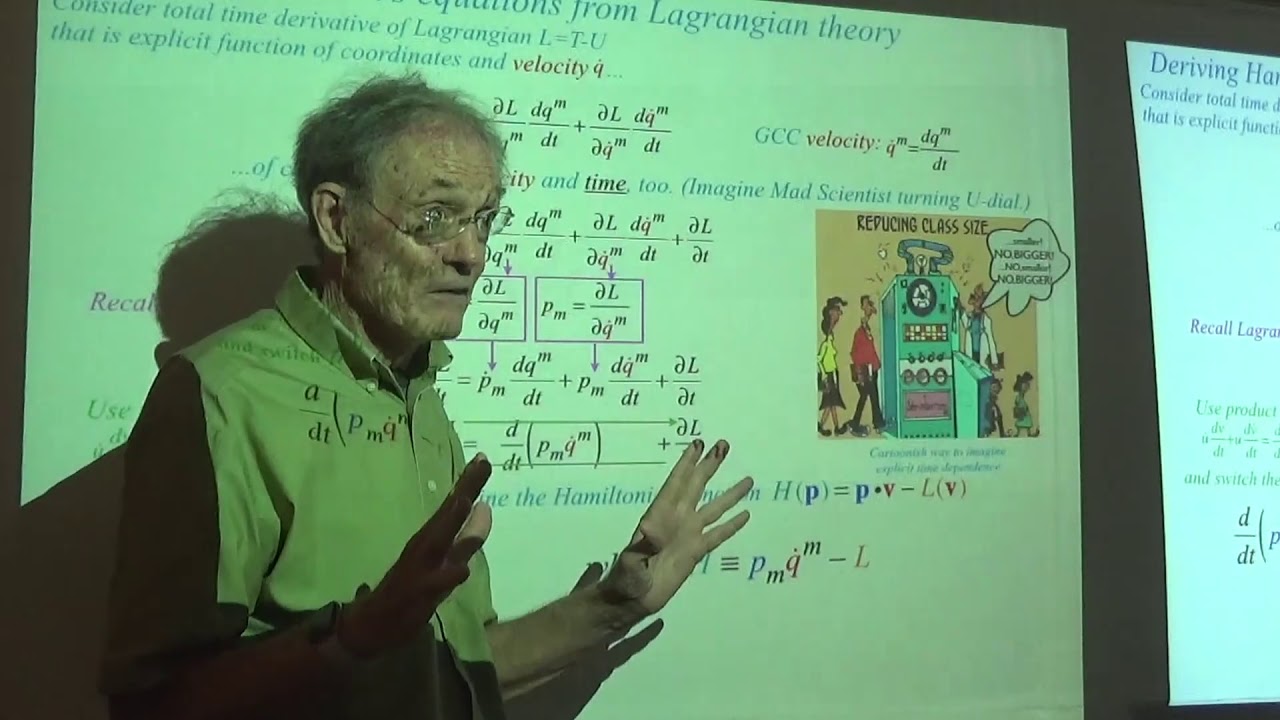
Classical Mechanics with a Bang! (2019 Fall) - Lecture #10
Keywords
Summary
148 words
Critical Evaluation
Value of the Information & Strength of the Argument
The lecture provides a thorough and rigorous exposition of Hamiltonian mechanics, with a clear emphasis on the geometric interpretation and the algebraic manipulations involved. The instructor demonstrates the derivation of Hamilton’s equations step by step, making the material accessible to graduate students. The argumentation is solid, as it builds on previously established concepts and shows the practical utility of the Hamiltonian approach through examples like the effective potential and numerical integration. The value of the information is high for students seeking a deep understanding of classical mechanics, as it clarifies the differences between Lagrangian and Hamiltonian formulations and their respective strengths.
Scientific Rigor, Source Quality, Title Accuracy
The lecture is scientifically rigorous, based on well-established principles of classical mechanics. The instructor references the course textbook and provides supplementary materials, including slides and a course website, which enhance the credibility of the content. The title accurately reflects the content, as the lecture indeed covers classical mechanics with a focus on Hamiltonian methods. The presentation is well-structured, and the instructor’s expertise is evident. However, as a lecture, it does not include citations to external research, but it is consistent with standard physics education.
200 words
Title / Content Match
The title accurately reflects the content, which is a lecture on classical mechanics with a focus on Hamiltonian mechanics and geometric approaches.
Quality & Reliability
8/10
Lecture by a university professor, part of a graduate course, with a clear pedagogical structure and references to course materials. The content is based on established physics theory, and the presentation is rigorous, though it is a lecture rather than peer-reviewed research.
Key Moments
Markers derived by PSI from the transcript: the creator did not define chapters.
- Introduction to the lecture, mentioning the Irish connection and the plan to discuss Hamiltonian mechanics.
- Review of the Lagrangian and the derivation of Hamilton's equations from the chain rule.
- Application of Hamilton's equations to polar coordinates, deriving the equations of motion.
- Discussion of the effective potential and its role in simplifying problems with conserved angular momentum.
- Reduction of the radial motion to a quadrature and explanation of the term 'quadrature'.
- Comparison of Hamiltonian and Lagrangian methods for numerical integration, highlighting the advantages of Hamilton's equations.
- Preview of future topics, including the Hamilton-Jacobi equation and applications to oscillators and the Coulomb potential.
Cited Sources
- Course Web site — Course materials and information for the Advanced Mechanics course.
- Lecture #10 slide presentation (pdf) — Slides used in this lecture, providing detailed derivations and examples.
Concurring Sources
- Classical Mechanics (Goldstein) — Standard textbook covering Hamiltonian mechanics and its applications.
Contribution & Novelties
This lecture provides a clear and detailed exposition of Hamiltonian mechanics, emphasizing its geometric interpretation and practical advantages over the Lagrangian approach. The instructor’s method of deriving Hamilton’s equations from the Lagrangian and applying them to polar coordinates offers a valuable pedagogical contribution. The discussion of the effective potential and the reduction to quadrature are particularly insightful, as they highlight the power of Hamiltonian methods in simplifying complex problems.
Pour aller plus loin :
- Hamiltonian mechanics — Overview of Hamiltonian mechanics and its applications.
- Effective potential — Explanation of the effective potential concept in classical mechanics.
- Quadrature (mathematics) — Definition and historical context of quadrature in mathematics.
107 words
Radar Profile
The radar profile shows high scores in all dimensions, indicating a lecture that is information-dense, technically rigorous, and reliable. The balance between quantity and quality of information is strong, with a slight emphasis on technical depth, making it suitable for advanced students.