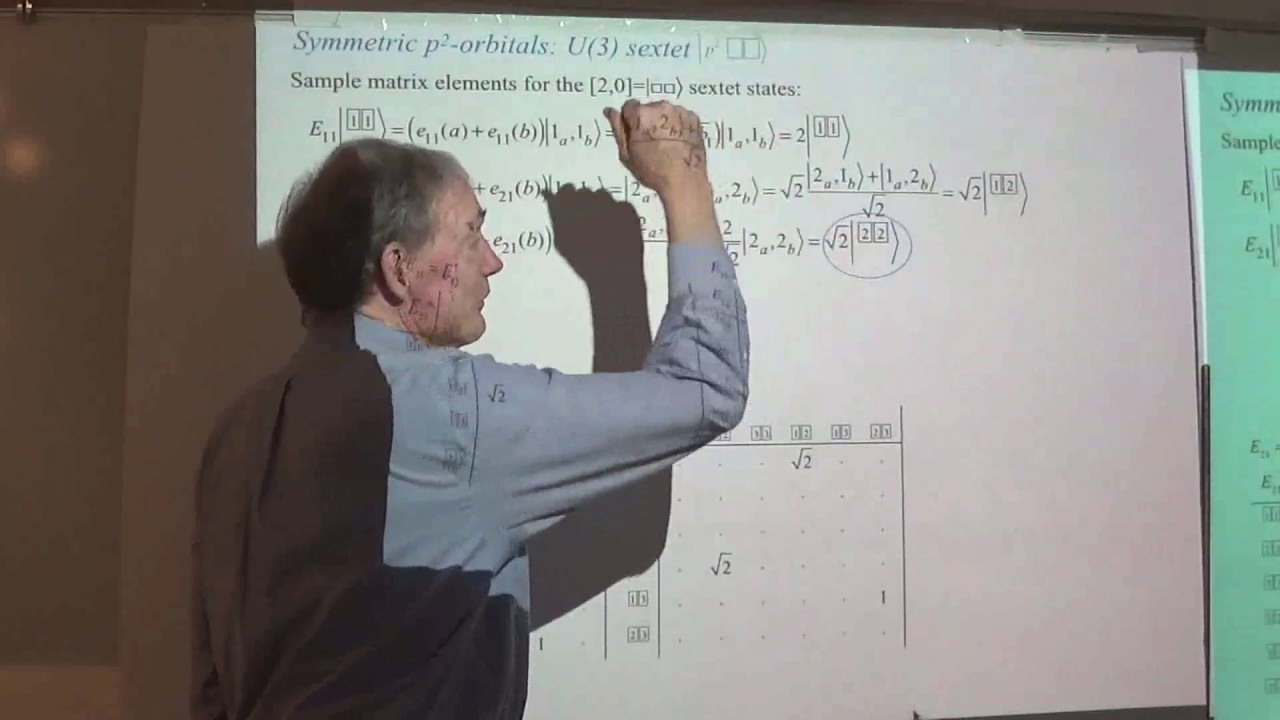
Symmetry Principles for Atomic, Molecular, Optical Physics (2018 Spring) - Lecture #22
Keywords
Summary
149 words
Critical Evaluation
Value of the Information & Strength of the Argument
The lecture provides a rigorous and detailed exposition of the use of U(3) symmetry in atomic physics. The argumentation is solid, built on step-by-step derivations and explicit calculations. The instructor demonstrates the power of the tableau method in simplifying complex many-body problems, and the logical flow from elementary operators to irreducible representations is clear. The value lies in the deep insight into the mathematical structure underlying atomic shell theory, which is often not covered in standard textbooks. The lecture also highlights the pedagogical approach of using symmetry to unify various aspects of quantum mechanics.
Scientific Rigor, Source Quality, Title Accuracy
The lecture is scientifically rigorous, with careful derivations and references to course materials. The instructor cites his own textbooks and course website, which are authoritative for the subject. The title accurately reflects the content, which is a specialized lecture on symmetry principles. The sources are appropriate for a graduate-level course, though they are not peer-reviewed publications. The lecture is part of a series, and the content is consistent with the course structure.
181 words
Title / Content Match
The title accurately describes the lecture content, which focuses on symmetry principles applied to atomic and molecular physics.
Quality & Reliability
8/10
The lecture is part of a graduate course by a recognized professor, with detailed derivations and references to course materials. The content is mathematically rigorous and internally consistent, though not peer-reviewed.
Key Moments
Markers derived by PSI from the transcript: the creator did not define chapters.
- Introduction to the lecture topic: U(3) symmetry and tableau method for atomic shells.
- Review of elementary operators and commutation relations for U(3).
- Definition of creation and destruction operators and their relation to elementary operators.
- Derivation of matrix elements for elementary operators acting on symmetrized states.
- Construction of the diagonalizing transform using projectors from permutation group analysis.
- Application to the p-shell configuration of carbon and discussion of the U(3) model.
- Discussion of the connection between U(3) and SU(2) spin algebra.
- Introduction of the tableau method for simplifying many-particle calculations.
- Detailed example of matrix element calculation using the tableau method.
- Summary and outlook for future lectures.
Cited Sources
- AMOP Course Website — Course website for the AMOP graduate course, containing lecture materials and resources.
- Lecture #22 Slide Presentation (PDF) — PDF slides for this specific lecture, used by the instructor during the presentation.
Concurring Sources
- Quantum Theory for the Computer Age — One of the textbooks by Prof. Harter used in the course, providing detailed derivations of the symmetry principles.
- Principles of Symmetry, Dynamics, and Spectroscopy — Another textbook by Prof. Harter, covering related topics in symmetry and spectroscopy.
Contribution & Novelties
This lecture provides a detailed and pedagogical exposition of the application of U(3) symmetry to atomic shell theory, specifically using the tableau method. The instructor’s approach emphasizes the use of elementary operators and commutation relations to build matrix elements, offering a clear and systematic method that is often not presented in standard textbooks. The lecture also highlights the connection between unitary group representations and permutation symmetry, providing a deeper understanding of the underlying mathematical structure.
Pour aller plus loin :
- Lie group — Provides background on Lie groups, which are fundamental to the symmetry principles discussed.
- Representation theory of SU(2) — Relevant for understanding the connection between U(3) and SU(2) spin algebra.
- Atomic orbital — Background on atomic orbitals, which are the physical context for the p-shell configuration discussed.
129 words
Radar Profile
The radar profile shows high scores in information quality and technical level, indicating a dense and rigorous lecture. The quantity of information is also high, but the global reliability is slightly lower due to the lack of peer review. Overall, the lecture is highly specialized and suitable for advanced students.