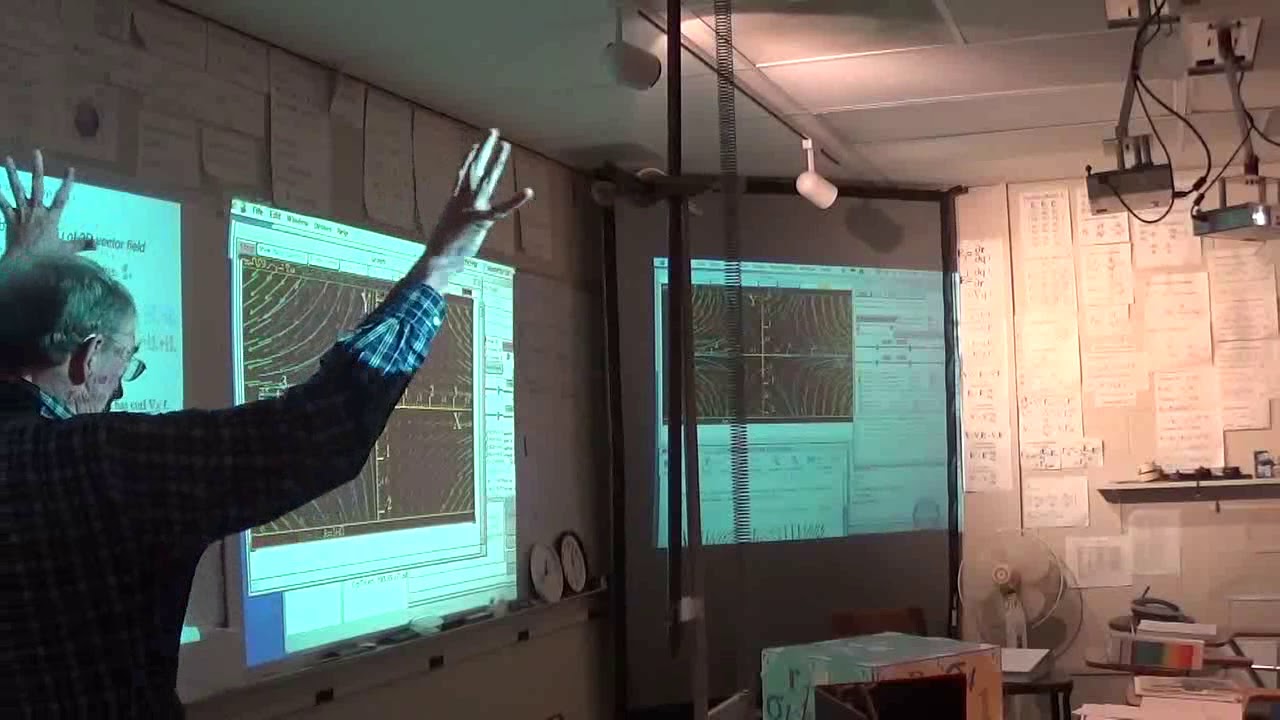
Classical Mechanics with a Bang! (2017 Fall) - Lecture #13 w/ processed audio
Keywords
Summary
157 words
Critical Evaluation
Value of the Information & Strength of the Argument
The lecture provides a deep and rigorous mathematical treatment of vector fields using complex analysis, which is a valuable perspective for understanding classical mechanics. The argumentation is logical and builds step by step, starting from basic definitions and progressing to more complex concepts like multipole expansion. The instructor uses visual aids and examples to illustrate abstract ideas, making the content more accessible. However, the presentation is dense and assumes a strong background in both physics and mathematics, which may limit its audience. The value lies in the unique geometric approach that connects classical and quantum mechanics, as mentioned in the course description.
Scientific Rigor, Source Quality, Title Accuracy
The lecture is based on the instructor’s own textbook ‘Classical Mechanics with a Bang!’ and is part of a structured course. The slides are available online, providing additional resources. The title accurately reflects the content, as it is a lecture on classical mechanics with a focus on geometric methods. The scientific rigor is high, with careful derivations and references to figures in the textbook. However, the video has very few views and no comments, so there is no external validation from the audience. The sources cited are the course website and the lecture slides, which are directly relevant.
215 words
Title / Content Match
The title accurately reflects the content: a lecture on classical mechanics with a geometric approach, part of a series.
Quality & Reliability
8/10
Lecture by a university professor, based on a textbook and accompanied by slides. The content is mathematically rigorous, but the audio quality is processed and the video has very low viewership, limiting external validation.
Key Moments
Markers derived by PSI from the transcript: the creator did not define chapters.
- Introduction and overview of the lecture topics.
- Review of complex derivatives and their relation to divergence and curl.
- Discussion of source-free fields and the complex potential.
- Example of f(z)=z generating a quadrupole field.
- Comparison of fields with and without conjugation.
- Introduction to the monopole field and its properties.
- Explanation of the logarithmic potential and its multi-valued nature.
- Derivation of the dipole field from the monopole via differentiation.
- Discussion of higher-order multipoles and their physical significance.
- Preview of non-analytic sources and curvilinear coordinates.
Cited Sources
- Course Web site — Official course website with resources and materials.
- Lecture #13 slides (PDF) — Slides used in this lecture, providing visual aids and derivations.
Concurring Sources
- Classical Mechanics with a Bang! (textbook) — The textbook on which the course is based, providing consistent material.
Contribution & Novelties
The lecture offers a unique geometric perspective on classical mechanics, using complex analysis to unify concepts like divergence, curl, and potential. It demonstrates how simple analytic functions can generate complex physical fields, and introduces the multipole expansion as a natural consequence of differentiation. This approach provides a deeper understanding of symmetry principles that also apply to quantum theory.
Pour aller plus loin :
- Complex analysis — Foundational for the methods used in the lecture.
- Multipole expansion — Directly related to the derivation of higher-order fields.
- Conformal map — The geometric transformations underlying the field representations.
95 words
Radar Profile
The radar profile shows high scores in technical level and information quality, indicating a dense and rigorous lecture. The quantity of information is also high, but the overall accessibility may be limited due to the advanced nature. The balance between theoretical depth and practical examples is skewed towards theory.