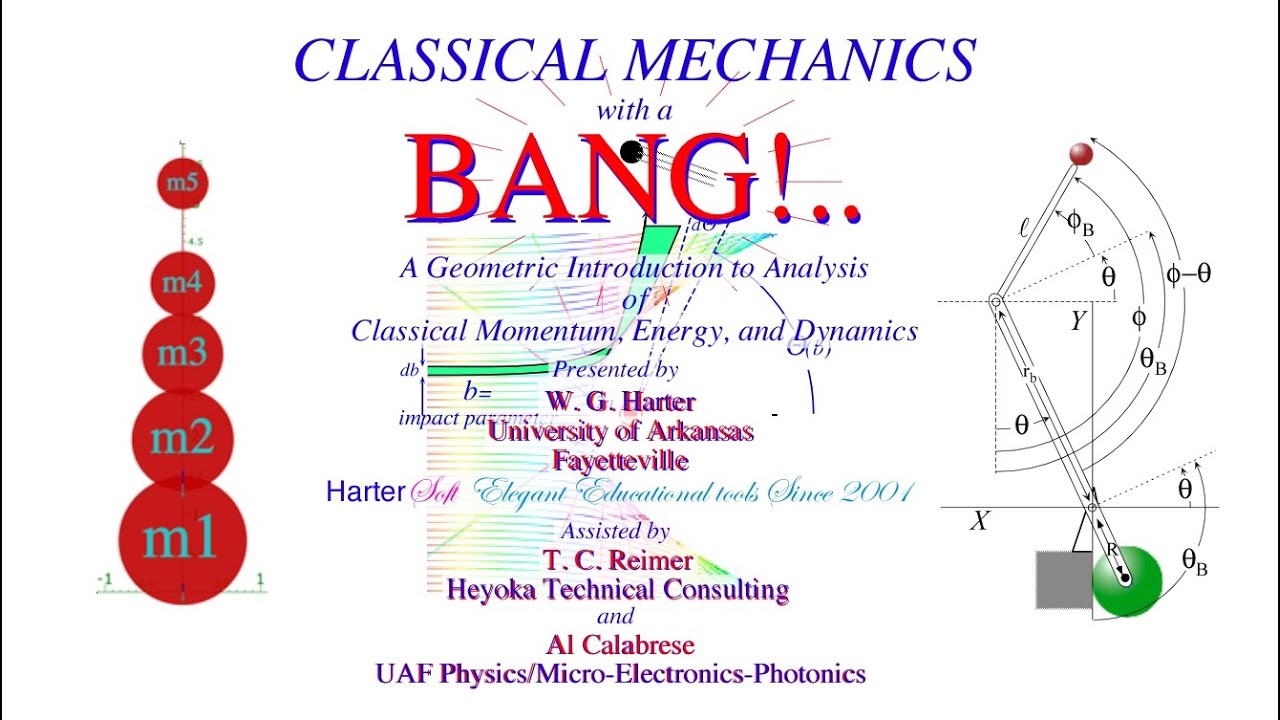
Classical Mechanics with a Bang! - Lecture 27
Keywords
Summary
172 words
Critical Evaluation
Value of the Information & Strength of the Argument
The lecture provides valuable insights into parametric resonance and its connection to quantum mechanics. The argumentation is solid, with clear mathematical derivations and physical demonstrations. The professor effectively uses analogies to bridge classical and quantum concepts, enhancing understanding. The discussion of stability bands and inverted pendulum states is particularly illuminating, showing how classical systems can exhibit quantum-like behavior.
Scientific Rigor, Source Quality, Title Accuracy
The lecture is scientifically rigorous, with careful mathematical treatment and references to standard concepts like the Mathieu equation and band theory. The title accurately reflects the content. No external sources are cited, but the lecture is based on the textbook ‘Classical Mechanics with a Bang!’ by the same author. The presentation is clear and well-structured, though the informal style and occasional tangents may reduce formality.
138 words
Title / Content Match
The title accurately reflects the content, which focuses on classical mechanics with a geometric approach, including parametric resonance and band theory analogies.
Quality & Reliability
8/10
Lecture from a university physics course, presented by a professor with clear mathematical derivations and connections to quantum mechanics. The content is rigorous and well-structured, though the video is a raw lecture with no editing or additional verification.
Key Moments
Markers derived by PSI from the transcript: the creator did not define chapters.
- Introduction to linear vs. parametric resonance
- Demonstration of parametric resonance with a pendulum
- Discussion of the Mathieu equation and band theory analogy
- Matrix eigenvalue problem for band structure
- Numerical results showing energy bands and gaps
- Stability of inverted pendulum states and practical examples
- Connection to quantum mechanics and symmetry analysis
Cited Sources
- Classical Mechanics with a Bang! — Textbook by William Harter used for the course
Concurring Sources
- Classical Mechanics with a Bang! — The lecture is based on this textbook, providing consistent content.
Contribution & Novelties
The lecture offers a unique geometric approach to classical mechanics, emphasizing the analogy between parametric resonance and quantum band theory. It provides a fresh perspective on stability phenomena and demonstrates the power of symmetry analysis. The connection between a driven pendulum and the Schrödinger equation is particularly insightful, offering a tangible classical analog to quantum concepts.
Pour aller plus loin :
- Mathieu equation — The differential equation central to parametric resonance.
- Band theory — Explains energy bands and gaps in solids.
- Parametric oscillator — General concept of parametric excitation.
89 words
Radar Profile
The radar profile shows high scores in quantity and technical level, indicating a dense, advanced lecture. Quality and reliability are also strong, but the informal delivery and lack of external citations slightly reduce the overall reliability score.