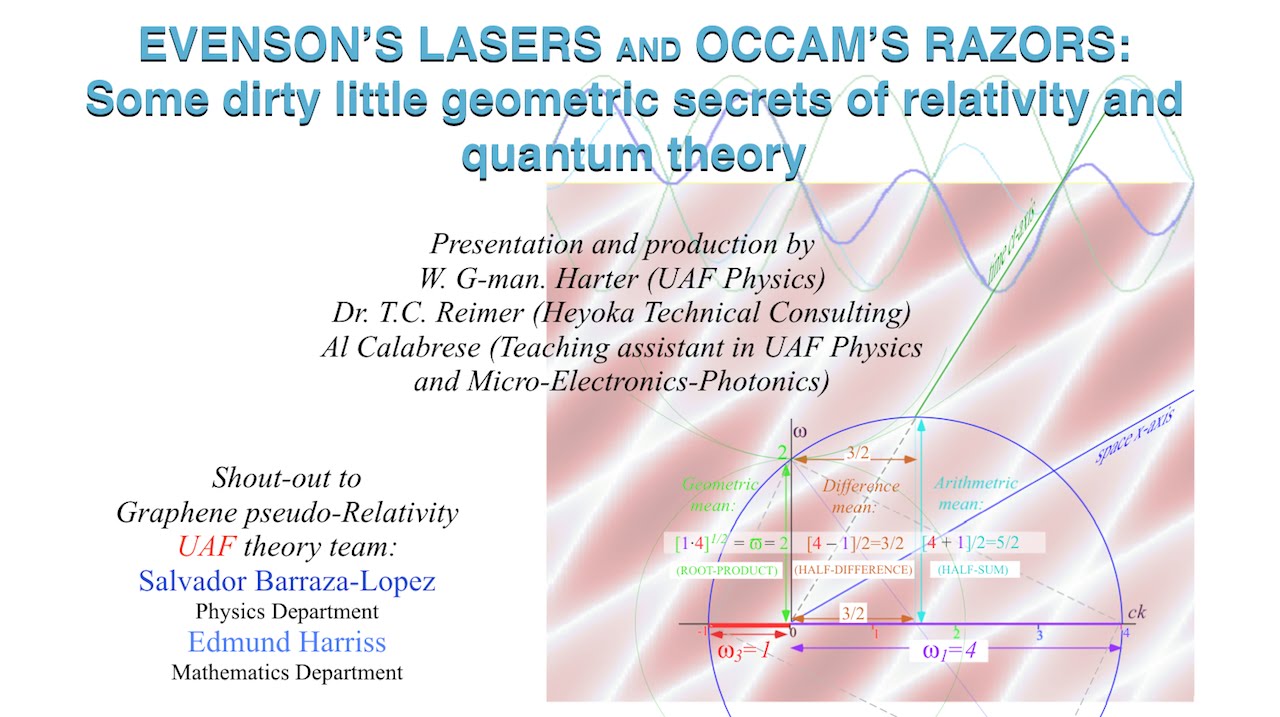
EVENSON’S LASERS AND OCCAM’S RAZORS: Some dirty little geometric secrets of relativity and quantum theory
Keywords
Summary
143 words
Critical Evaluation
Value of the Information & Strength of the Argument
The talk offers a valuable and original perspective on the foundations of relativity and quantum mechanics, arguing that a geometric approach based on continuous wave light can simplify and clarify these theories. The argumentation is logically structured, starting with the failure of Galilean relativity and the need for a new axiom, then developing the concept of inverse space-time and using it to derive Doppler shifts and quantization. The speaker effectively uses analogies and visual aids to make complex ideas accessible, and he supports his claims with references to his own publications and to the work of Evenson. However, the argumentation is not a formal proof but rather a pedagogical proposal, and some steps rely on intuitive leaps rather than rigorous derivations. The talk is thought-provoking and could be valuable for physics educators and researchers interested in alternative formulations.
Scientific Rigor, Source Quality, Title Accuracy
The scientific rigor is high: the speaker is a physics professor with a PhD, and the content is based on his own research and publications, as well as on the work of Kenneth Evenson, a metrologist known for precise laser frequency measurements. The sources cited include the speaker’s own draft book and presentation slides, which are available on the University of Arkansas website. The title accurately reflects the content, focusing on Evenson’s lasers and the application of Occam’s razor to reveal geometric secrets. The talk is not peer-reviewed, but it is a colloquium presentation, which implies a certain level of academic scrutiny. The supplementary resources provided are credible and directly related to the talk. No comments were provided for analysis.
273 words
Title / Content Match
The title accurately reflects the content: the talk discusses Evenson's laser experiments and applies Occam's razor to simplify the geometric foundations of relativity and quantum mechanics.
Quality & Reliability
8/10
The talk is given by a physics professor (William Harter) with a PhD and extensive experience, and it is based on published work and presentations available on university websites. The content is mathematically rigorous and internally consistent, though it presents a non-standard pedagogical approach. The sources are academic and credible, but the talk is not peer-reviewed and contains some personal interpretations.
Key Moments
Markers derived by PSI from the transcript: the creator did not define chapters.
- Introduction of the speaker by a colleague, highlighting his career and contributions.
- Harter introduces the topic: using Occam's razor to simplify relativity and quantum mechanics via geometry.
- Discussion of the pulse-wave axiom and its limitations, introducing the continuous wave (CW) axiom.
- Introduction of inverse space-time (frequency and wave number) as a 'keyboard of the gods'.
- Explanation of wave speed as slope in inverse space-time, and the concept of rapidity.
- Demonstration of Doppler shift using rapidity and the geometric nature of light.
- Discussion of quantization as a consequence of confining waves, and the role of wave number quantization.
- Presentation of the unified geometric approach and its potential for new research avenues.
- Conclusion and invitation to explore supplementary materials.
Cited Sources
- Presentation slides — Slides used during the colloquium, containing the visual aids and derivations.
- INBRE 2014 Workshop portal page — Portal page for a related workshop, providing additional resources.
- Special Relativity and Quantum Theory by Ruler and Compass (Draft) — Draft book by Harter that expands on the geometric approach presented in the talk.
Concurring Sources
- Special Relativity and Quantum Theory by Ruler and Compass (Draft) — The draft book expands on the ideas presented in the talk, providing more detailed derivations.
Contribution & Novelties
The talk presents a novel pedagogical approach that unifies special relativity and quantum mechanics through a geometric framework based on continuous wave light. It simplifies the axioms by replacing the pulse-wave axiom with a CW axiom, and uses inverse space-time to derive key concepts such as Doppler shift and quantization. This approach could make these theories more accessible to students and may offer new research perspectives.
Pour aller plus loin :
- Special relativity — Overview of the theory.
- Quantum mechanics — Overview of the theory.
- Occam’s razor — Principle of simplicity.
- Kenneth Evenson — Physicist known for laser frequency measurements.
- Rapidity — Concept used in relativity.
106 words
Radar Profile
The radar profile shows high scores in information quantity, quality, technical level, and reliability, indicating a dense and rigorous presentation. The talk is highly technical and aimed at an audience with a strong physics background, which is reflected in the high technical level score.