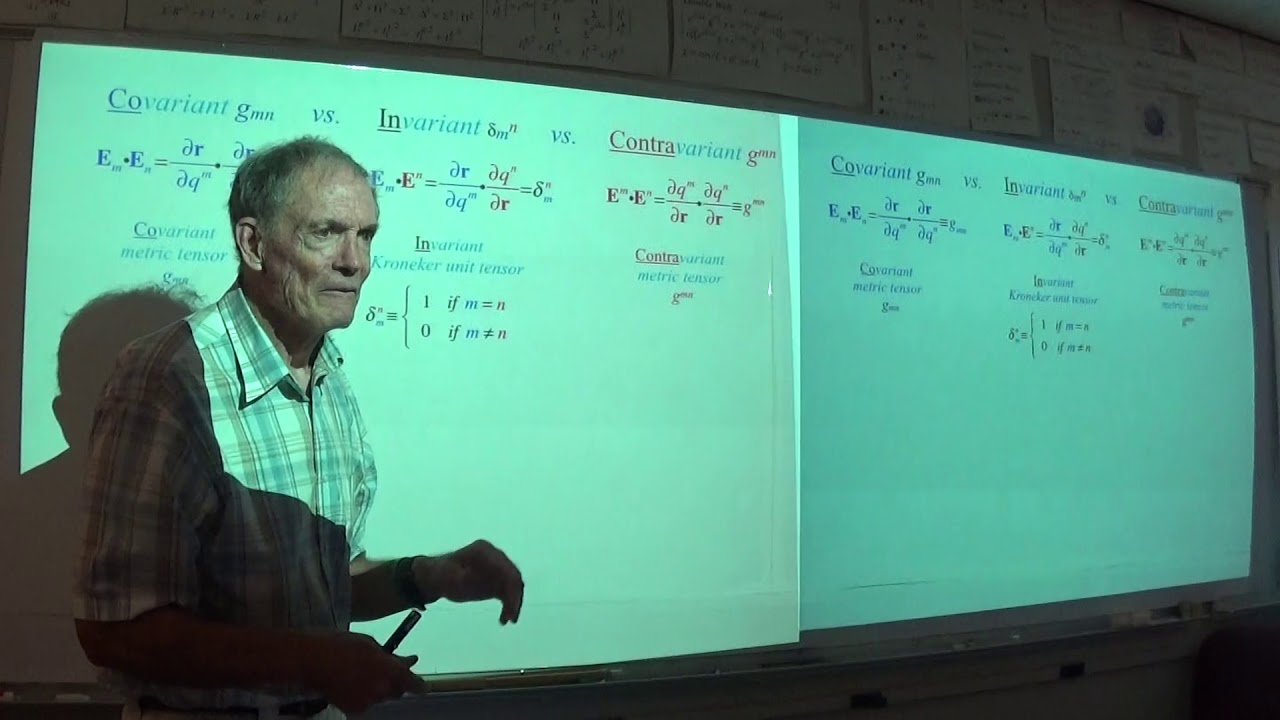
Classical Mechanics with a Bang! (2018 Fall) - Lecture #9 Part 2/2
Keywords
Summary
143 words
Critical Evaluation
Value of the Information & Strength of the Argument
The lecture provides a clear and rigorous derivation of the Lagrangian formalism in curvilinear coordinates, emphasizing the geometric meaning of covariant and contravariant vectors. The argumentation is solid, building from the Jacobian matrix to the metric tensor and then to the equations of motion. The instructor uses concrete examples, such as polar coordinates and the Coriolis effect, to illustrate abstract concepts. The value lies in the deep understanding it offers of the mathematical structure underlying classical mechanics, which is essential for advanced studies in physics.
Scientific Rigor, Source Quality, Title Accuracy
The lecture is part of a university course and is based on the instructor’s textbook ‘Classical Mechanics with a Bang!’. The presentation is mathematically rigorous and consistent with standard physics. The sources cited are the course website and the lecture slides, which are provided in the description. The title accurately reflects the content, as it is a continuation of a lecture on classical mechanics. The instructor’s expertise is evident, and the content is reliable for educational purposes.
177 words
Title / Content Match
The title accurately reflects the content, which is a continuation of a lecture on classical mechanics.
Quality & Reliability
8/10
The lecture is part of a graduate course by a university professor, providing a rigorous mathematical treatment of classical mechanics. The content is consistent with standard physics, and the instructor demonstrates expertise. However, it is a single lecture without peer review, and some explanations are informal.
Key Moments
Markers derived by PSI from the transcript: the creator did not define chapters.
- Introduction to covariant and contravariant vectors in curvilinear coordinates.
- Explanation of covariant vectors as columns of the Jacobian matrix.
- Discussion of contravariant vectors as rows of the inverse Jacobian.
- Introduction of the metric tensor and its role in kinetic energy.
- Application to polar coordinates and derivation of the Lagrangian.
- Derivation of canonical momenta and Lagrange's equations.
- Identification of centrifugal and Coriolis forces in the equations of motion.
- Connection to weather systems and hurricanes, illustrating the Coriolis effect.
- Summary of the Lagrangian and Hamiltonian approaches.
Cited Sources
- Course Web site — Official course website for 'Classical Mechanics with a Bang!'
- Lecture #9 slides (PDF) — PDF slides used in this lecture
Concurring Sources
- Classical Mechanics (Goldstein) — Standard graduate textbook on classical mechanics, covering similar topics.
Contribution & Novelties
This lecture provides a clear geometric interpretation of covariant and contravariant vectors in classical mechanics, which is often abstract. It bridges the gap between mathematical formalism and physical intuition, particularly in deriving centrifugal and Coriolis forces. The connection to weather systems is a nice pedagogical touch.
Pour aller plus loin :
- Lagrangian mechanics — Provides a comprehensive overview of the Lagrangian formalism.
- Coriolis force — Detailed explanation of the Coriolis effect and its applications.
- Metric tensor — Mathematical background on metric tensors in differential geometry.
85 words
Radar Profile
The radar profile shows high scores in technical level and information quality, indicating a rigorous and detailed lecture. The lower score in information quantity suggests it is a focused segment rather than a broad overview. Overall, it is a specialized resource for advanced students.
💬 No comments were provided for analysis.