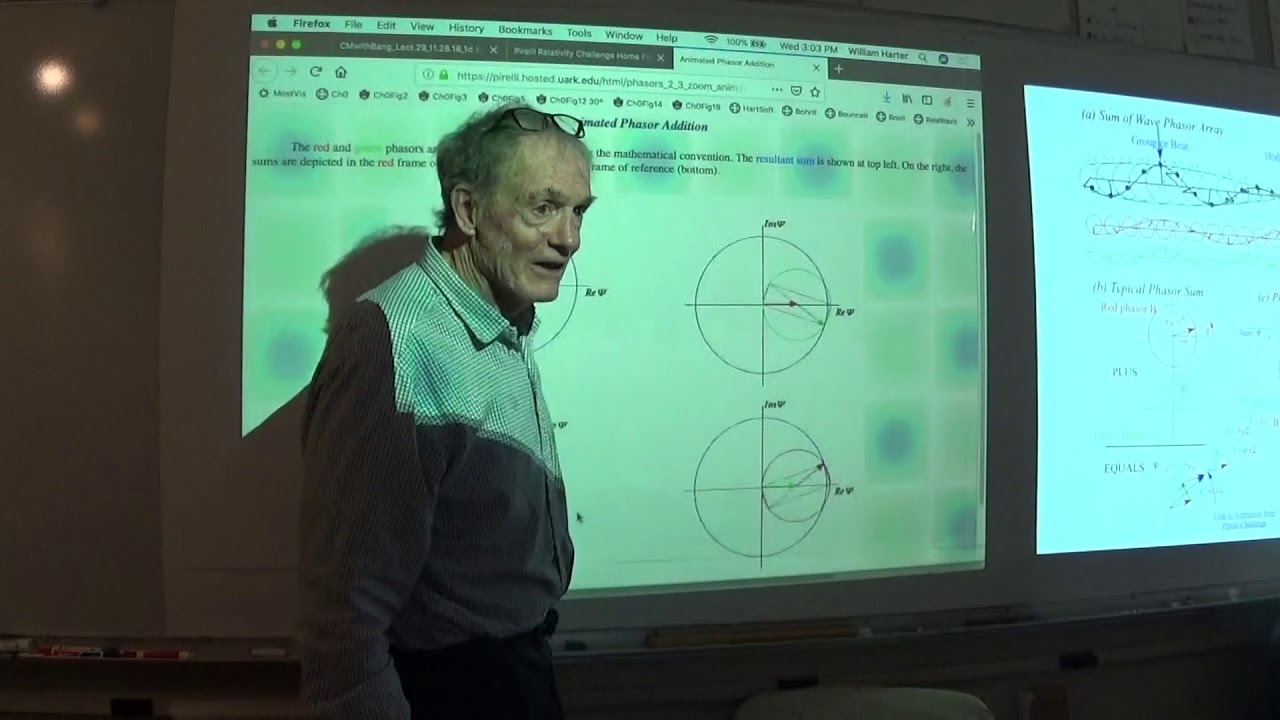
Classical Mechanics with a Bang! (2018 Fall) - Lecture #29 Part2/2
Keywords
Summary
125 words
Critical Evaluation
Value of the Information & Strength of the Argument
The lecture provides a unique geometric perspective on classical mechanics and relativity, offering intuitive visualizations of abstract concepts. The argumentation is logical and builds progressively, using mathematical derivations and graphical constructions. The instructor effectively demonstrates how rapidity simplifies velocity addition and how wave interference leads to a coordinate system, making the material accessible to advanced students.
Scientific Rigor, Source Quality, Title Accuracy
The lecture is scientifically rigorous, based on established physics principles. The instructor references his own course materials and website, but does not cite external sources. The title accurately reflects the content, which is a continuation of a lecture on classical mechanics with a focus on wave interference and relativity. The presentation is informal but mathematically sound.
127 words
Title / Content Match
The title accurately reflects the content, which is a continuation of a lecture on classical mechanics with a focus on wave interference and relativity.
Quality & Reliability
8/10
Lecture by a university professor, part of a graduate course, with a geometric approach to classical mechanics and relativity. The content is mathematically rigorous, but the presentation is informal and lacks citations to external sources.
Key Moments
Markers derived by PSI from the transcript: the creator did not define chapters.
- Introduction of rapidity as logarithm of Doppler ratio
- Demonstration of velocity addition using rapidity
- Discussion of wave interference and group velocity
- Construction of baseball diamond analogy for wave phases
- Derivation of coordinate system from interference patterns
- Application of Doppler shift to transform the lattice
- Geometric derivation of time dilation and length contraction
- Discussion of experimental setups to observe relativistic effects
Cited Sources
- Course Web site — Course materials and resources for 'Classical Mechanics with a Bang!'
- Lecture #29 slide presentation (pdf) — Slides for this lecture, providing visual aids and detailed derivations
Concurring Sources
- Classical Mechanics with a Bang! (Course website) — The course website provides additional materials and context for the lecture.
Contribution & Novelties
This lecture offers a novel geometric approach to understanding special relativity through wave interference, making abstract concepts like rapidity and Lorentz transformations more intuitive. It provides a visual and mathematical framework that connects classical mechanics to quantum theory.
Pour aller plus loin :
- Rapidity — Wikipedia article on rapidity, the key concept introduced.
- Lorentz group — Mathematical group underlying special relativity.
- Wave interference — Basic physics of wave superposition.
69 words
Radar Profile
The radar profile shows high scores in quality of information and technical level, indicating a rigorous and advanced lecture. The quantity of information is moderate, and the overall reliability is high due to the academic context.