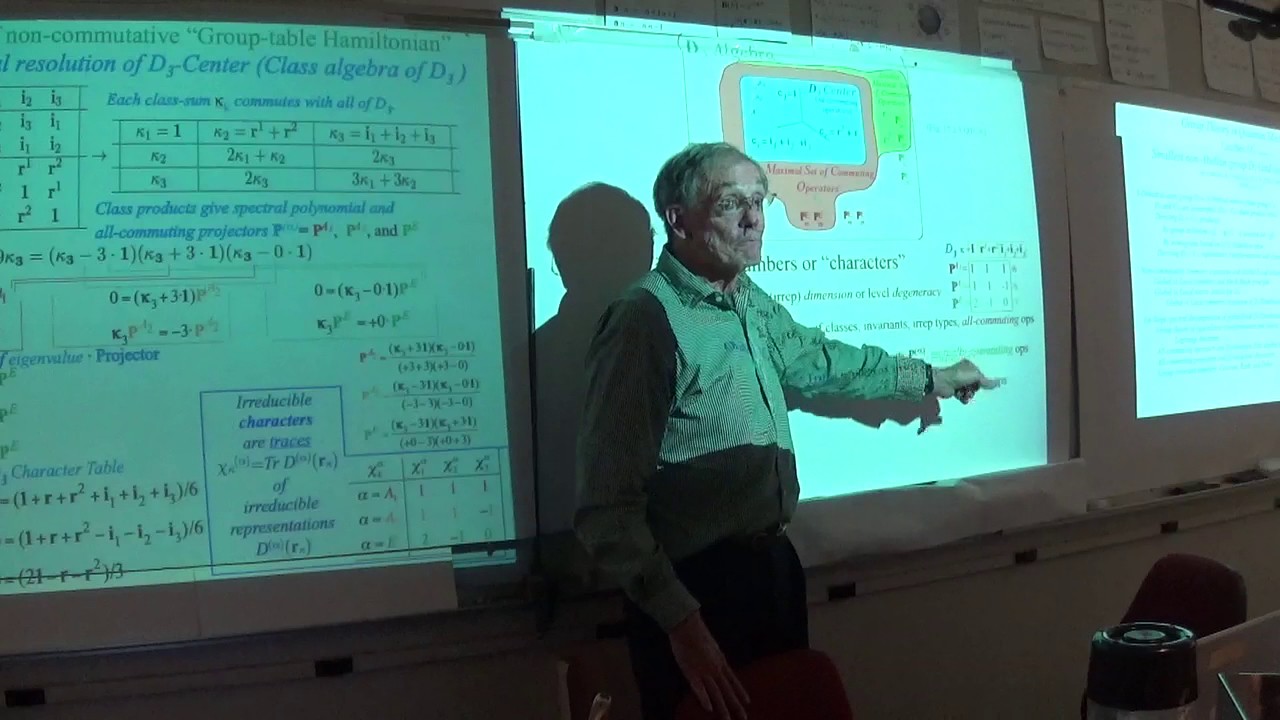
Group Theory in Quantum Mechanics (2017 Sp) - Lecture #15 (Part 2)
Keywords
Summary
98 words
Critical Evaluation
Value of the Information & Strength of the Argument
The lecture provides valuable insights into the practical application of group theory in quantum mechanics, particularly the use of projection operators to decompose representations. The argumentation is based on mathematical derivations and physical examples, such as angular momentum and the hydrogen atom. The instructor’s expertise is evident, and the approach of deriving mathematics from physical reality is pedagogically sound. However, the presentation is somewhat disorganized and may be difficult to follow for those not already familiar with the subject.
Scientific Rigor, Source Quality, Title Accuracy
The lecture is based on the instructor’s own textbooks and course materials, which are authoritative in the field. The sources are cited in the video description, including the course website and lecture slides. The title accurately reflects the content. The lecture is part of a structured course, indicating a rigorous academic context. However, the recording quality is poor, and the lecture is not self-contained, which may affect its accessibility.
163 words
Title / Content Match
The title accurately reflects the content: a lecture on group theory applied to quantum mechanics, specifically the decomposition of representations and projection operators.
Quality & Reliability
8/10
Lecture by a professor with deep expertise in group theory and quantum mechanics, based on his own textbooks and course materials. The content is mathematically rigorous and presented in an academic context. However, the recording quality is low and the lecture is not self-contained, assuming prior knowledge.
Key Moments
Markers derived by PSI from the transcript: the creator did not define chapters.
- Introduction to the lecture, discussing the sum of squares of dimensions of irreducible representations.
- Explanation of the number of irreducible representations and the concept of mutually commuting operators.
- Discussion of the group D3 and the splitting of projectors.
- Application to angular momentum and the labeling of states.
- Mention of the hydrogen atom symmetry and the Runge-Lenz vector.
- Further details on the projection operators and the complete labeling of eigenstates.
Cited Sources
- Course Website — Course materials and additional content for the Group Theory in Quantum Mechanics course.
- Lecture Slides PDF — Slides for Lecture #15, used in the video.
Concurring Sources
- Group Theory and Quantum Mechanics — General reference on group theory and its applications in quantum mechanics.
Contribution & Novelties
The lecture provides a clear demonstration of how to decompose representations using projection operators, a fundamental technique in quantum mechanics. It connects abstract group theory to physical observables, such as angular momentum and the hydrogen atom. The approach of deriving mathematics from physical reality is a distinctive pedagogical contribution.
Pour aller plus loin :
- Group representation theory — Overview of representation theory.
- Projection operator — Mathematical background on projection operators.
- Runge-Lenz vector — Symmetry in the hydrogen atom.
78 words
Radar Profile
The radar profile shows high scores in technical level and information quality, reflecting the advanced and rigorous nature of the lecture. The lower scores in information quantity and global reliability are due to the short duration and the informal, somewhat disorganized presentation.