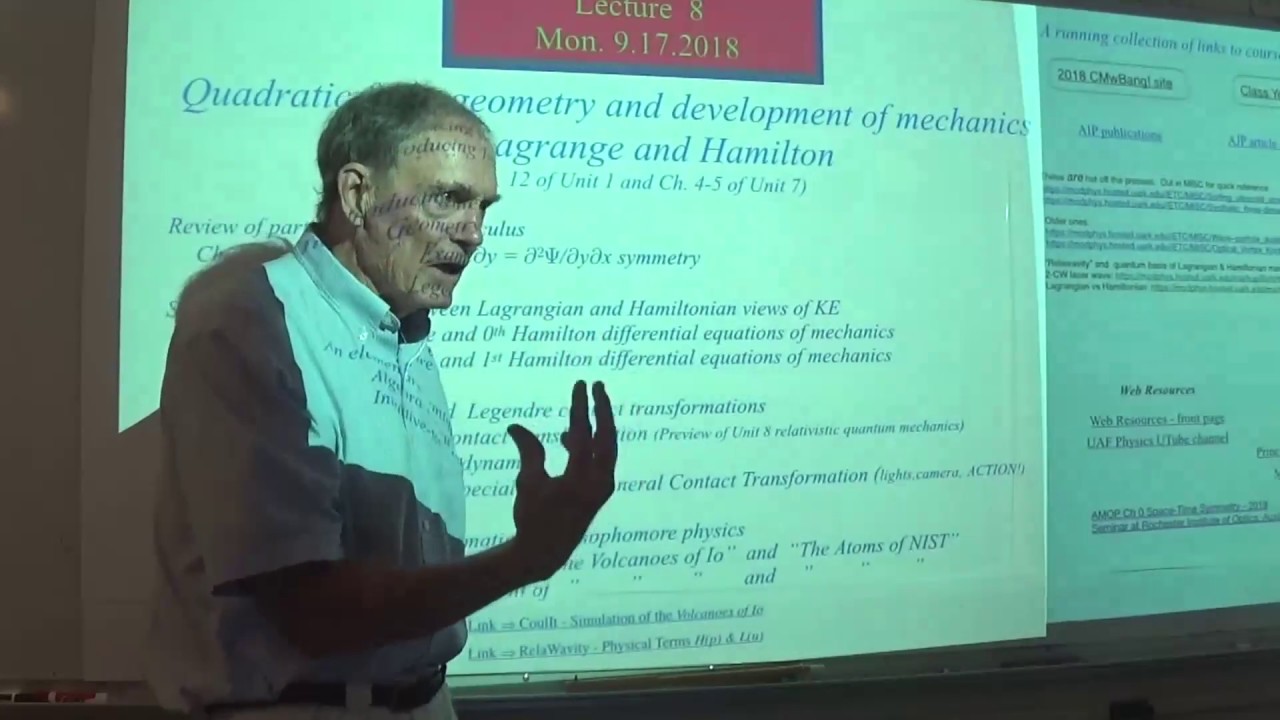
Classical Mechanics with a Bang! (2018 Fall) - Lecture #8
Keywords
Summary
163 words
Critical Evaluation
Value of the Information & Strength of the Argument
The lecture provides a deep and insightful geometric perspective on classical mechanics, which is often missing in standard treatments. The argumentation is rigorous, building from the symmetry of partial derivatives to the derivation of the fundamental equations. The use of visual aids, such as ellipses and paraboloids, helps to make abstract concepts more concrete. The lecturer also connects the material to broader topics like relativity and wave mechanics, adding value for advanced students. However, the argumentation is sometimes informal and relies on intuitive explanations that may not be fully rigorous for all viewers.
Scientific Rigor, Source Quality, Title Accuracy
The lecture is scientifically rigorous, as it is part of a university course and based on a textbook by the same author. The sources cited are the course website and the lecture slides, which are provided in the description. The title accurately reflects the content, as it is a lecture on classical mechanics. The lecture does not cite external sources beyond the course materials, but this is appropriate for a lecture. The adequacy between title and content is good.
187 words
Title / Content Match
The title accurately reflects the content: a lecture on classical mechanics, part of a series.
Quality & Reliability
8/10
Lecture by a university professor, part of a graduate course, with a structured presentation and references to course materials. The content is advanced and mathematically rigorous, but the video is a raw lecture with no editing, and some explanations are informal.
Key Moments
Markers derived by PSI from the transcript: the creator did not define chapters.
- Introduction and overview of the lecture topics.
- Review of partial derivatives and symmetry.
- Introduction to the Lagrangian and Hamiltonian formulations.
- Derivation of Hamilton's and Lagrange's equations.
- Geometric interpretation of the equations using ellipses.
- Discussion of contact transformations and their significance.
- Connection to wave mechanics and relativity.
- Interactive visualization of the relativistic Hamiltonian and Lagrangian.
Cited Sources
- Course Web site — Course website for Classical Mechanics with a Bang! providing additional resources.
- Lecture #8 slide presentation (pdf) — Slides used in this lecture, containing the detailed derivations and diagrams.
Concurring Sources
- Classical Mechanics (Goldstein) — Standard graduate textbook that covers similar material, though without the geometric emphasis.
Contribution & Novelties
This lecture offers a unique geometric approach to classical mechanics, emphasizing the visual and conceptual links between Lagrangian and Hamiltonian formulations. It provides a clear derivation of the fundamental equations from symmetry principles and connects them to wave mechanics and relativity, which is not commonly found in standard textbooks. The interactive visualizations are a valuable pedagogical tool.
Pour aller plus loin :
- Legendre transformation — The mathematical operation underlying the connection between Lagrangian and Hamiltonian.
- Hamiltonian mechanics — The formulation of mechanics in terms of momentum and energy.
- Lagrangian mechanics — The formulation of mechanics in terms of velocity and energy.
- Contact geometry — The geometric structure that underlies the contact transformations mentioned in the lecture.
- Symplectic geometry — The mathematical framework for Hamiltonian mechanics.
125 words
Radar Profile
The radar profile shows high scores in technical level and information quality, indicating a rigorous and detailed lecture. The quantity of information is also high, but the fiabilite is slightly lower due to the informal nature of some explanations.