Classical Mechanics with a Bang! (2019 Fall) - Lecture #22
Keywords
Summary
184 words
Critical Evaluation
Value of the Information & Strength of the Argument
The lecture provides valuable insights into the mathematical structures underlying both classical and quantum mechanics. The argumentation is rigorous, building from the Schrödinger equation to classical equations via algebraic manipulations. The use of spinor algebra and quaternions offers a unifying perspective that is both elegant and practical. The presentation is clear, though it assumes a strong background in linear algebra and differential equations. The lecturer’s enthusiasm and historical anecdotes enhance the educational value, making complex concepts more accessible.
Scientific Rigor, Source Quality, Title Accuracy
The scientific rigor is high, as the content is based on established mathematical and physical principles. The lecture is part of a formal graduate course, and the instructor is a professor with expertise in the field. The sources are primarily the course textbook and lecture notes, which are not formally cited but are implied. The title accurately reflects the content, which is a lecture on classical mechanics with a geometric approach. The lecture does not cite external sources, but the material is consistent with standard treatments of quantum mechanics and classical mechanics.
185 words
Title / Content Match
The title accurately reflects the content, which is a lecture on classical mechanics with a geometric approach, including connections to quantum mechanics.
Quality & Reliability
8/10
The lecture is part of a graduate physics course, presented by an experienced professor, and covers advanced topics in classical and quantum mechanics with mathematical rigor. The content is consistent with established theory, though the presentation is informal and lacks formal citations.
Key Moments
Markers derived by PSI from the transcript: the creator did not define chapters.
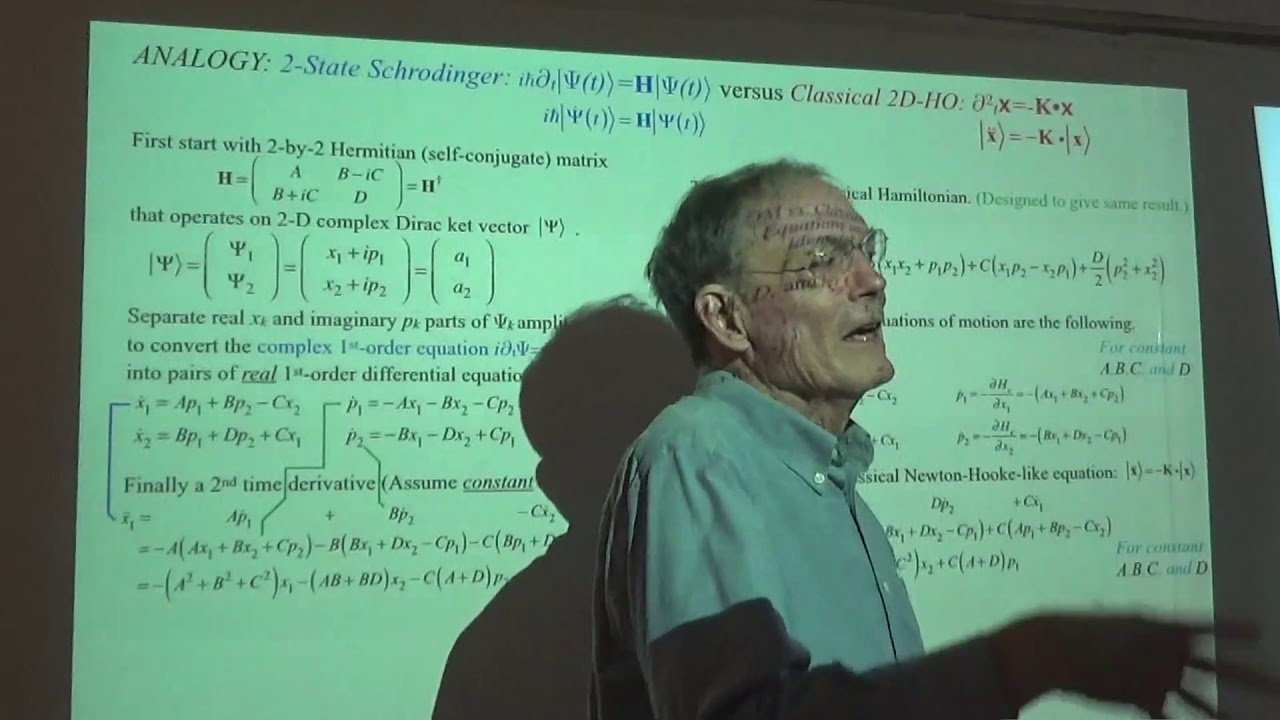
- Introduction to the lecture and overview of topics: repeated eigenvalues, degeneracy, and symmetry.
- Decomposition of the Schrödinger equation into real and imaginary parts.
- Construction of a classical Hamiltonian that yields the same equations as the quantum system.
- Derivation of the second-order classical oscillator equation by squaring the Schrödinger operator.
- Introduction to Pauli spin matrices and their algebra.
- Generalization of complex numbers to spinors and the vector algebra of Pauli matrices.
- Derivation of the exponential of a Hamiltonian using the 'crazy theorem'.
- Examples of spinor exponentials and their physical interpretations.
- Discussion of historical contributions by Hamilton and Pauli.
- Conclusion and preview of future topics on symmetry and degeneracy.
Cited Sources
- Course Web site — Course materials and resources for PHYS 5103.
- Lecture #22 slide presentation (pdf) — Slides used in the lecture, containing detailed derivations and examples.
Concurring Sources
- Classical Mechanics with a Bang! (textbook) — The textbook used for the course, which covers the geometric approach to classical mechanics.
Contribution & Novelties
This lecture offers a unique pedagogical approach by explicitly connecting the Schrödinger equation to classical mechanics through spinor algebra and quaternions. The ‘crazy theorem’ provides a clear method for exponentiating Hamiltonians, which is often glossed over in standard treatments. The lecture also highlights the historical development of these ideas, making it valuable for students seeking a deeper understanding of the mathematical foundations of quantum mechanics.
Pour aller plus loin :
- Pauli matrices — Essential for understanding spin operators and their algebra.
- Quaternions — Historical and mathematical background on quaternions, which are central to the lecture.
- Euler’s formula — The complex exponential formula generalized in the lecture.
106 words
Radar Profile
The radar profile shows high scores in technical level and information quality, reflecting the advanced and rigorous nature of the lecture. The moderate score in quantity of information suggests a focused but not exhaustive coverage of the topic. Overall, the lecture is well-suited for graduate students and researchers in physics.