Symmetry Principles for Atomic, Molecular, Optical Physics (2018 Spring) - Lecture #11
Keywords
Summary
155 words
Critical Evaluation
Value of the Information & Strength of the Argument
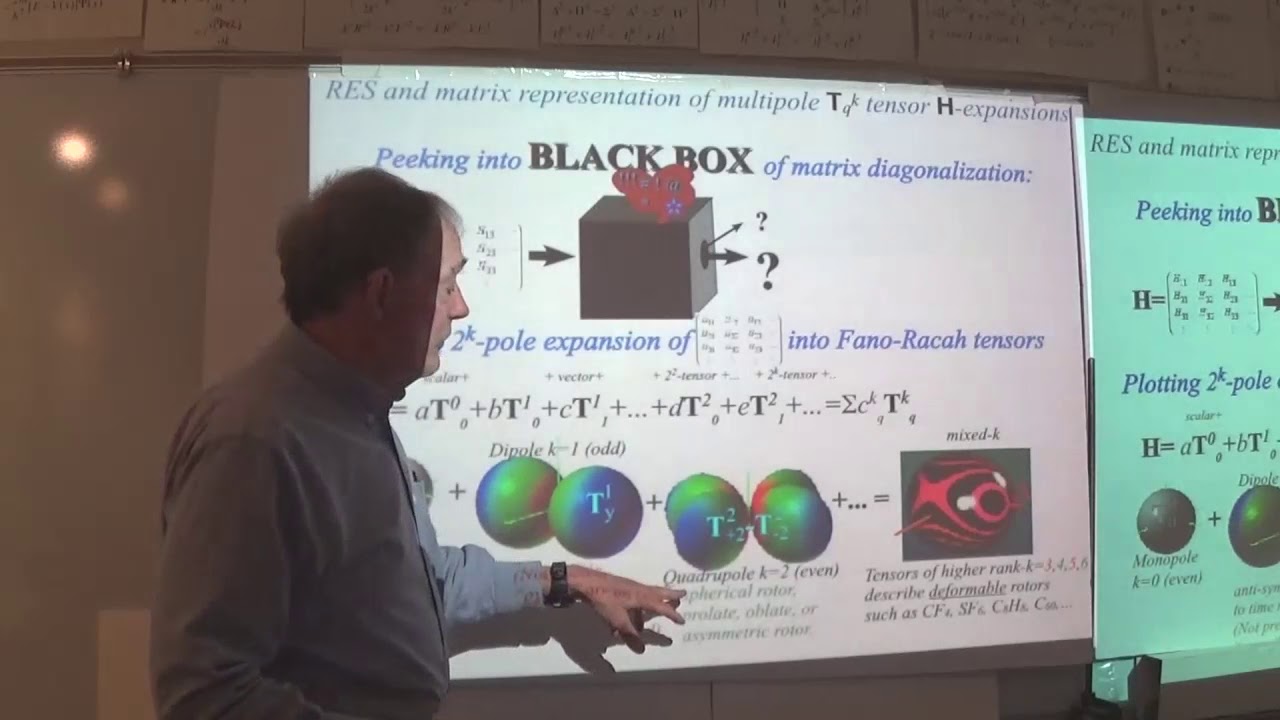
The lecture provides valuable insights into the application of group theory and tensor operators to molecular physics. The instructor’s argumentation is solid, building from basic principles to more complex concepts, and he uses visual aids like rotational energy surfaces to illustrate abstract ideas. He also contrasts different approaches (top-down vs. bottom-up) and discusses the trade-offs, which adds depth to the presentation. The value lies in the clear explanation of how symmetry can be used to simplify and understand molecular Hamiltonians, and the practical demonstration of constructing energy surfaces.
Scientific Rigor, Source Quality, Title Accuracy
The lecture is scientifically rigorous, drawing on established texts and the instructor’s own research. The sources cited include the course website and a PDF of the lecture slides, which provide additional material. The title accurately reflects the content, which is a detailed exploration of symmetry principles in AMOP physics. The lecture is well-structured, with clear explanations and derivations, though some parts are informal and rely on hand-waving. The use of visual aids and physical models enhances understanding. Overall, the scientific quality is high, and the content is reliable for an advanced audience.
195 words
Title / Content Match
The title accurately reflects the content, which focuses on symmetry principles applied to atomic, molecular, and optical physics, specifically using tensor operators and group theory.
Quality & Reliability
8/10
Lecture from a university graduate course by a professor with expertise in the field, based on established texts and providing detailed derivations. However, it is a single lecture without peer review, and some explanations are informal.
Key Moments
Markers derived by PSI from the transcript: the creator did not define chapters.
- Introduction to the lecture's focus on tensor operators and rotational energy surfaces.
- Discussion of the top-down approach to symmetry analysis.
- Explanation of tensor operators and their role in Hamiltonian construction.
- Derivation of the fourth-rank tensor for octahedral symmetry.
- Construction of rotational energy surfaces for SF6 and methane.
- Introduction to the octahedral group and its 24 rotation operations.
- Demonstration of group multiplication using the slide rule device.
- Discussion of non-commutativity of rotations and its implications.
- Preview of applications to molecular rotation and vibration.
Cited Sources
- AMOP Web Course Site — Course website with additional materials and references.
- Lecture #11 Slides (PDF) — PDF of the lecture slides used in this presentation.
Concurring Sources
- Quantum Theory for the Computer Age — Textbook by William Harter, referenced as a course resource.
- Principles of Symmetry, Dynamics, and Spectroscopy — Textbook by William Harter, referenced as a course resource.
Contribution & Novelties
This lecture provides a detailed exposition of using tensor operators and group theory to analyze molecular Hamiltonians, with a focus on rotational energy surfaces. The top-down approach to symmetry analysis is a notable pedagogical contribution, as it contrasts with the traditional bottom-up method. The lecture also demonstrates the use of a physical slide rule to visualize group operations, which is an innovative teaching tool.
Pour aller plus loin :
- Rotational energy surface — Wikipedia article on rotational energy surfaces, which are central to the lecture.
- Clebsch–Gordan coefficients — Wikipedia article on Clebsch-Gordan coefficients, which are mentioned in the lecture.
- Octahedral symmetry — Wikipedia article on octahedral symmetry, relevant to the group discussed.
112 words
Radar Profile
The radar profile shows high scores in technical level and information quality, reflecting the advanced and detailed nature of the lecture. The moderate scores in quantity and reliability suggest that while the content is rich, it is a single lecture without peer review, and the presentation is somewhat informal.