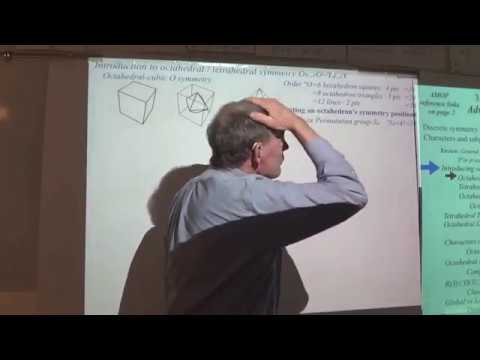
Symmetry Principles for Atomic, Molecular, Optical Physics (2018 Spring) - Lecture #15
Keywords
Summary
133 words
Critical Evaluation
Value of the Information & Strength of the Argument
The lecture provides a comprehensive and rigorous treatment of group theory applied to molecular symmetry. The instructor carefully derives the character tables and explains the underlying mathematical principles, such as Schur’s lemma and the use of projectors. The argumentation is solid, building on previous lectures and providing clear logical steps. The value lies in the detailed exposition of octahedral symmetry, which is essential for understanding the spectroscopy of symmetric molecules. The lecture also connects abstract group theory to practical applications, such as the analysis of molecular vibrations and rotations.
Scientific Rigor, Source Quality, Title Accuracy
The lecture is scientifically rigorous, with a clear pedagogical structure. The instructor references course materials and provides links to lecture notes and PDF slides. The sources are appropriate for a graduate-level physics course, and the content is consistent with established group theory literature. The title accurately reflects the content, which is a detailed exploration of symmetry principles in AMOP. The lecture does not cite external scientific papers, but it is based on the instructor’s own course materials and textbooks, which are well-regarded in the field.
189 words
Title / Content Match
The title accurately reflects the content: the lecture focuses on symmetry principles applied to atomic, molecular, and optical physics, specifically discussing octahedral and tetrahedral symmetries.
Quality & Reliability
8/10
Lecture by a university professor, part of a graduate course, with detailed mathematical derivations and references to course materials. The content is rigorous and well-structured, though it is a lecture rather than peer-reviewed publication.
Key Moments
Markers derived by PSI from the transcript: the creator did not define chapters.
- Introduction and overview of the lecture topics: octahedral and tetrahedral symmetries.
- Review of irreducible representation frequency formula and class sums.
- Discussion of the zoo of groups and the importance of the octahedral group.
- Introduction to the octahedral group: classes of rotations and their geometric interpretation.
- Construction of the character table for the octahedral group.
- Discussion of subgroups: T, Td, and their relevance to molecular symmetry.
- Application to molecules like SF6 and methane, and the role of symmetry in spectroscopy.
- Comparison of octahedral and tetrahedral symmetries and their character tables.
- Discussion of the full octahedral group Oh and its relation to O.
- Conclusion and preview of next lecture on representations.
Cited Sources
- AMOP Web Course — Course website with materials for the AMOP course.
- Lecture #15 Slides (PDF) — PDF slides used in this lecture.
Concurring Sources
- Molecular Symmetry and Group Theory — General reference on molecular symmetry and point groups.
- Character Tables for Point Groups — Explanation of character tables and their construction.
Contribution & Novelties
This lecture provides a detailed and rigorous exposition of octahedral and tetrahedral symmetries, which are fundamental to understanding molecular spectroscopy. The instructor’s approach emphasizes the use of character tables and projection operators, and he connects these mathematical tools to physical applications. The lecture is particularly valuable for its clear explanation of the structure of the octahedral group and its subgroups, and for its discussion of how these symmetries manifest in real molecules like SF6 and methane.
Pour aller plus loin :
- Molecular symmetry — Overview of molecular symmetry and point groups.
- Character table — Explanation of character tables and their use in group theory.
- Octahedral symmetry — Detailed article on the octahedral group and its representations.
116 words
Radar Profile
The radar profile shows high scores in quantity of information, technical level, and reliability, reflecting the lecture's depth and academic rigor. The quality of information is also high, though slightly lower due to the lecture format and lack of peer review. Overall, the profile indicates a highly technical and reliable educational resource.