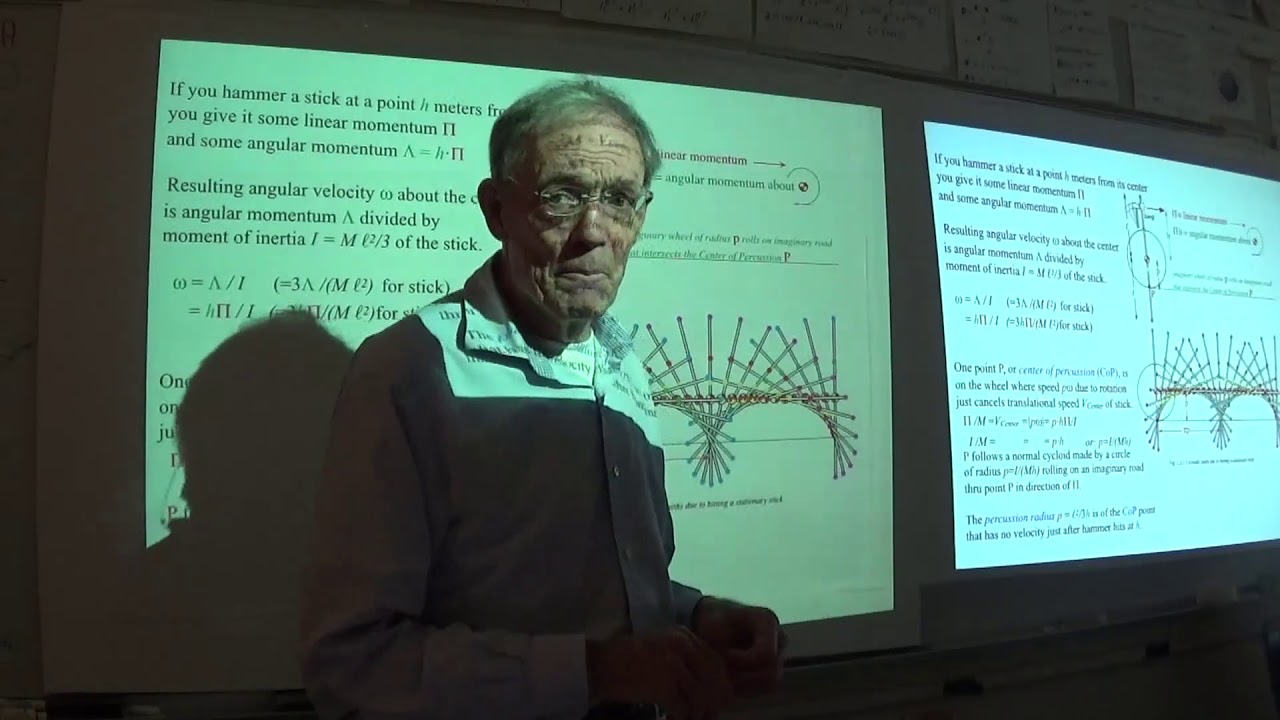
Classical Mechanics with a Bang! (2019 Fall) - Lecture #18
Keywords
Summary
140 words
Critical Evaluation
Value of the Information & Strength of the Argument
The lecture provides valuable insights into the geometric interpretation of classical mechanics, particularly through the use of cycloids and the center of percussion. The argumentation is solid, building from simple examples to more complex derivations. The professor clearly explains the mathematical steps, such as using the Levi-Civita tensor to handle cross products, which is useful for students. The connection between mechanics and electromagnetism is well-motivated, and the derivation of the Lagrangian is rigorous. However, the lecture assumes a high level of prior knowledge, and some parts may be challenging for viewers without a strong background in advanced mechanics and tensor calculus.
Scientific Rigor, Source Quality, Title Accuracy
The lecture is scientifically rigorous, with derivations based on established principles. The professor references the course textbook and provides supplementary materials on the course website. The title accurately reflects the content, which is a lecture on classical mechanics with a geometric approach. The content is well-structured, and the professor’s explanations are clear, though the lecture is aimed at graduate students and may be too advanced for a general audience.
185 words
Title / Content Match
The title accurately reflects the content, which covers classical mechanics with a geometric approach, including applications to electromagnetism.
Quality & Reliability
8/10
Lecture by a university professor, part of a graduate course, with detailed derivations and references to course materials. The content is rigorous and based on established physics, though it is a lecture rather than peer-reviewed research.
Key Moments
Markers derived by PSI from the transcript: the creator did not define chapters.
- Introduction to the physics of hitting a stick and the center of percussion.
- Discussion of cycloidal motion and its relation to the stick's motion.
- Application to billiards: optimal cushion height to avoid skidding.
- Transition to electromagnetism: review of Maxwell's equations and vector potential.
- Use of Levi-Civita tensor to simplify triple cross product in Lorentz force.
- Derivation of Lagrangian for a charged particle in electromagnetic field.
- Preview of mechanical analog for cyclotron resonance.
Cited Sources
- Course Web site — Course materials and information for PHYS 5103.
- Lecture #18 slide presentation (pdf) — Slides used in this lecture.
Concurring Sources
- Classical Mechanics with a Bang! (course textbook) — The course textbook, which the lecture follows.
Contribution & Novelties
This lecture offers a unique geometric perspective on classical mechanics, linking everyday phenomena like hitting a stick to advanced concepts in electromagnetism. The use of cycloids to illustrate the motion of a charged particle in crossed fields is particularly insightful. The derivation of the Lagrangian using tensor notation provides a clear and efficient method for handling complex cross products.
Pour aller plus loin :
- Levi-Civita symbol — Essential for tensor manipulations in physics.
- Hall effect — Directly related to the lecture’s discussion of crossed fields.
- Lagrangian mechanics — Foundational for the derivation presented.
93 words
Radar Profile
The radar profile shows high scores in quantity and technical level, indicating a dense, advanced lecture. The quality and reliability scores are also high, reflecting the professor's expertise and the rigorous mathematical treatment.
💬 No comments were provided for analysis.