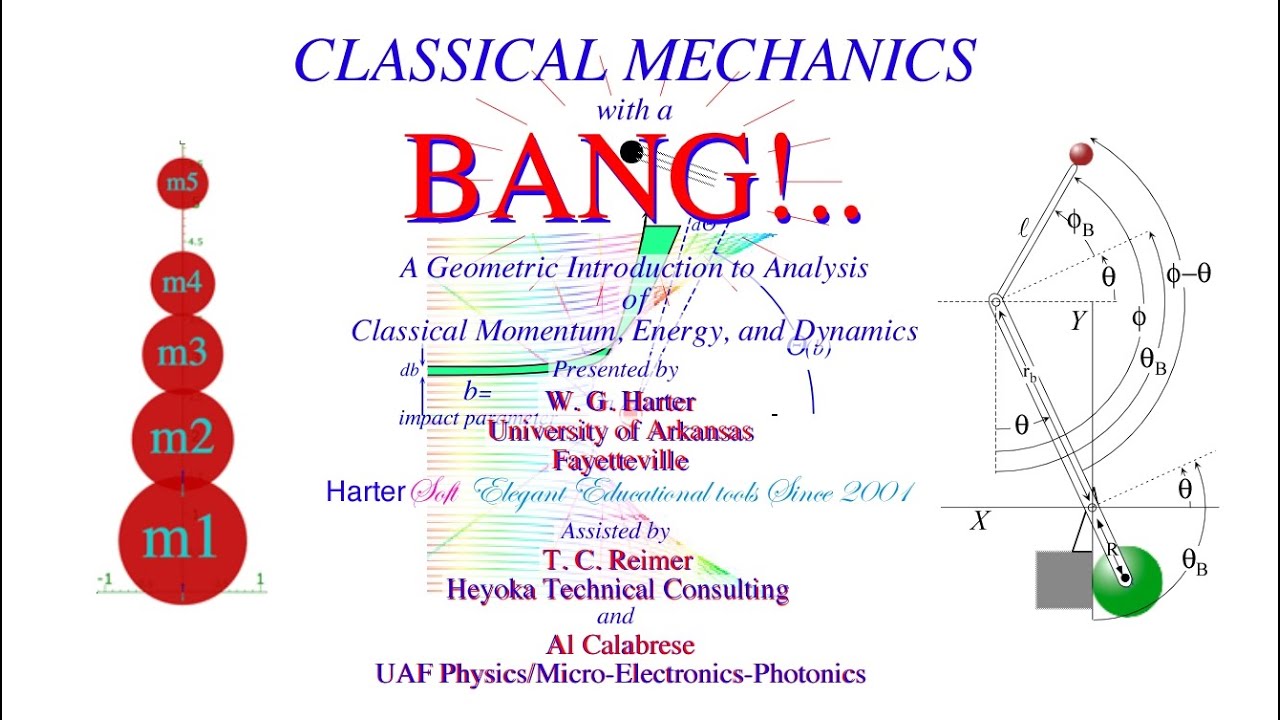
Classical Mechanics with a Bang! - Lecture 14
Keywords
Summary
158 words
Critical Evaluation
Value of the Information & Strength of the Argument
The lecture provides a deep insight into the geometric nature of Hamiltonian mechanics, which is often not emphasized in standard courses. The use of simulations to visualize phase space and the evolution of the system is highly effective. The argumentation is solid, building from basic principles to more advanced concepts, and the instructor addresses common pitfalls. The discussion of elliptic functions and their connection to physical phenomena like Bose-Einstein condensates adds value. The lecture also touches on the practical importance of phase space in accelerator physics, making the content relevant beyond the classroom.
Scientific Rigor, Source Quality, Title Accuracy
The lecture is based on the instructor’s own textbook, ‘Classical Mechanics with a Bang!’, which is a credible source. The mathematical derivations are rigorous, and the simulations are used to illustrate theoretical points. The title is somewhat informal but accurately reflects the dynamic approach. The content is well-structured, and the instructor’s expertise is evident. However, as a lecture, it lacks the formal citation of external sources, but this is typical for such educational content.
182 words
Title / Content Match
The title 'Classical Mechanics with a Bang!' reflects the dynamic and visual approach to classical mechanics, and this lecture indeed covers core topics with simulations.
Quality & Reliability
8/10
Lecture by a university professor, based on a textbook, with mathematical derivations and simulations. The content is rigorous and well-structured, though it is a lecture and not peer-reviewed.
Key Moments
Markers derived by PSI from the transcript: the creator did not define chapters.
- Introduction to the lecture and review of phase space plots.
- Discussion of the simple pendulum, potential energy, and common sign errors.
- Introduction of the Hamiltonian surface and phase space geometry.
- Demonstration of Hamilton's equations as cross product with gradient.
- Simulation of pendulum motion for various amplitudes, showing anharmonic behavior.
- Discussion of elliptic functions and their appearance in pendulum motion.
- Exploration of unstable solutions and the Fourier transform of the motion.
- Introduction of the cycloidal pendulum and its isochronous property.
- Comparison of simple and cycloidal pendulums, and discussion of Huygens' work.
- Preview of more complex systems and the importance of phase space in accelerator design.
Cited Sources
- Classical Mechanics with a Bang! — Textbook by William Harter, used as the basis for the course.
Concurring Sources
- Classical Mechanics (Goldstein) — Standard graduate textbook covering Hamiltonian mechanics and phase space.
Contribution & Novelties
This lecture offers a unique geometric perspective on Hamiltonian mechanics, using phase space plots and simulations to illustrate concepts that are often abstract. It bridges the gap between classical and quantum mechanics by highlighting the wave-like nature of classical motion. The discussion of elliptic functions and their physical applications is particularly valuable.
Pour aller plus loin :
- Hamiltonian mechanics — Overview of the Hamiltonian formalism.
- Phase space — Concept of phase space in dynamical systems.
- Elliptic functions — Mathematical background on elliptic functions.
- Cycloid — Geometry of the cycloid and its properties.
92 words
Radar Profile
The radar profile shows high scores in all dimensions, indicating a well-balanced and rigorous lecture. The strongest aspects are the quality of information and technical depth, while the quantity of information is slightly lower due to the focused scope.
💬 Sur les 0 commentaires analysés, aucune tendance n'est observable.