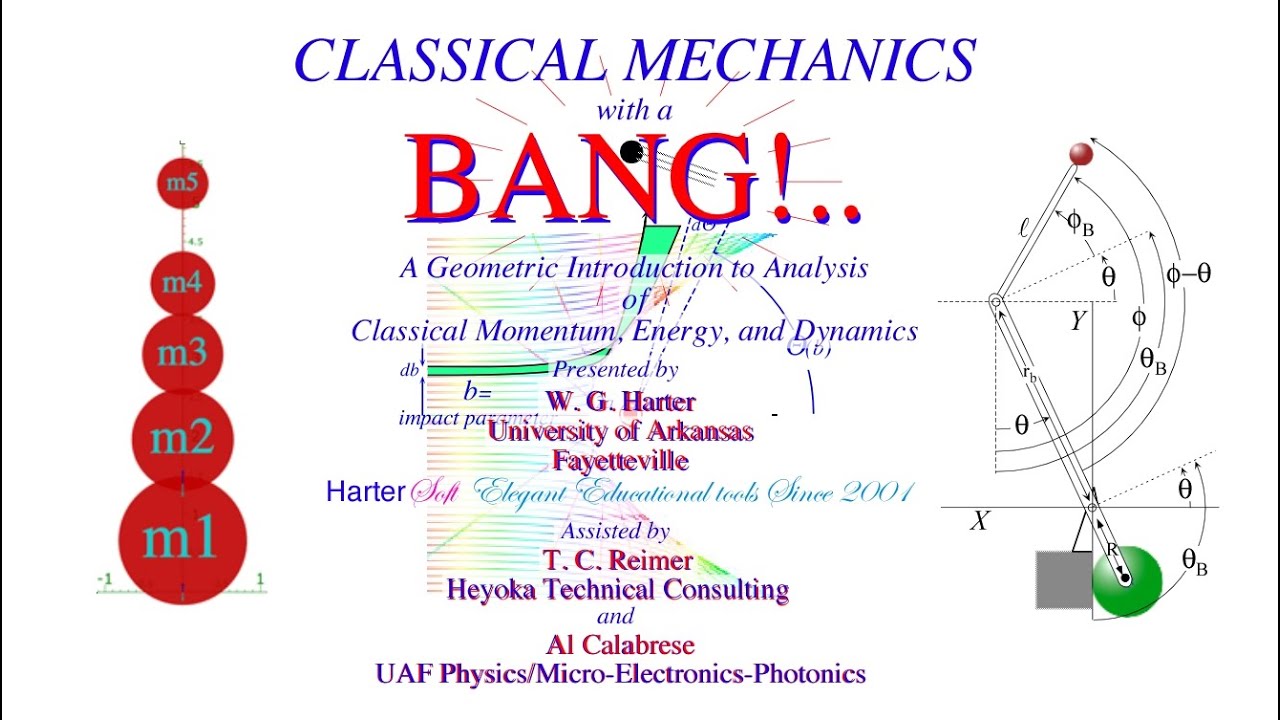
Classical Mechanics with a Bang! - Lecture 13
Keywords
Summary
126 words
Critical Evaluation
Value of the Information & Strength of the Argument
The lecture provides a thorough and rigorous derivation of Hamiltonian mechanics, building on the Lagrangian formalism. The instructor clearly explains the mathematical steps, such as the Legendre transformation and the inversion of the metric tensor, and connects them to physical concepts like conservation laws and effective potentials. The argumentation is solid, with each step justified and linked to broader principles. The use of polar coordinates as a concrete example helps illustrate the abstract tensor algebra, making the content accessible to graduate students. The lecture also emphasizes the importance of the Hamiltonian formulation for numerical integration and its relevance to quantum mechanics, adding depth to the presentation.
Scientific Rigor, Source Quality, Title Accuracy
The lecture is scientifically rigorous, with careful derivations and references to standard physics texts, such as Feynman’s lectures. The instructor is a professor at the University of Arkansas, and the course is part of a graduate program, ensuring a high level of expertise. The title accurately reflects the content, as it is indeed a lecture on classical mechanics. The sources cited are primarily the course textbook and standard physics references, which are appropriate for the level of the course. The lecture does not include any external sources beyond the course materials, but the mathematical derivations are self-contained and well-supported.
220 words
Title / Content Match
The title accurately reflects the content, as the lecture is part of a series on classical mechanics and focuses on Hamiltonian mechanics.
Quality & Reliability
8/10
Lecture by a university professor, part of a graduate course, with rigorous mathematical derivations and references to standard physics concepts. The content is well-structured and pedagogically sound, though it is a lecture rather than peer-reviewed research.
Key Moments
Markers derived by PSI from the transcript: the creator did not define chapters.
- Review of scalars, vectors, and tensors, with emphasis on contravariant and covariant components.
- Introduction to the Hamiltonian and its relation to the Lagrangian via Legendre transformation.
- Derivation of Hamilton's equations from Lagrange's equations, including the role of explicit time dependence.
- Discussion of conservation laws, particularly energy conservation when the Hamiltonian is time-independent.
- Example of polar coordinates: expressing the Hamiltonian in terms of momentum and the effective potential.
- Tensor algebra details: inverting the metric tensor and simplifying the Hamiltonian.
- Connection to quantum mechanics: bra-ket notation and the analogy between covariant/contravariant vectors and bras/kets.
- Preview of upcoming topics: Hamilton-Jacobi theory and phase plots.
Cited Sources
- Classical Mechanics with a Bang! — Course textbook by Prof. William Harter, used as the primary reference for the lecture.
- Feynman Lectures on Physics, Vol. III — Referenced in the lecture when discussing transformation matrices and quantum mechanics notation.
Concurring Sources
- Classical Mechanics (Goldstein) — Standard graduate textbook covering Hamiltonian mechanics in depth, consistent with the lecture's content.
- Mathematical Methods of Classical Mechanics (Arnold) — Provides a rigorous mathematical treatment of Hamiltonian mechanics, aligning with the lecture's geometric approach.
Contribution & Novelties
This lecture provides a clear and detailed derivation of Hamiltonian mechanics from the Lagrangian formalism, emphasizing the geometric and tensor aspects. The instructor’s approach of using covariant and contravariant vectors to clarify the roles of momentum and velocity is particularly insightful. The lecture also highlights the practical advantages of Hamiltonian equations for numerical integration and their connection to quantum mechanics, which is valuable for graduate students.
Pour aller plus loin :
- Hamiltonian mechanics — Overview of the Hamiltonian formulation and its applications.
- Legendre transformation — Mathematical foundation for the transformation between Lagrangian and Hamiltonian formalisms.
- Effective potential — Concept used in central force problems, as discussed in the lecture.
109 words
Radar Profile
The radar profile shows high scores in technical level and information quality, reflecting the advanced nature of the lecture. The quantity of information is also high, but the overall score is slightly lower due to the lack of external sources and the lecture format, which may not be as engaging for a general audience.