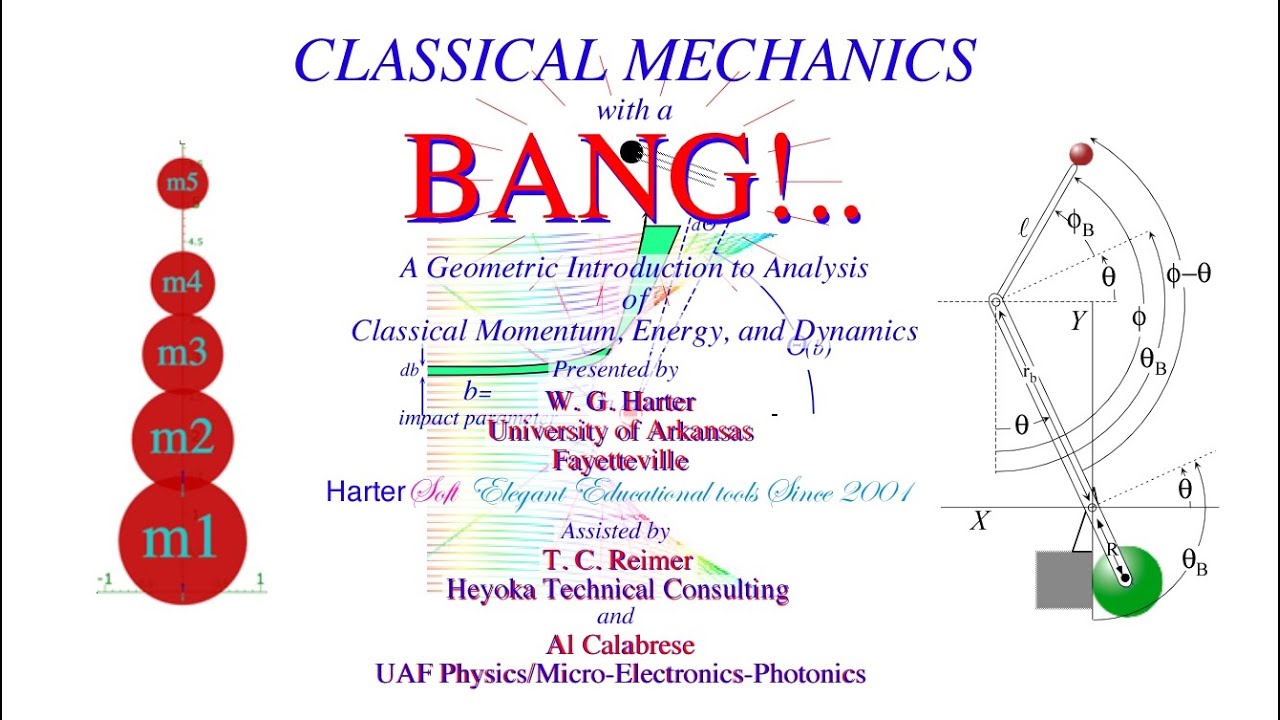
Classical Mechanics with a Bang! - Lecture 29
Keywords
Summary
155 words
Critical Evaluation
Value of the Information & Strength of the Argument
The lecture provides valuable insights into classical mechanics through geometric constructions, offering a unique perspective that is often missing in standard treatments. The argumentation is solid, with clear derivations and logical progression from the scattering problem to the conservation laws. The professor’s enthusiasm and historical context enhance the value, making complex concepts more accessible. The use of computer simulations and visual aids strengthens the explanations, and the connection to quantum mechanics and real-world phenomena adds depth.
Scientific Rigor, Source Quality, Title Accuracy
The lecture is scientifically rigorous, with careful derivations and references to the textbook and published papers. The professor mentions his own publications in the American Journal of Physics, which adds credibility. The title accurately reflects the content, as it is part of a series on classical mechanics. The lecture is well-structured and the sources are appropriate for a graduate-level course.
151 words
Title / Content Match
The title reflects the course name and lecture number, accurately indicating the content on classical mechanics.
Quality & Reliability
8/10
Lecture by a university professor, part of a graduate course, with detailed derivations and references to published work. The content is rigorous and well-structured, though it is a lecture rather than peer-reviewed material.
Key Moments
Markers derived by PSI from the transcript: the creator did not define chapters.
- Introduction to lecture 29, overview of topics: Rutherford scattering and eccentricity vector.
- Review of differential scattering cross-section and historical context of Rutherford's experiment.
- Introduction of geometric construction for hyperbolic orbits using compass and ruler.
- Demonstration of the construction method with a specific impact parameter.
- Discussion of the envelope of trajectories and its parabolic shape.
- Connection to quantum mechanics and wave interference in scattering.
- Application to solar wind and Lyman-alpha shock waves.
- Derivation of differential scattering cross-section and total cross-section divergence.
- Introduction of the eccentricity vector and its conservation.
- Generalization to arbitrary initial conditions and summary of key concepts.
Cited Sources
- Classical Mechanics with a Bang! — Textbook by Prof. William G. Harter, used for the course.
- American Journal of Physics — Mentioned as the journal where the professor published papers on geometric constructions.
Concurring Sources
- Classical Mechanics (Goldstein) — Standard textbook that covers similar topics, though the geometric approach is unique.
Contribution & Novelties
The lecture offers a unique geometric method for constructing Coulomb orbits, which is not commonly found in textbooks. It provides a clear visual understanding of scattering and the conservation of the eccentricity vector. The connection between classical and quantum scattering is highlighted, and the historical context enriches the presentation.
Pour aller plus loin :
- Runge-Lenz vector — Central to the conservation laws discussed.
- Rutherford scattering — The experiment and its significance.
- Kepler problem — Related to the orbits and conservation laws.
81 words
Radar Profile
The radar profile shows high scores in quantity of information, technical level, and reliability, indicating a dense and rigorous lecture. The quality of information is also high, but the relatively lower score in 'fiabilite_globale' (8) compared to others suggests a slight caution due to the lecture format and lack of peer review.