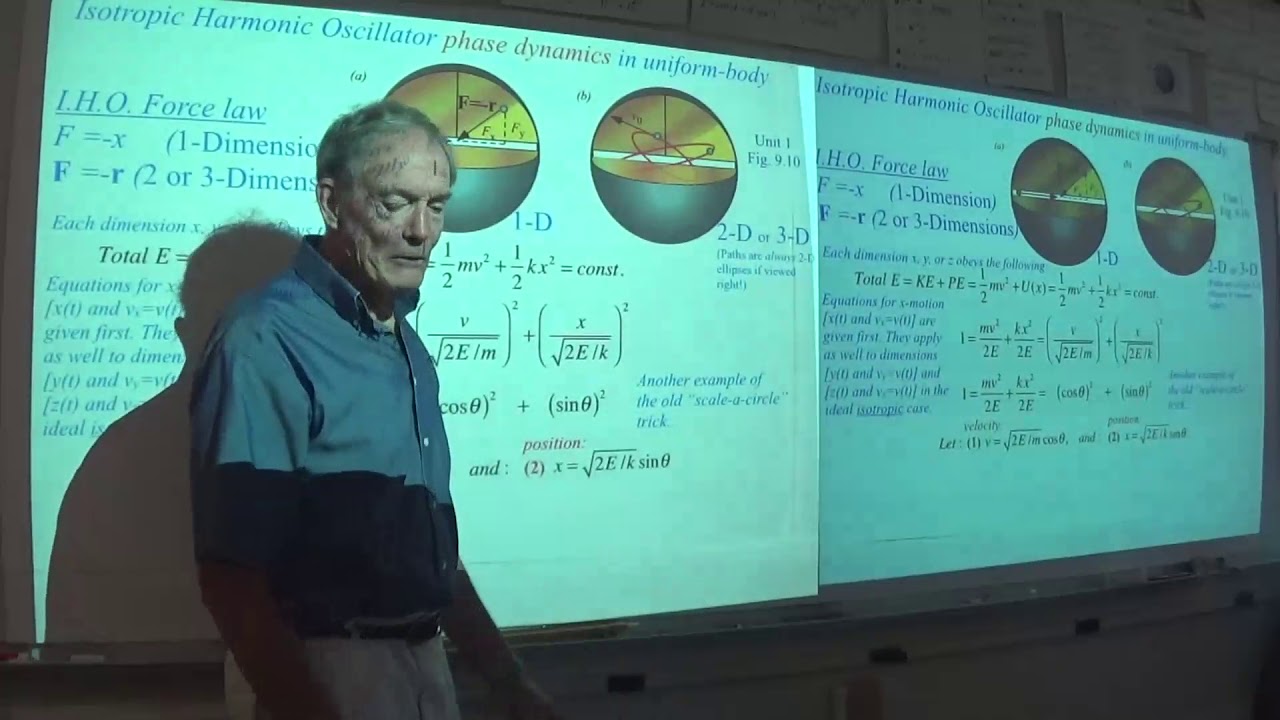
Classical Mechanics with a Bang! (2018 Fall) - Lecture #7
Keywords
Summary
158 words
Critical Evaluation
Value of the Information & Strength of the Argument
The lecture provides a valuable and insightful geometric perspective on the harmonic oscillator, which is a fundamental system in physics. The use of phasors and phase space diagrams offers a clear visualization of the motion and its symmetries. The argumentation is solid, building from basic principles to more complex concepts, and the connections to Kepler’s laws and quantum mechanics are well-motivated. The interactive simulations enhance the explanatory power, making abstract concepts more tangible. However, the lecture is somewhat informal and may require prior knowledge of mechanics and calculus to fully appreciate.
Scientific Rigor, Source Quality, Title Accuracy
The scientific rigor is high, as the lecture is based on a well-established textbook and the derivations are mathematically sound. The sources cited are the course website and the lecture slides, which are appropriate for a university course. The title accurately reflects the content, which is a lecture on classical mechanics. The lecture is part of a series, so it assumes prior knowledge from previous lectures. The presentation is clear, but the informal style and occasional digressions might reduce the perceived rigor for some viewers.
191 words
Title / Content Match
The title accurately reflects the content: a lecture on classical mechanics, specifically the isotropic harmonic oscillator and its geometric treatment.
Quality & Reliability
8/10
Lecture by a university professor, based on a textbook and accompanied by course materials. The content is mathematically rigorous and pedagogically structured, but it is not peer-reviewed and represents a single instructor's perspective.
Key Moments
Markers derived by PSI from the transcript: the creator did not define chapters.
- Introduction and overview of the lecture topic: isotropic harmonic oscillator and its geometric treatment.
- Derivation of the equation of motion for the isotropic harmonic oscillator using the Lagrangian and energy conservation.
- Introduction of the phasor representation and its use in visualizing the oscillator's motion.
- Discussion of the eccentric anomaly construction and its relation to Kepler's laws.
- Derivation of velocity and acceleration vectors using calculus, and the introduction of higher derivatives (jerk, etc.).
- Demonstration of interactive simulations showing the motion of the oscillator and the relationship between position, velocity, and acceleration.
- Discussion of the connection between the classical oscillator and quantum mechanics, and the role of symmetry.
- Conclusion and summary of the key concepts covered in the lecture.
Cited Sources
- Course Web site — Official course website for 'Classical Mechanics with a Bang!'
- Lecture #7 slides (PDF) — Slides used in this lecture, containing the derivations and figures.
Concurring Sources
- Classical Mechanics (Goldstein) — Standard graduate textbook on classical mechanics, covering similar topics.
Contribution & Novelties
The lecture offers a unique geometric perspective on the harmonic oscillator, emphasizing visual and intuitive understanding. It connects classical mechanics to quantum mechanics through the concept of symmetry and phasors. The use of interactive simulations is a notable pedagogical innovation.
Pour aller plus loin :
- Harmonic oscillator — Fundamental concept in physics.
- Phase space — Mathematical space where all possible states of a system are represented.
- Kepler’s laws of planetary motion — Laws describing planetary motion, related to the eccentric anomaly discussion.
82 words
Radar Profile
The radar profile shows high scores in all dimensions, indicating a well-rounded lecture with strong quantitative and qualitative content, a high technical level, and reliable sources. The balance between theory and visualization is particularly notable.