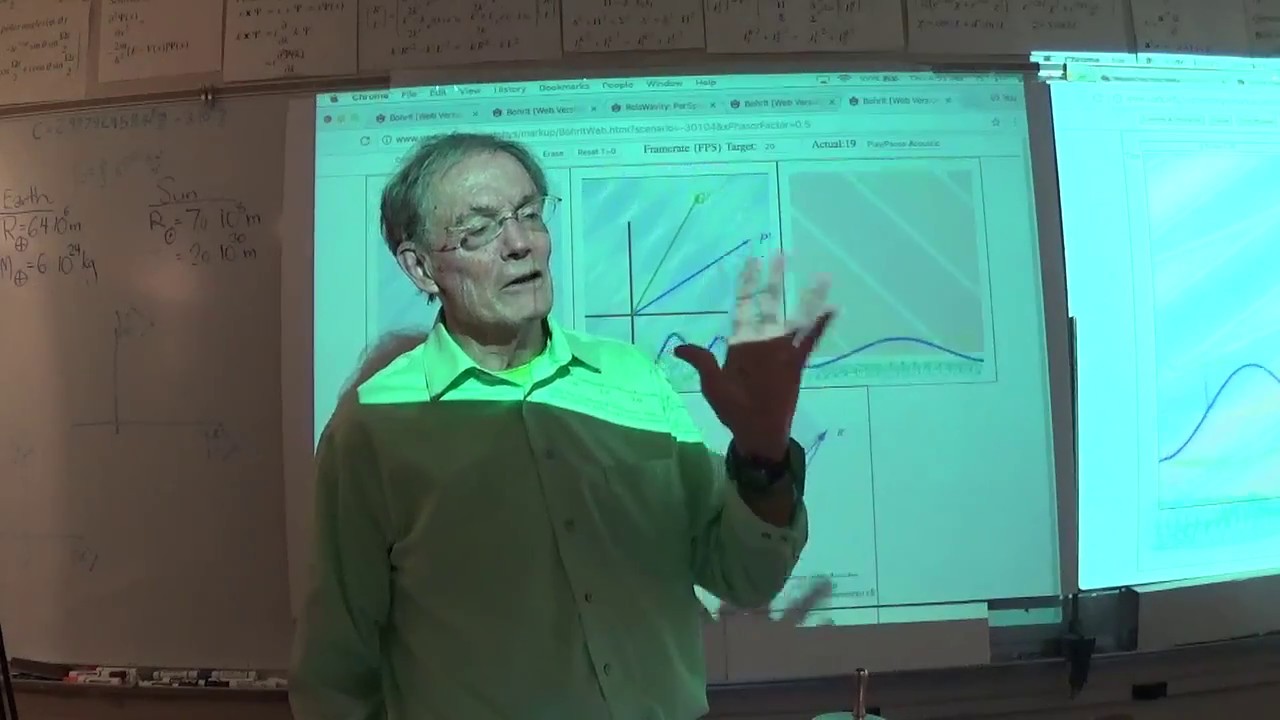
Group Theory in Quantum Mechanics (2017 Sp) - Lecture #12 (Part 2)
Keywords
Summary
186 words
Critical Evaluation
Value of the Information & Strength of the Argument
The lecture provides valuable insights into the connection between group theory and relativity, particularly through the graphical representation of wave packets. The argumentation is based on mathematical derivations and physical reasoning, but the historical narrative is anecdotal and lacks rigorous sourcing. The professor’s expertise is evident, but the informal style and digressions reduce the clarity of the scientific argument.
Scientific Rigor, Source Quality, Title Accuracy
The lecture references the course textbooks by William Harter, and the course website and PDF slides are provided in the description. The scientific content is consistent with established physics, but the historical claims are not backed by specific sources. The title accurately describes the content, but the lecture’s focus on history may not be fully anticipated by the title.
133 words
Title / Content Match
The title accurately reflects the content, which is a continuation of a lecture on group theory in quantum mechanics, focusing on relativity and historical context.
Quality & Reliability
6/10
The lecture is part of a graduate physics course, presented by a professor with expertise in the field. The content is based on established textbooks and includes mathematical derivations, but the informal delivery and historical digressions reduce the precision and verifiability of some claims.
Key Moments
Markers derived by PSI from the transcript: the creator did not define chapters.
- Discussion of wave packet representation and group velocity exceeding speed of light.
- Introduction to relativity and Minkowski's contribution.
- Historical anecdote about Minkowski and Einstein.
- Discussion of Minkowski's early death and his work.
- Historical context of World War I and its impact on science.
- Einstein's personal life and Nobel Prize.
- Reflection on anti-Semitism and academic politics.
- Discussion of the seven liberal arts and seven deadly sins.
- Mention of the quadrivium and mathematics in music.
Cited Sources
- Course Web site — Course materials and additional content.
- Lecture #12 slide presentation (pdf) — Slides used in the lecture.
Concurring Sources
- Quantum Theory in the Computer Age — Textbook by William Harter, referenced in the course.
- Principles of Symmetry, Dynamics, and Spectroscopy — Textbook by William Harter, referenced in the course.
Contribution & Novelties
The lecture offers a unique pedagogical approach by linking group theory to relativity through visual representations, which may aid in understanding. However, the content is not novel, as it is based on established textbooks. The historical anecdotes provide context but are not original research.
Pour aller plus loin :
- Special relativity — Overview of the theory.
- Hermann Minkowski — Biography and contributions.
- Lorentz transformation — Mathematical foundation.
- Group theory — General concept.
72 words
Radar Profile
The radar profile shows moderate scores across all dimensions, with a slightly higher technical level and reliability, but lower quantity of information due to the short duration and historical digressions.
💬 No comments were provided for analysis.