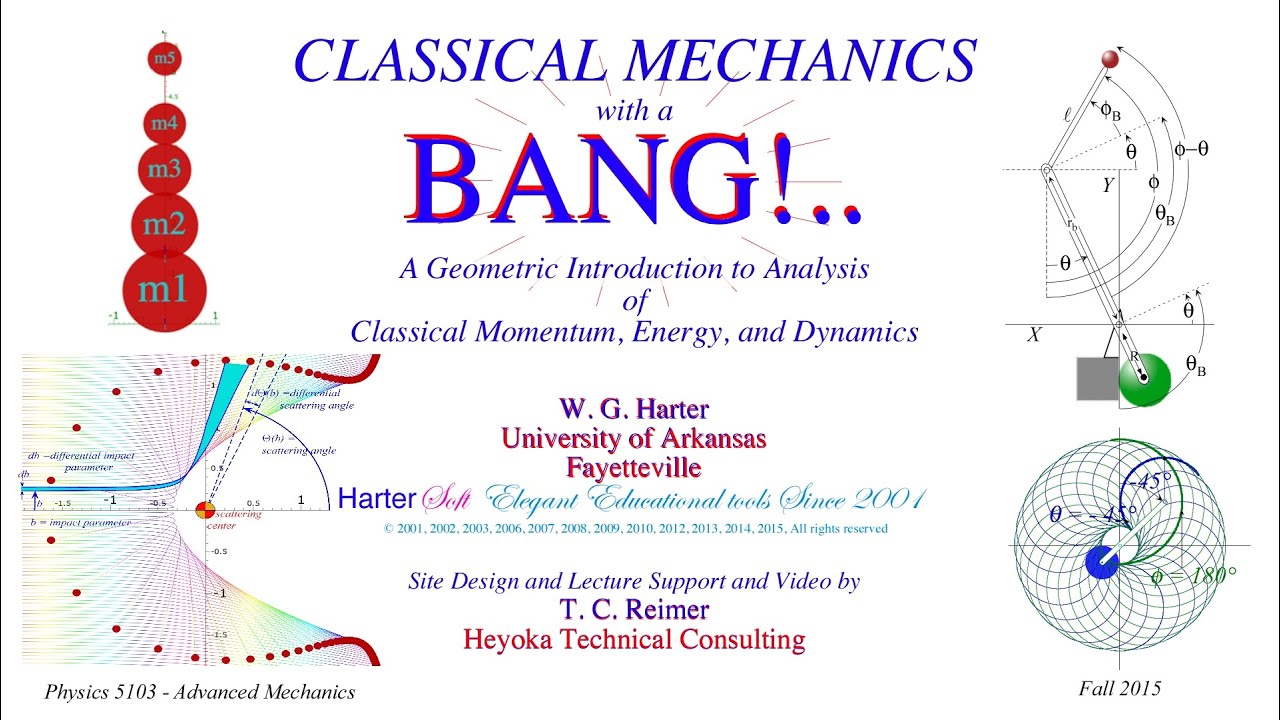
Classical Mechanics with a Bang! (2015 Fall) - Lecture #13
Keywords
Summary
133 words
Critical Evaluation
Value of the Information & Strength of the Argument
The lecture provides a clear and insightful review of complex analysis, connecting abstract mathematical concepts to physical applications. The argumentation is solid, building from basic principles to more advanced topics. The use of compound interest as an intuitive introduction to the exponential function is effective. The professor’s emphasis on geometric interpretations and the connection to vector analysis and quantum mechanics adds value. The presentation is well-structured, with a logical progression from arithmetic to calculus and then to applications.
Scientific Rigor, Source Quality, Title Accuracy
The lecture is scientifically rigorous, with a solid mathematical foundation. The professor references the course textbook and provides supplementary materials (PDF slides) for further study. The title accurately reflects the content, which is a lecture on classical mechanics with a focus on complex analysis. The sources cited are the course website and the lecture slides, which are appropriate for a university course. No external sources are mentioned, but the content is consistent with standard mathematical and physical literature.
171 words
Title / Content Match
The title accurately reflects the content, which is a lecture on classical mechanics with a focus on complex analysis and its applications.
Quality & Reliability
8/10
Lecture by a university professor, part of a graduate course, with a structured presentation and references to course materials. The content is mathematically rigorous and pedagogically sound, though it is a lecture rather than peer-reviewed research.
Key Moments
Markers derived by PSI from the transcript: the creator did not define chapters.
- Introduction to the lecture, reviewing complex functions and their importance in mechanics.
- Discussion of compound interest and the exponential function, leading to the definition of e.
- Derivation of the Taylor series for the exponential function and its convergence.
- Geometric interpretation of Taylor series approximations for exponential, sine, and cosine functions.
- Introduction of Euler's formula and its importance in complex analysis.
- Use of complex numbers for automatic trigonometry and vector operations.
- Representation of vectors using complex numbers and quaternions, comparison with Gibbs notation.
- Introduction of the complex derivative and its relation to divergence and curl.
Cited Sources
- Course Web site — Course materials and information for PHYS 5103.
- Lecture #13 slide presentation (pdf) — Slides used in this lecture.
Concurring Sources
- Classical Mechanics with a Bang! (textbook) — The textbook used for the course, which the lecture follows.
Contribution & Novelties
The lecture provides a pedagogical review of complex analysis with a focus on its applications in classical mechanics. It emphasizes geometric interpretations and connects the material to quantum theory. The use of compound interest as an intuitive introduction to the exponential function is a novel teaching approach.
Pour aller plus loin :
- Euler’s formula — Directly related to the core concept of the lecture.
- Taylor series — Fundamental to the series expansions discussed.
- Complex analysis — The broader field of study.
- Quaternions — Mentioned in the lecture as an alternative to vector notation.
93 words
Radar Profile
The radar profile shows high scores in technical level and information quality, indicating a mathematically rigorous lecture. The quantity of information is also high, but the global score is slightly lower due to the narrow focus and lack of broader context.