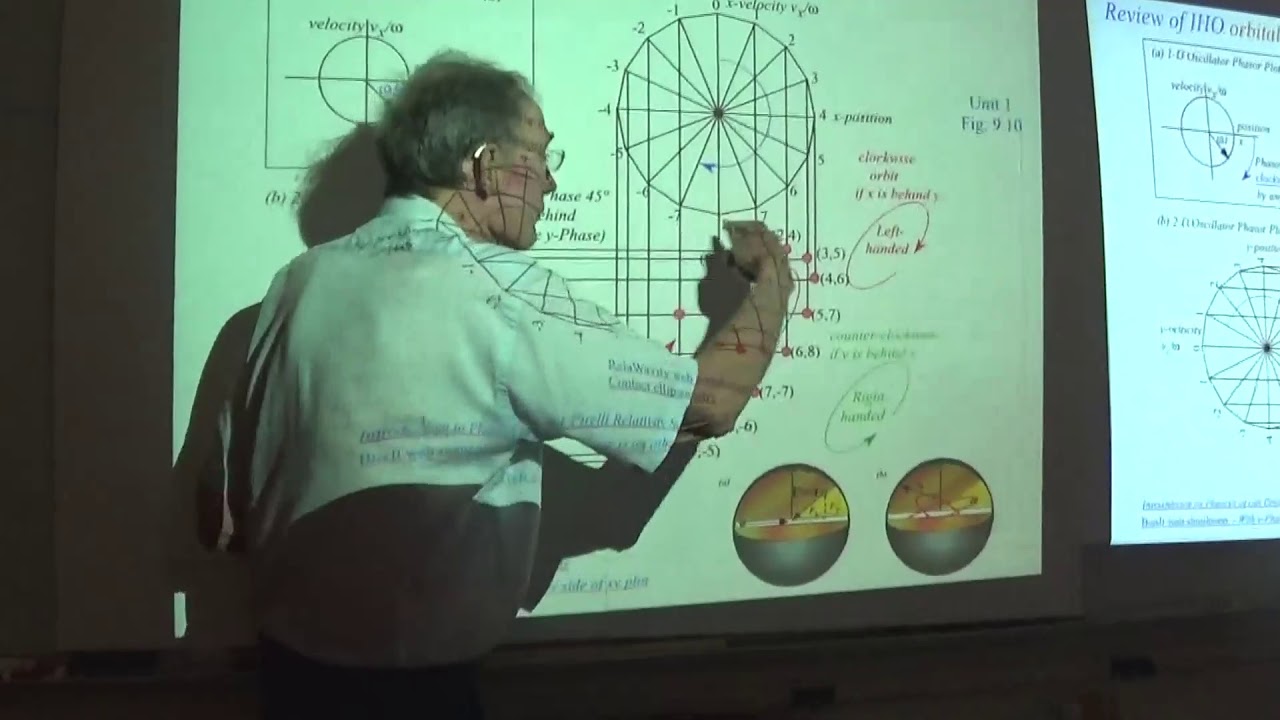
Classical Mechanics with a Bang! (2019 Fall) - Lecture #7
Keywords
Summary
153 words
Critical Evaluation
Value of the Information & Strength of the Argument
The lecture provides a deep and insightful exploration of the harmonic oscillator, using both geometric and algebraic approaches. The use of phasors and animations effectively illustrates the underlying symmetry and phase space structure. The argumentation is rigorous, building from fundamental principles and clearly explaining each step. The connection to quantum mechanics is well-motivated and adds value for advanced students. The instructor’s enthusiasm and expertise are evident, making the content engaging despite its technical nature.
Scientific Rigor, Source Quality, Title Accuracy
The lecture is based on the instructor’s own textbook and course materials, which are made available online. The mathematical derivations are sound and consistent. The title accurately reflects the content, which is a lecture on classical mechanics with a focus on geometric methods. The sources cited are the course website and the lecture slides, which are directly relevant and provide supplementary material. No external sources are referenced, but the content is self-contained and authoritative.
163 words
Title / Content Match
The title accurately reflects the content, which is a lecture on classical mechanics with a focus on geometric methods.
Quality & Reliability
8/10
Lecture by a university professor, based on a textbook and accompanied by course materials. The content is mathematically rigorous and internally consistent, but relies on the instructor's expertise and is not peer-reviewed.
Key Moments
Markers derived by PSI from the transcript: the creator did not define chapters.
- Introduction and overview of the lecture topics.
- Review of the isotropic harmonic oscillator and introduction of phasors.
- Demonstration of phasor animations showing circular and elliptical orbits.
- Geometric construction of elliptical orbits using two circles.
- Calculus of the oscillator: position, velocity, acceleration, and jerk.
- Discussion of the connection to quantum mechanics and creation/destruction operators.
- Further animations and discussion of angular momentum conservation.
- Conclusion and summary of key points.
Cited Sources
- Course Web site — Course materials and resources for the textbook 'Classical Mechanics with a Bang!'
- Lecture #7 slide presentation (pdf) — Slides used in this lecture, providing detailed notes and figures.
Concurring Sources
- Classical Mechanics with a Bang! — The textbook by William Harter, which this lecture is based on.
Contribution & Novelties
The lecture offers a unique geometric perspective on classical mechanics, emphasizing the use of phasors and phase space to understand the harmonic oscillator. It bridges classical and quantum mechanics through the factorization of the Hamiltonian into creation and destruction operators. The animations provide an intuitive grasp of abstract concepts.
Pour aller plus loin :
- Phase space — Wikipedia article on phase space, a central concept in the lecture.
- Harmonic oscillator — Wikipedia article on the harmonic oscillator, covering classical and quantum aspects.
- Kepler’s equation — Wikipedia article on Kepler’s equation, related to the geometric construction discussed.
- Creation and annihilation operators — Wikipedia article on these operators, relevant to the quantum connection.
111 words
Radar Profile
The radar profile shows high scores across all dimensions, indicating a well-rounded and reliable educational resource. The lecture is technically deep, information-rich, and presented by an expert, making it highly valuable for advanced students.