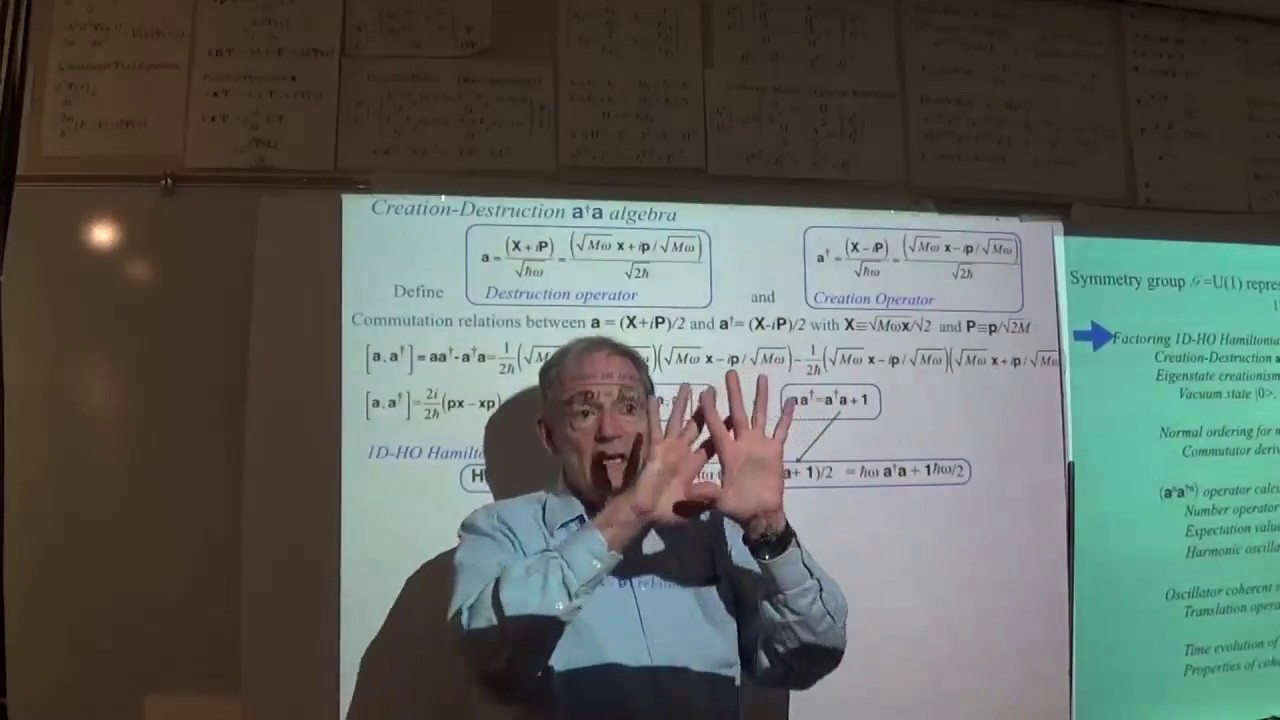
Symmetry Principles for Atomic, Molecular, Optical Physics (2018 Spring) - Lecture #7
Keywords
Summary
171 words
Critical Evaluation
Value of the Information & Strength of the Argument
The lecture provides a clear and rigorous derivation of the quantum harmonic oscillator using symmetry principles and algebraic methods. The argumentation is solid, building from the commutation relation to the full spectrum and wave functions. The instructor connects the algebraic approach to the more familiar Schrödinger equation, showing how the two are equivalent. The use of animations helps visualize the wave function dynamics, enhancing understanding. The value lies in the pedagogical approach that emphasizes symmetry as a unifying concept in physics.
Scientific Rigor, Source Quality, Title Accuracy
The lecture is scientifically rigorous, based on well-established quantum mechanics. The instructor references standard texts and his own published works. The title accurately describes the content. The course website and lecture slides are provided, which contain further resources. The lecture is part of a structured graduate course, indicating a high level of academic rigor.
150 words
Title / Content Match
The title accurately reflects the content: a lecture on symmetry principles applied to atomic, molecular, and optical physics, focusing on the harmonic oscillator as a symmetry example.
Quality & Reliability
8/10
Lecture by a professor with deep expertise, based on established quantum mechanics and symmetry principles. The content is mathematically rigorous and consistent with standard treatments, though it is a lecture and not peer-reviewed.
Key Moments
Markers derived by PSI from the transcript: the creator did not define chapters.
- Introduction to the harmonic oscillator and the use of symmetry operators.
- Derivation of the commutation relation [a, a†] = 1.
- Expression of the Hamiltonian in terms of creation and annihilation operators.
- Definition of the vacuum state and derivation of the Gaussian wave function.
- Discussion of zero-point energy and its physical meaning.
- Derivation of the first excited state wave function.
- Use of animations to illustrate wave function evolution.
- Connection between classical and quantum oscillators, and coherent states.
- Preview of extensions to two-dimensional oscillators and electromagnetic fields.
Cited Sources
- AMOP Course Website — Course website with additional materials and resources.
- Lecture #7 Slides (PDF) — Slides used in the lecture, containing the detailed derivations and figures.
Concurring Sources
- Quantum Theory for the Computer Age — Textbook by Prof. Harter, referenced in the course description, likely contains the same material.
- Principles of Symmetry, Dynamics, and Spectroscopy — Another textbook by Prof. Harter, also referenced in the course description.
Contribution & Novelties
The lecture provides a unique pedagogical approach by emphasizing symmetry principles and group algebra in solving the harmonic oscillator, which is often presented in a more standard way. It connects the algebraic method to the wave function approach, offering deeper insight into the structure of quantum mechanics. The use of animations to visualize wave function dynamics is a valuable educational tool.
Pour aller plus loin :
- Quantum harmonic oscillator - Wikipedia — Provides a comprehensive overview of the quantum harmonic oscillator, including the algebraic solution.
- Creation and annihilation operators - Wikipedia — Explains the operators used in the lecture and their properties.
- Coherent states - Wikipedia — Discusses coherent states, which are mentioned in the lecture as the bridge to classical mechanics.
- Group theory - Wikipedia — Provides background on the mathematical framework used in the lecture.
137 words
Radar Profile
The radar profile shows high scores in technical level and information quality, indicating a rigorous and detailed lecture. The quantity of information is also high, but the fiability is slightly lower due to the lecture format and lack of peer review. Overall, the lecture is highly informative and technically sound.