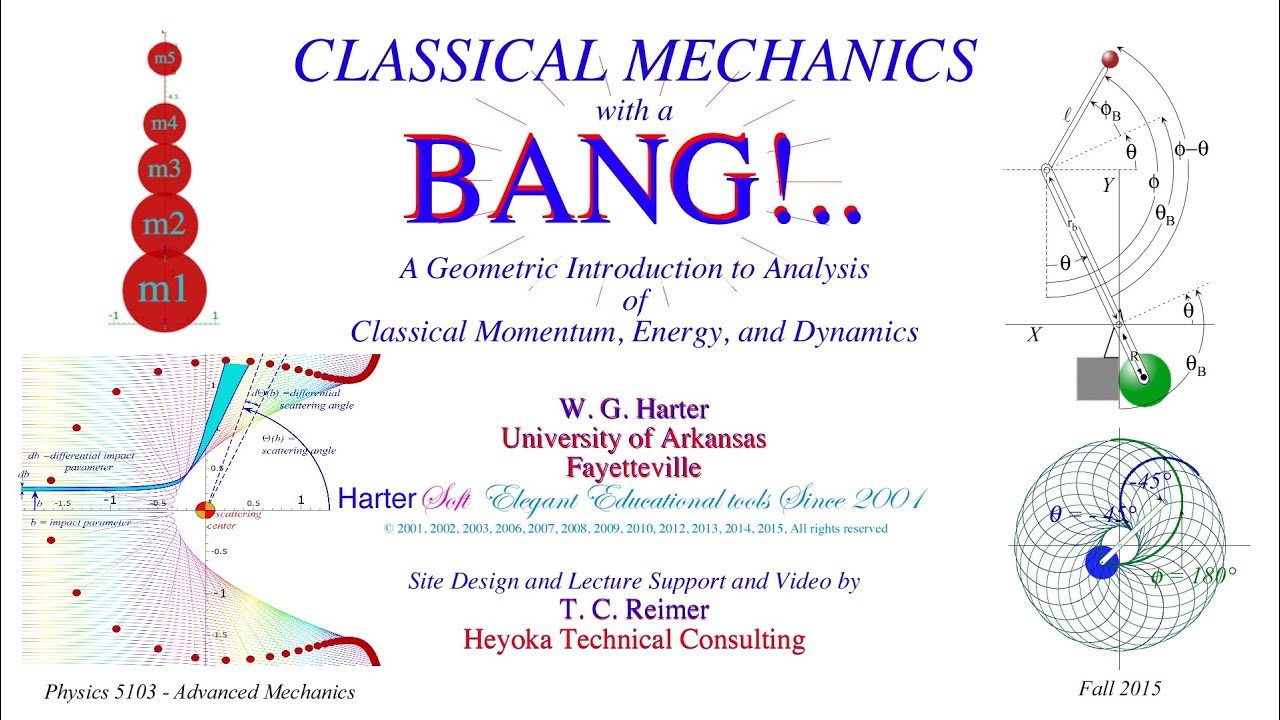
Classical Mechanics with a Bang! (2015 Fall) - Lectures #13 & #14
Keywords
Summary
173 words
Critical Evaluation
Value of the Information & Strength of the Argument
The lecture provides valuable insights into the foundational mathematics of classical mechanics, particularly the use of complex numbers and exponentials. The argumentation is solid, building from basic principles like compound interest to the derivation of Taylor series and Euler’s formula. The instructor emphasizes geometric interpretations, which aids in understanding the physical significance. The presentation is clear and logical, with practical examples and visual aids. The value lies in its pedagogical approach, making abstract concepts more accessible.
85 words
Title / Content Match
The title accurately reflects the content, which is a lecture on classical mechanics with a geometric approach, as part of the course series.
Quality & Reliability
8/10
Lecture by a university professor, part of a graduate course, with supplementary PDF slides. Content is mathematically rigorous and based on established principles, but lacks external citations and peer review.
Key Moments
Markers derived by PSI from the transcript: the creator did not define chapters.
- Introduction to complex numbers and their importance in mechanics.
- Explanation of compound interest and the exponential function.
- Derivation of the Taylor series for exponential, sine, and cosine.
- Geometric interpretation of Taylor series approximations.
- Introduction to Euler's formula and its significance.
- Use of complex exponentials for automatic trigonometry.
- Phasors and oscillator phase analysis.
- Conversion between Cartesian and polar forms, and atan2 function.
- Complex multiplication yielding dot and cross products.
Cited Sources
- Course Web site — Course materials and information.
- Lecture #13 slides (PDF) — Slides for lecture 13.
- Lecture #14 slides (PDF) — Slides for lecture 14.
Concurring Sources
- Classical Mechanics with a Bang! (course textbook) — The textbook used for the course, which aligns with the lecture content.
Contribution & Novelties
The lecture offers a pedagogical approach to classical mechanics by emphasizing the geometric and complex analysis foundations. It provides a clear derivation of the exponential function from compound interest, illustrating its convergence to e. The geometric interpretation of Taylor series is highlighted, showing how successive approximations approximate functions. The use of complex exponentials for automatic trigonometry and phasor analysis is a valuable tool for understanding oscillations. The lecture also introduces the concept of spinor operators, which will be explored further in later units.
Pour aller plus loin :
- Euler’s formula — Provides a comprehensive overview of Euler’s formula and its applications.
- Taylor series — Detailed explanation of Taylor series and their convergence.
- Phasor — Introduction to phasors and their use in electrical engineering and physics.
125 words
Radar Profile
The radar profile shows high scores in quantity, quality, technical level, and reliability, indicating a comprehensive and rigorous lecture. The balance suggests a well-structured presentation with strong mathematical foundations.