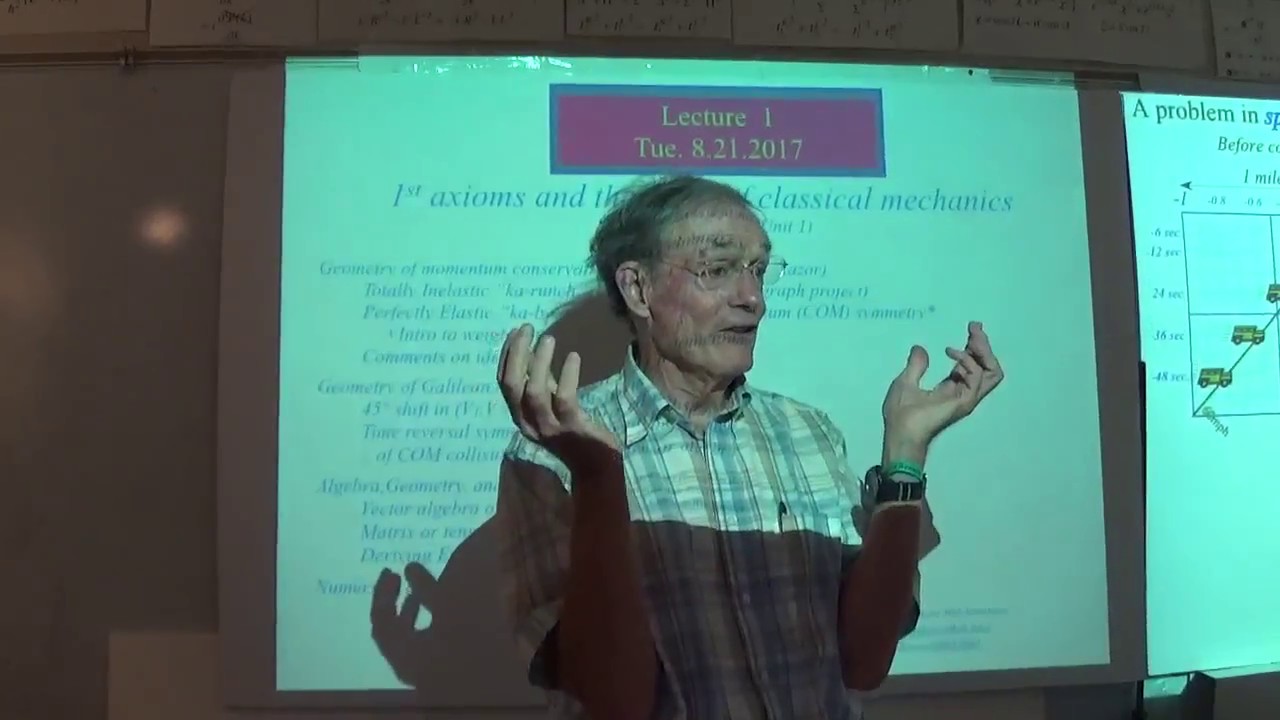
Classical Mechanics with a Bang! (2017 Fall) - Lecture #1
Keywords
Summary
140 words
Critical Evaluation
Value of the Information & Strength of the Argument
The lecture provides a clear and insightful geometric interpretation of classical collisions, which is valuable for understanding the underlying principles. The argumentation is logical and builds from a single axiom (conservation of momentum) to derive the behavior of collisions. The use of a concrete example (SUV vs. VW) makes the concepts accessible, and the step-by-step graphical construction helps visualize the physics. The instructor also connects the material to broader topics like tensor analysis and quantum mechanics, adding depth. However, the lecture is introductory and does not delve into advanced derivations, but it sets a solid foundation.
Scientific Rigor, Source Quality, Title Accuracy
The lecture is scientifically rigorous, based on well-established principles of classical mechanics. The instructor is a professor, and the course is part of a university curriculum. The description provides links to the course website and the PDF slides, which serve as reliable sources. The title accurately reflects the content, focusing on classical mechanics with a geometric approach. No external sources are cited in the lecture itself, but the course materials are provided. The lecture is well-structured and logically coherent.
190 words
Title / Content Match
The title accurately reflects the content: a lecture on classical mechanics using a geometric approach, with a focus on collisions.
Quality & Reliability
8/10
Lecture by a university professor, part of a graduate course, with accompanying course materials and PDF slides. The content is logically structured and based on established physics principles, though it is a single lecture and not peer-reviewed.
Key Moments
Markers derived by PSI from the transcript: the creator did not define chapters.
- Introduction to the course and the geometric approach.
- Example of a collision between an SUV and a VW Beetle.
- Introduction of the conservation of momentum axiom.
- Graphical representation of the collision on a velocity-velocity graph.
- Discussion of perfectly inelastic collision (crunch) and center of momentum line.
- Introduction of perfectly elastic collision (bang) and the circle construction.
- Use of vectors and Dirac notation to represent the collision.
- Discussion of degrees of freedom and extension to higher dimensions.
Cited Sources
- Course Web site — Official course website with materials and information.
- Lecture #1 slides (PDF) — PDF slides used in the lecture.
Concurring Sources
- Classical Mechanics (Wikipedia) — General reference for classical mechanics principles.
Contribution & Novelties
The lecture offers a fresh geometric perspective on classical mechanics, emphasizing logical efficiency and minimal axioms. It demonstrates how complex collision problems can be solved with simple graphical constructions, making the physics more intuitive. The use of Dirac notation early on prepares students for quantum mechanics. The approach is original in its pedagogical style.
Pour aller plus loin :
- Conservation of momentum — Fundamental principle underlying the lecture.
- Elastic collision — Discusses the physics of perfectly elastic collisions.
- Inelastic collision — Covers perfectly inelastic collisions.
- Dirac notation — Mathematical notation used in the lecture.
94 words
Radar Profile
The radar profile shows high scores in all dimensions, indicating a well-rounded lecture with substantial information, high technical depth, and strong reliability. The lecture is particularly strong in providing a solid foundation and clear explanations.