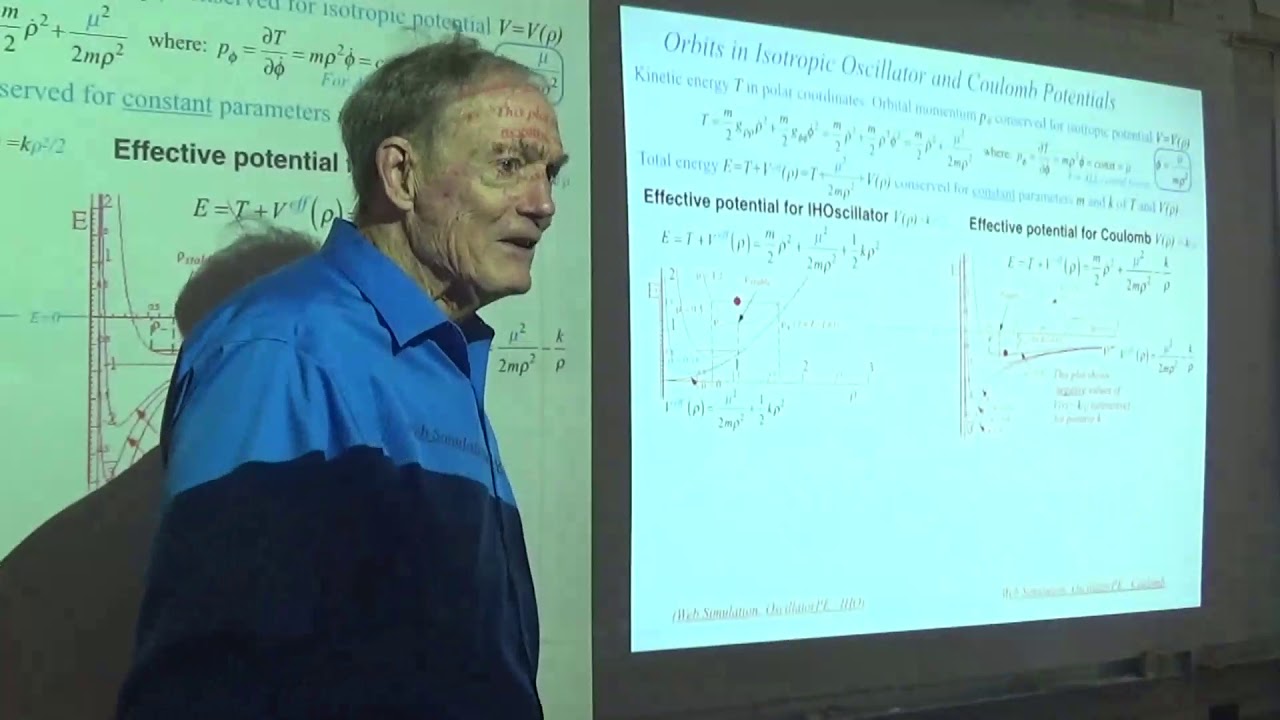
Classical Mechanics with a Bang! (2018 Fall) - Lecture #25
Keywords
Summary
158 words
Critical Evaluation
Value of the Information & Strength of the Argument
The lecture provides a thorough and rigorous derivation of the orbit equations for two fundamental potentials, highlighting the mathematical parallels between them. The argumentation is systematic, building from basic principles to complex results, and the instructor takes care to explain each step. The value lies in the clear exposition of the algebraic methods and the demonstration of the deep connection between the harmonic oscillator and Coulomb problems, which is not commonly emphasized. The presentation is well-structured, with frequent references to the course textbook and slides, enhancing its credibility.
Scientific Rigor, Source Quality, Title Accuracy
The scientific rigor is high, as the lecture is part of a university graduate course and is based on a textbook authored by the instructor. The sources cited are the course website and the lecture slides, which are directly relevant and provide supplementary material. The title accurately reflects the content, which is a lecture on classical mechanics with a focus on orbital motion. The lecture does not cite external peer-reviewed sources, but this is typical for a lecture format. The internal consistency and mathematical correctness are evident, though the lack of external verification limits the overall reliability.
200 words
Title / Content Match
The title accurately reflects the content, which is a lecture on classical mechanics with a focus on orbital motion and the Coulomb problem.
Quality & Reliability
8/10
Lecture by a professor in a graduate course, based on a textbook and accompanied by detailed slides. The content is mathematically rigorous and internally consistent, but not peer-reviewed and lacks external verification.
Key Moments
Markers derived by PSI from the transcript: the creator did not define chapters.
- Introduction to the lecture, outlining the plan to compare the harmonic oscillator and Coulomb potential.
- Review of effective potentials and the concept of orbits in a plane.
- Derivation of stability points and frequencies for small oscillations.
- Finding classical turning points (apogee and perigee) for both potentials.
- Introduction of inverse radial variables to simplify orbit equations.
- Solving the integrals to obtain the orbit equations.
- Tabulating the parameters for elliptical orbits in both cases.
- Discussion of the 'mystery similarity' between the two problems.
- Conclusion and preview of the next lecture on symmetry analysis.
Cited Sources
- Course Web site — Official course page with resources and materials.
- Lecture #25 slides (PDF) — Slides used in the lecture, containing detailed derivations and figures.
Concurring Sources
- Classical Mechanics (Goldstein et al.) — Standard graduate textbook covering similar material on central forces and orbit equations.
Contribution & Novelties
The lecture offers a unique pedagogical approach by treating the harmonic oscillator and Coulomb potential side by side, revealing a ‘mystery similarity’ in their algebraic structures. This comparative method is not standard in textbooks and provides deeper insight into the underlying symmetries. The use of inverse radial variables and the emphasis on conic sections are valuable for understanding orbital mechanics.
Pour aller plus loin :
- Laplace–Runge–Lenz vector — This vector is a conserved quantity in the Coulomb problem and explains the symmetry that makes orbits closed.
- Kepler problem — The classical problem of two bodies interacting via a central force, with solutions that are conic sections.
- Harmonic oscillator — A fundamental system in physics, whose quantum and classical treatments are extensively studied.
122 words
Radar Profile
The radar profile shows high scores in all dimensions, with a particularly strong technical level. This indicates a lecture that is dense, mathematically rigorous, and highly informative, but may be challenging for a general audience.
💬 No comments were provided for analysis.