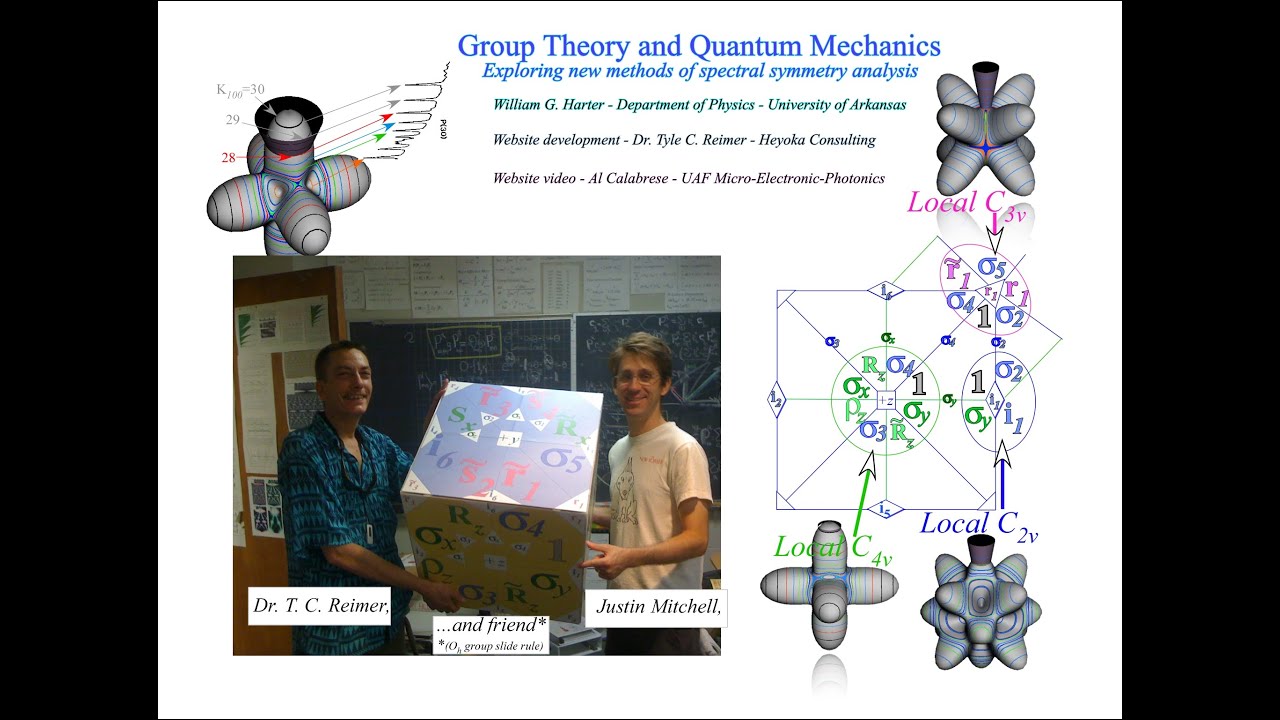
Applications of Group Theory to Physics - Lecture 12
Keywords
Summary
159 words
Critical Evaluation
Value of the Information & Strength of the Argument
The lecture provides a thorough and rigorous treatment of cyclic group representations and their application to physics. The argumentation is solid, building from basic group theory concepts to more complex applications in wave dynamics. The instructor emphasizes the physical interpretation of mathematical results, which enhances the value of the content. The use of visual aids and examples helps clarify abstract concepts. The lecture is well-structured, with a clear progression from spectral resolution to wave dynamics.
Scientific Rigor, Source Quality, Title Accuracy
The lecture is based on the instructor’s own textbooks, ‘Quantum Theory in the Computer Age’ and ‘Principles of Symmetry, Dynamics, and Spectroscopy’, which are established references in the field. The course website and lecture slides are provided, offering additional resources. The title accurately reflects the content, which focuses on applications of group theory to physics. The lecture is scientifically rigorous, with careful derivations and attention to mathematical detail.
158 words
Title / Content Match
The title accurately reflects the content, which focuses on applications of group theory to physics, specifically cyclic symmetries and their use in wave dynamics.
Quality & Reliability
8/10
Lecture by a professor in a university course, based on established textbooks and mathematical derivations. The content is rigorous and well-structured, but it is a lecture, not peer-reviewed research.
Key Moments
Markers derived by PSI from the transcript: the creator did not define chapters.
- Introduction to the lecture on higher symmetries of cyclic type, focusing on C6 symmetry.
- Discussion of the regular representation and construction of Hamiltonians with C6 symmetry.
- Explanation of nearest-neighbor and next-nearest-neighbor couplings in the block model.
- Introduction to roots of unity and character tables for C6.
- Derivation of irreducible projectors and spectral resolution of operators.
- Interpretation of characters as waves and discussion of momentum quantization.
- Comparison of wave functions for different momenta and visualization of standing waves.
- Introduction to dispersion functions and their physical meaning.
- Discussion of wave packets and pulses, and the difference between them.
- Preview of deriving matter-wave dispersion and using lasers for space-time coordinates.
Cited Sources
- Course Website — Course website with additional content and resources.
- Lecture 12 Slides (PDF) — PDF slides for this lecture.
Concurring Sources
- Quantum Theory in the Computer Age — Textbook by William Harter, referenced as a principal text for the course.
- Principles of Symmetry, Dynamics, and Spectroscopy — Textbook by William Harter, referenced as a principal text for the course.
Contribution & Novelties
This lecture provides a detailed and pedagogical exposition of cyclic group theory applied to physics, emphasizing the physical interpretation of mathematical concepts. It bridges abstract group theory with practical applications in wave dynamics and quantum mechanics. The instructor’s approach of presenting mathematical analysis as a consequence of physical reality is particularly valuable for understanding the relationship between mathematics and physics.
Pour aller plus loin :
- Group representation — Provides background on representation theory.
- Character table — Explains character tables, which are central to this lecture.
- Dispersion relation — Related to the dispersion functions discussed in the lecture.
- Bloch wave — Relevant to the lattice models and wave dynamics.
108 words
Radar Profile
The radar profile shows high scores in technical level and information quality, indicating a dense and rigorous lecture. The quantity of information is also high, but the accessibility might be limited to advanced students. The overall reliability is strong, given the academic context.